
Why No Long-Term IT Contracts Benefit Businesses

Avoiding long-term IT contracts is the most effective way for small businesses to protect their budgets and stay current with fast-moving technology. The standard industry term for this approach is flexible IT service agreements, and the case for them has never been stronger. In 2026, short-term managed IT models give you real negotiating power, the freedom to switch providers when service slips, and the ability to adopt new tools like AI and cloud platforms without waiting for a contract to expire. This article explains why no long-term IT contracts benefit businesses, what the hidden costs of multi-year deals actually look like, and how to evaluate any IT agreement before you sign.
What financial risks do long-term IT contracts pose?
Long-term IT contracts create financial exposure that most small business owners do not see until it is too late. The most common trap is the discount illusion. Vendors offer 5–10% discounts for 24–36 month contracts, but those savings are routinely wiped out by mid-term price increases, unused software licenses, and the inability to switch when a better option appears. A 7% discount on a $3,000 monthly contract saves you $2,520 per year. One unused software license tier or a single missed technology upgrade can cost far more than that.
The industry term for unused licensed software is shelfware, and it is one of the most common hidden costs in multi-year agreements. When your business grows, shrinks, or pivots, you often need fewer seats or a completely different tool. A long-term contract prevents you from right-sizing mid-term, so you keep paying for capacity you do not use.
There is also a negotiating leverage problem. Long-term contracts transfer implementation risk to the client while securing stable revenue for the vendor. Once you sign, your leverage disappears. The vendor has no financial incentive to improve service quality because you are locked in regardless.
Consider these specific financial risks tied to multi-year IT agreements:
- Sunk costs: You have already paid for months of service, making it psychologically and financially harder to exit even when performance is poor.
- Auto-renewal traps: Contracts with automatic renewals and complex offboarding create operational dependence that makes switching expensive and time-consuming.
- Cancellation penalties: Early termination fees can equal several months of remaining contract value, turning a bad vendor relationship into a costly one to exit.
- Missed market pricing: Technology costs generally fall over time. A two-year contract locks you into today's pricing even as the market drops.
Understanding your IT budgeting exposure before signing any multi-year deal is the first step toward protecting your bottom line.
How does flexibility in IT services improve operations?

Flexible IT service agreements give your business the ability to respond to change without financial penalty. The most significant operational benefit is technology agility. Long-term contracts cause vendor lock-in that prevents adoption of modern AI or cloud solutions due to platform inflexibility. That means a business locked into a 2024 contract could still be running outdated infrastructure in 2026 simply because switching costs too much.
Vendor lock-in is both a financial and an operational problem. On the financial side, you pay for tools you cannot replace. On the operational side, your team works around limitations that a newer platform would eliminate in days. Both outcomes slow your business down.
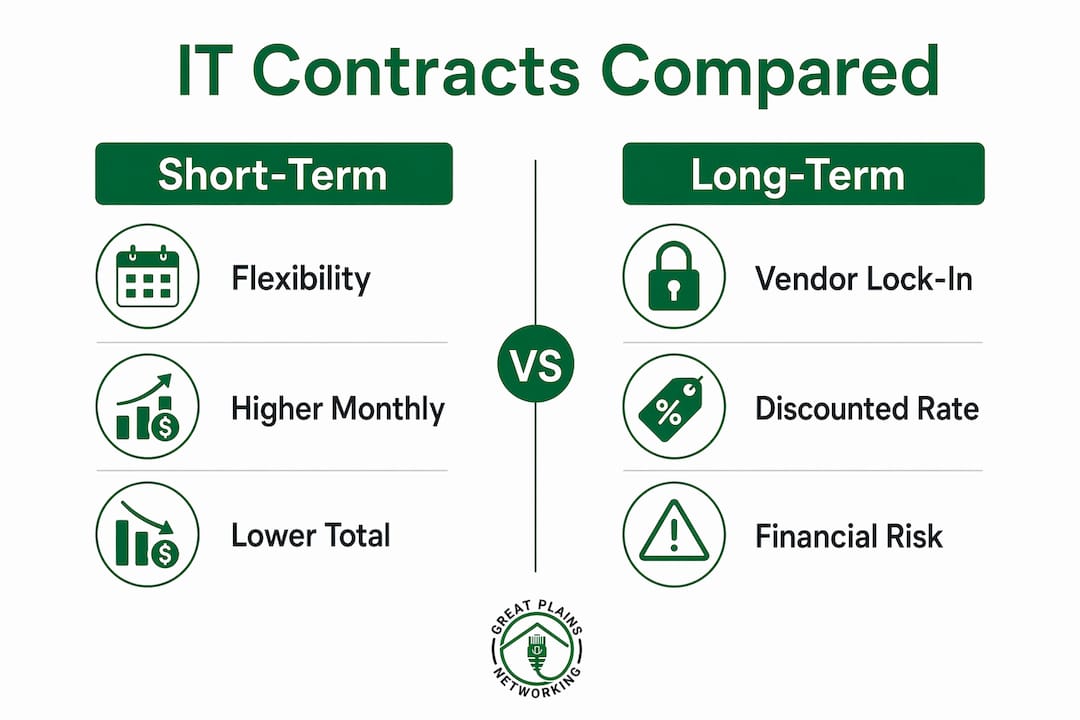
Short-term agreements flip this dynamic. When a provider knows you can leave at the end of a 30 or 90-day term, they have a direct incentive to deliver results every single month. Avoiding long-term contracts pressures vendors to continuously earn your business, producing higher service quality without legal tie-downs. That accountability structure is something a multi-year contract simply cannot replicate.
The benefits of short-term IT contracts on daily operations include:
- Faster technology adoption: You can switch to a better platform, a new cybersecurity tool, or an upgraded cloud service as soon as it makes business sense.
- Scalable support: Your IT support can grow or shrink with your headcount, seasonal demand, or project load without renegotiating a fixed agreement.
- Verified performance: You assess provider quality in real time and make decisions based on results, not promises made during a sales presentation.
- Reduced downtime risk: A provider who knows they must perform to retain your business responds faster and resolves issues more thoroughly.
Pro Tip: Align your IT contract review cycle with your business planning calendar. If you review your budget and staffing every quarter, schedule your IT contract evaluation at the same time. This keeps your technology spend in sync with your actual operational needs.
Exploring the managed IT support benefits available through flexible agreements gives you a clearer picture of what accountable service actually looks like in practice.
Short-term vs. long-term IT contracts: cost and risk compared
The break-even point for IT contract cost-effectiveness is a concrete number, not a general principle. For engagements under 11–13 months, contract-based arrangements are more cost-effective than long-term commitments. Long-term deals only become cheaper after roughly a year of sustained, verified performance. That means if you sign a 24-month contract with a provider you have never worked with before, you are betting a significant sum on an unproven relationship.
The table below compares the two models across the dimensions that matter most to small business owners.
| Factor | Short-Term IT Contracts | Long-Term IT Contracts |
|---|---|---|
| Monthly cost | Slightly higher per month | Lower per month with discounts |
| Total cost risk | Low. Exit if performance drops | High. Locked in regardless of quality |
| Technology flexibility | Switch tools or providers anytime | Restricted by platform and vendor terms |
| Negotiating leverage | Retained throughout the relationship | Lost after signing |
| Hidden costs | Minimal. Pay for what you use | Shelfware, penalties, and price locks |
| Vendor accountability | High. Must earn renewal each term | Low. Revenue is secured regardless |
The numbers tell a clear story. A slightly higher monthly rate on a short-term agreement is almost always cheaper than the total cost of a multi-year deal that includes shelfware, cancellation fees, and missed technology upgrades.
Pro Tip: Before comparing quotes from IT providers, ask each one to itemize every cost that could appear over a 24-month period, including renewal terms, price escalation clauses, and offboarding fees. The provider who gives you a transparent answer is the one worth trusting.
Understanding the full structure of an IT support contract before you commit protects you from costs that never appear in the headline price.
What should small businesses look for in an IT contract?
The impact of contract length on IT services is most visible in the fine print. Standard IT contracts often include auto-renewals, cancellation penalties, and vague support levels that protect providers and trap clients in unfavorable arrangements. Knowing what to look for before you sign is the most practical defense against these terms.
Watch for these specific contract elements:
- Auto-renewal clauses: These renew your contract automatically unless you cancel within a narrow window, often 30–90 days before the term ends. Miss the window and you are committed for another full year.
- Vague SLAs: Service level agreements that use language like "reasonable efforts" or "best endeavors" give the provider no measurable accountability. Demand specific response times and resolution targets in writing.
- Termination fees: Some contracts charge you the full remaining balance if you exit early. Others charge a percentage. Either way, the cost can be substantial.
- Scope creep language: Contracts that define services broadly allow providers to charge extra for work you assumed was included.
The 90-day rule is a practical framework for evaluating any new IT provider before committing long term. The principle is straightforward: delay any long-term commitment until the provider has demonstrated measurable value over a defined short period. A provider who resists a 90-day evaluation period is signaling that they need the contract more than they need to earn your trust.
A reliable evaluation framework follows three steps: consult with the provider to define specific deliverables, assess their performance against those deliverables at the 30 and 60-day marks, and finalize a longer agreement only when the results are verified. This approach eliminates the guesswork that leads most small businesses into bad long-term deals.
Pro Tip: Ask every IT provider you evaluate to show you a sample contract before any sales conversation. A provider confident in their service quality will share contract terms openly. One who delays or deflects is worth questioning.
Key takeaways
Flexible IT service agreements protect small businesses from financial lock-in, preserve negotiating leverage, and allow faster adoption of new technology than multi-year contracts permit.
| Point | Details |
|---|---|
| Discount illusion is real | Vendors offer 5–10% multi-year discounts that shelfware and price locks routinely cancel out. |
| Break-even favors short-term | Contracts under 11–13 months are more cost-effective before sustained performance is verified. |
| Vendor accountability requires flexibility | Short-term agreements pressure providers to earn renewal, producing better service quality. |
| Fine print creates hidden costs | Auto-renewals, vague SLAs, and termination fees add costs that never appear in headline pricing. |
| The 90-day rule reduces risk | Evaluate providers on a short initial term before committing to any longer agreement. |
Why i think the lock-in model is broken for small businesses
Working with small businesses across Norman, Moore, and Oklahoma City, I have watched the same pattern repeat itself. A business owner signs a two-year IT contract because the monthly rate looks attractive. Twelve months later, the service has slipped, a better provider has entered the market, or the business has changed enough that the original agreement no longer fits. But they are stuck. The exit costs are too high, and the vendor knows it.
The uncomfortable truth is that long-term contracts are designed to benefit the vendor, not the client. They stabilize vendor revenue and remove the pressure to perform. A provider who genuinely delivers results does not need a two-year contract to keep your business. They keep it by solving your problems faster than anyone else would.
The 2026 IT market makes this even more relevant. AI tools, cloud platforms, and cybersecurity solutions are evolving faster than any two-year contract can anticipate. A business locked into a 2024 agreement may be paying for a security stack that no longer reflects current threats or a cloud setup that a newer platform would handle better and cheaper.
The businesses I have seen thrive are the ones that treat their IT provider like any other performance-based relationship. You measure results, you hold the provider accountable, and you retain the right to make a change if the results stop. That is not a difficult standard. It is just a reasonable one. If your current IT arrangement does not meet it, the IT consulting options available to small businesses today make switching far less complicated than most owners expect.
— Nicholas
How Greatplainsnetworking supports small businesses without lock-ins
Greatplainsnetworking provides managed IT support for small businesses in Norman, Moore, and Oklahoma City with no long-term contracts required. Every plan is built around your specific needs, with transparent pricing, same-day response times, and 24/7 monitoring that catches problems before they disrupt your operations.
Whether you run a dental practice, a law firm, or a retail operation, Greatplainsnetworking delivers customized IT plans that include cybersecurity, data recovery, and proactive support without locking you into terms that stop serving your business. You keep full flexibility and full accountability from your provider every single month. Contact Greatplainsnetworking today to get a clear, no-obligation quote and see what IT support looks like when the provider has to earn your business every month.
FAQ
What does "no long-term IT contract" actually mean?
A no long-term IT contract model means your managed IT services renew on a short-term basis, typically monthly or quarterly, with no multi-year commitment required. You retain the right to adjust, pause, or cancel service without paying termination penalties.
Are short-term IT contracts more expensive per month?
Short-term agreements may carry a slightly higher monthly rate than multi-year deals, but the total cost is usually lower. Shelfware, cancellation fees, and missed technology upgrades in long-term contracts routinely exceed the savings from a 5–10% multi-year discount.
What is vendor lock-in and why does it matter?
Vendor lock-in occurs when contract terms, platform dependencies, or offboarding complexity make switching providers prohibitively expensive. It limits your ability to adopt better technology and removes your negotiating leverage after the contract is signed.
How long should i evaluate an IT provider before committing?
The 90-day rule recommends evaluating a new IT provider over a short initial term before agreeing to any long-term arrangement. This period gives you verified performance data and eliminates the risk of committing to a provider who cannot deliver on their promises.
What contract terms should i avoid when choosing an IT provider?
Avoid contracts with automatic renewal clauses, vague service level agreements, early termination fees, and broadly defined scopes that allow providers to charge extra for standard work. Ask for a sample contract before any sales conversation to assess transparency upfront.
Recommended
Want help putting this into practice?
We'll audit your security, speed, and hardware in under an hour — no commitment, no sales pitch. Just a clear roadmap of what to fix and why.