
Types of Managed IT Service Plans for Small Businesses

Managed IT service plans fall into seven core categories: managed security, managed cloud and infrastructure, network monitoring and NOC, help desk and end-user support, backup and disaster recovery, project and on-site services, and managed communications such as VoIP. The fastest way to pick the right plan is to match your dominant business risk to the plan's emphasis. If your biggest exposure is a ransomware attack or HIPAA audit, lead with a security-focused plan. If your team runs entirely in the cloud, a per-user model with cloud infrastructure management fits better. If you operate a device-heavy environment like a dental office or manufacturing floor, per-device or tiered pricing usually costs less.
Pro Tip: Before signing anything, ask your MSP to define in writing what counts as "support" versus a "project." Many providers bill migrations, office moves, and major upgrades separately even under an "all-inclusive" label. Getting that definition in the contract prevents surprise invoices.
Here is a quick selection framework:
- Identify your dominant risk: security/compliance, uptime, or device count.
- Match that risk to the plan type that addresses it most directly.
- Confirm the pricing model fits your operational profile (cloud-centric vs. device-heavy).
- Verify SLA response times, resolution commitments, and what triggers a separate project fee.
- Request a documented onboarding checklist and an offboarding policy before you sign.
Table of Contents
- What this article covers and what to do next
- What types of managed IT services do MSPs actually deliver?
- How are managed IT service plans priced?
- What does a managed IT service plan typically include?
- How do you choose the right managed IT plan and vet an MSP?
- What should you expect during onboarding and implementation?
- What do MSP buyers most often get wrong?
- What contract terms and flexibility should you expect?
- Key Takeaways
- A local provider's perspective on choosing the right plan
- Greatplainsnetworking offers managed IT plans built for Oklahoma small businesses
- Useful sources and further reading
What this article covers and what to do next
This article walks through every major decision point in evaluating outsourced IT support, from service categories to contract terms.
Sections covered:
- Core types of managed IT services and who needs each
- Common pricing models and how they affect your budget
- What a typical plan includes and what gets billed separately
- How to vet an MSP and red flags to avoid
- Onboarding timelines and common implementation pitfalls
- Research-backed insights and misconceptions
- Contract terms, flexibility, and cancellation policies
- Local provider perspective from Greatplainsnetworking
Your next steps:
Shortlist the two or three service types your business needs most. Prepare six vetting questions (covered in the "How to choose" section below). When you talk to any provider, ask for an onboarding timeline and a written exit plan before the first proposal.
What types of managed IT services do MSPs actually deliver?
Managed services is not a single product. It is a menu of service pillars, and most providers let you combine them. Understanding what each pillar covers helps you build a plan that matches your actual risk profile rather than paying for coverage you do not need.
Managed security (MSSP-like functions)
Managed security covers threat detection, endpoint protection, firewall management, email filtering, multi-factor authentication (MFA) enforcement, and incident response. For regulated businesses, it also includes compliance-aligned controls for HIPAA, CMMC, or IRS Publication 4557. A law firm handling client data or a dental practice storing protected health information (PHI) should treat this as a non-negotiable baseline, not an add-on.

Managed cloud and infrastructure
This pillar covers server management, cloud platform administration (Microsoft Azure, Microsoft 365), virtual machine maintenance, and storage management. It is the right fit for businesses that have moved most workloads off-premise and need someone to manage uptime, licensing, and configuration drift. Cloud IT service plans in this category often include Microsoft 365 setup, ongoing tenant management, and license lifecycle tracking.

Network monitoring and NOC
A Network Operations Center (NOC) watches your infrastructure around the clock, catching performance degradation, failed backups, and unusual traffic before they become outages. This is where the "proactive" claim in most MSP pitches lives or dies. Mature providers resolve a significant share of incidents through monitoring before users ever notice a problem.
Help desk and end-user support
Help desk support handles password resets, software troubleshooting, printer issues, new user setup, and device configuration. Tiers typically run from Tier 1 (routine requests) through Tier 3 (escalated engineering). Response time and resolution time are different metrics, and the gap between them matters more than most buyers realize.
Backup and disaster recovery (BDR)
BDR services cover automated backups, offsite or cloud replication, recovery point objective (RPO) and recovery time objective (RTO) planning, and tested restore procedures. A retail business that loses its point-of-sale data on a Saturday afternoon needs a verified backup and recovery process, not a backup that has never been tested. Backup validation should be a documented, scheduled activity in any BDR plan.
On-site and break/fix support
Some issues require a technician on the floor. On-site support covers hardware failures, cabling, physical server work, and situations where remote access is not possible. Break/fix is the ad-hoc version: you call when something breaks and pay per visit. It is the least predictable model for both cost and resolution time.
Project-based services
Office moves, server migrations, new location buildouts, and major software deployments are discrete projects. Most MSPs bill these separately from recurring support, even under broad plan labels. Knowing this boundary in advance prevents scope creep from inflating your monthly costs.
Managed communications (VoIP and unified comms)
VoIP management covers business phone systems, call routing, voicemail-to-email, and unified communications platforms. A distributed team or a multi-location medical practice benefits from having phone infrastructure managed alongside the rest of the IT environment.
Managed SaaS and software lifecycle
This covers license management, version control, vendor coordination, and software renewals. It is often bundled into broader plans but worth confirming explicitly, especially for businesses running multiple SaaS subscriptions.
Pro Tip: Managed security and network monitoring overlap significantly. Many providers bundle them, but ask specifically whether your plan includes active threat response or only alerting. Alerting without response is monitoring; response is security.
How are managed IT service plans priced?
Pricing model fit matters more than the lowest rate. The right model depends on how your business is structured, not just what you want to spend.
Per-user pricing
Per-user billing charges a flat monthly fee for each employee covered, regardless of how many devices that person uses. It aligns well with cloud-centric teams where each user accesses multiple devices and SaaS applications. The provider's incentive is to keep each user productive, which matches well with help desk and Microsoft 365 management. Per-user pricing is increasingly common as workplaces shift away from fixed workstations.
Per-device pricing
Per-device billing charges per endpoint: desktops, laptops, servers, and sometimes network equipment. It works well for device-heavy environments like manufacturing floors, dental offices with dedicated workstations, or retail locations with fixed POS terminals. If your user count is low but your device count is high, per-device pricing usually costs less than per-user.
Tiered plans
Tiered plans bundle services into defined levels, typically labeled Basic, Standard, and Premium or similar. Each tier adds more coverage: monitoring only at the base, monitoring plus help desk in the middle, and full security plus vCIO consulting at the top. Tiered models give budget predictability and a clear upgrade path as your business grows.
All-inclusive or fully managed
All-inclusive plans cover the full scope of day-to-day IT management under one flat fee. They are the closest thing to having an outsourced IT department. The critical caveat: "all-inclusive" rarely means everything. Projects, hardware replacements, and major migrations are almost always billed separately. Fixed-fee models align provider incentives with uptime because downtime does not increase the client's bill.
Monitoring-only plans
Monitoring-only plans provide NOC coverage and alerting without full help desk or security response. They suit businesses with internal IT staff who need eyes on the network but not full outsourcing. Cost is lower, but the response burden stays in-house.
Break/fix (ad-hoc)
Break/fix is not a managed plan. You pay per incident, per hour, or per visit. There is no proactive monitoring, no SLA, and no incentive for the provider to prevent problems. It can work for very small businesses with minimal IT complexity, but it leaves both cost and uptime unpredictable.
Co-managed IT
Co-managed plans split responsibilities between your internal IT staff and the MSP. Your team handles day-to-day requests; the MSP provides after-hours coverage, specialized security tools, or NOC monitoring. This model suits businesses that have one or two IT staff but need depth they cannot hire for.
| Pricing Model | Best Fit | Predictability | Provider Incentive | Common Add-ons |
|---|---|---|---|---|
| Per-user | Cloud-centric teams | High | User productivity | Advanced security, vCIO |
| Per-device | Device-heavy environments | High | Device uptime | On-site visits, server work |
| Tiered | SMBs wanting bundled options | High | Tier upsell | Compliance, projects |
| All-inclusive | Full outsourcing | High | Uptime, prevention | Projects, hardware |
| Monitoring-only | Internal IT teams needing NOC | Medium | Alerting accuracy | Help desk, response |
| Break/fix | Minimal IT complexity | Low | Volume of incidents | Everything |
| Co-managed | Businesses with internal IT staff | Medium | Shared outcomes | After-hours, security depth |
Choosing the wrong pricing model can cost more than choosing the wrong provider. A law firm with 12 users and 30 devices will pay significantly more on a per-device plan than a per-user one. Run the math against your actual headcount and device inventory before comparing quotes.
What does a managed IT service plan typically include?
Standard inclusions vary by provider and plan tier, but most business IT service packages cover a consistent core set of services. Knowing what is standard helps you spot gaps and hidden costs.
Commonly included services
- 24/7 network and endpoint monitoring
- Patch management for operating systems and common applications
- Tier 1 and Tier 2 help desk support (remote)
- Automated backup with periodic restore testing
- Antivirus and endpoint detection and response (EDR) tooling
- Vendor and license management for covered software
- Monthly or quarterly reporting and health summaries
- Basic security tooling (firewall monitoring, email filtering)
- New user setup and offboarding (within defined limits)
- vCIO or strategic IT consulting (quarterly, in higher tiers)
SLA examples: what the numbers actually mean
SLAs define the provider's commitments, but response time and resolution time are not the same thing. Response time is when the provider acknowledges the ticket. Resolution time is when the problem is fixed. A well-structured SLA covers both.
Typical SLA tiers for SMB managed IT plans:
- Critical (system down, business stopped): Response within 1 hour, resolution target within 4 hours.
- High (significant impact, workaround available): Response within 2–4 hours, resolution within 8 hours.
- Medium (partial impact, user can continue working): Response within 4–8 hours, resolution within 24 hours.
- Low (minor issue, no productivity impact): Response within 1 business day, resolution within 3 business days.
Uptime guarantees for managed infrastructure typically run at 99.5% or higher for covered systems. Ask whether the SLA covers only response or also commits to resolution, and whether uptime guarantees apply to your servers, your cloud environment, or both.
Industry guidance recommends that SLA documentation include a shared-responsibility matrix (SRM) that clearly assigns security and maintenance responsibilities between the MSP and the client. Without it, gaps in coverage are common and disputes are harder to resolve.
What is commonly excluded
- Hardware purchases and replacements
- Major migrations (server, cloud, or application)
- Office moves and new location buildouts
- Advanced security assessments and penetration testing
- Specialized compliance remediation (HIPAA gap analysis, CMMC readiness)
- Custom software development or integration work
- On-site visits beyond a defined monthly limit
The definition of "project" is where most billing surprises originate. Routine support typically covers password resets, new user setup, patching, and standard troubleshooting. Server replacements and major migrations are almost always project-billed, even under plans marketed as unlimited.
Co-managed setups: who handles what
In a co-managed arrangement, the internal IT team typically retains day-to-day help desk ownership, hardware procurement decisions, and direct user relationships. The MSP handles after-hours monitoring, security tooling management, backup oversight, and specialized projects. The split should be documented in the SLA to avoid gaps.
How do you choose the right managed IT plan and vet an MSP?
Choosing a plan without vetting the provider is like signing a lease without reading the terms. The plan type matters, but the provider's operational maturity determines whether those commitments hold.
Six vetting questions to ask every MSP
- What is your documented Time to Resolution for Tier 1 and Tier 2 tickets, and can you share a sample SLA report?
- What specifically counts as a "project" versus included support, and can you give three examples of each?
- What does your onboarding process cover, and is there a separate onboarding fee?
- What is your offboarding process? Who holds admin credentials, and how are they transferred at contract end?
- Do you have documented experience with clients in our industry (HIPAA, CMMC, IRS compliance)?
- Can you provide references from businesses similar to ours in size and industry?
Good providers answer these questions with specifics. Weak providers use generic language. Concrete examples of how a provider handled prior incidents and their offboarding process are the clearest signals of operational maturity.
Red flags to watch for
- Vague SLAs that commit only to response time, not resolution
- No documented incident response process
- Offboarding treated as proprietary or not discussed until contract end
- Pricing that changes significantly when you ask about project billing
- No references from clients in regulated industries if compliance is your requirement
- Resistance to providing sample monitoring dashboards or SLA reports
Match matrix: plan types by business profile
| Business Profile | Recommended Plan Type | Pricing Model | Key Compliance Need |
|---|---|---|---|
| Small office, 5–15 users, few devices | Tiered (Standard) or per-user | Per-user | General security baseline |
| Distributed remote workforce | All-inclusive or per-user | Per-user | MFA, endpoint security |
| Dental or medical practice | Managed security + BDR + help desk | Per-user or tiered | HIPAA |
| Law firm | Managed security + help desk + vCIO | Per-user | Data confidentiality, IRS |
| Manufacturing with fixed endpoints | Monitoring + BDR + on-site | Per-device or tiered | CMMC (if DoD contracts) |
| Business with internal IT staff | Co-managed | Hybrid | Varies |
For cybersecurity and compliance needs, verify that the provider has documented experience with the specific framework your industry requires, not just general security tooling.
Pro Tip: Request a documented offboarding checklist before you sign. A professional MSP will provide one without hesitation. If a provider treats the offboarding process as something to discuss "when the time comes," that is a significant risk signal.
What should you expect during onboarding and implementation?
Onboarding is not just plugging in software. For most SMBs, a thorough onboarding phase involves multiple weeks and several distinct phases. Knowing what to expect prevents delays and scope disputes.
Typical onboarding phases
| Phase | Description | Small SMB | Mid SMB |
|---|---|---|---|
| Assessment and scoping | Asset inventory, network audit, credential collection | Short duration | Longer duration |
| Baseline hardening | Agent deployment, patch baseline, security tooling rollout | Short duration | Longer duration |
| Monitored cutover | Live monitoring begins, help desk goes active | Moderate duration | Longer duration |
| Documentation handoff | Network diagrams, runbooks, admin credential vault | Moderate duration | Longer duration |
| Ongoing reporting cadence | Monthly or quarterly reviews, vCIO meetings begin | Ongoing | Ongoing |
A one-time onboarding fee is standard and often billed separately to bring your environment to the provider's monitoring and security baseline. Ask for this cost upfront so it does not appear as a surprise on the first invoice.
Onboarding checklist
- Complete asset inventory (all devices, servers, network equipment)
- Admin access and credential transfer to the MSP's vault
- Monitoring agent deployment on all covered endpoints
- Patch baseline: all systems brought to current patch level
- Backup validation: at least one verified restore test
- User training on help desk ticketing process
- Initial vCIO meeting to review findings and set 90-day priorities
- Documented network diagram and runbook
Common pitfalls that delay onboarding
- Missing or unknown admin credentials for legacy systems
- Unmanaged devices that were not included in the initial scope
- Scope creep when legacy cleanup is billed as a project mid-onboarding
- No documented offboarding plan from the previous provider
Pro Tip: Before your onboarding call, compile a list of every device, server, and SaaS application your business uses. Incomplete asset inventories are the single most common cause of onboarding delays and unexpected project billing in the first 90 days.
What do MSP buyers most often get wrong?
Several persistent misconceptions cost businesses money and create friction with providers. Research and practitioner experience point to the same patterns.
Pro Tip: Ask every MSP candidate: "What percentage of issues do you resolve through proactive monitoring before the client notices?" A provider that cannot answer this question with a documented figure is likely reactive, not proactive.
Three misconceptions that cost buyers money
-
"MSPs are a commodity." Providers vary dramatically in proactive monitoring depth, resolution speed, and compliance experience. Two providers quoting similar monthly rates can deliver entirely different outcomes. The difference shows up in metrics like Time to Resolution and the percentage of issues caught before users report them.
-
"Unlimited means everything." All-inclusive plans almost always carve out project work. A server migration, an office move, or a major security remediation will be billed separately. Get the written definition of "project" before you sign.
-
"Response time is the right SLA to focus on." Response time measures when someone acknowledges your ticket. Resolution time measures when your problem is fixed. A provider that responds in 15 minutes but takes 48 hours to resolve a critical issue is not delivering on the spirit of the SLA. Ask for both metrics and request a sample SLA report from a current client engagement.
Metrics worth requesting from any MSP candidate
- Average Time to Resolution by ticket tier (Tier 1, Tier 2, Tier 3)
- Percentage of issues resolved proactively before user notice
- Percentage of work billed as projects in the first 12 months of a typical engagement
- Uptime percentage for monitored systems over the prior 12 months
- Sample onboarding checklist and a documented offboarding policy
What contract terms and flexibility should you expect?
Contract structure is where managed IT plans diverge most sharply from each other, and where buyers most often get locked into arrangements that do not serve them.
Minimum contract length
Most MSPs require a minimum commitment of 12 months. Some offer month-to-month arrangements at a premium rate, typically 15–25% higher than the annual rate. Multi-year contracts (24 or 36 months) often come with a lower monthly rate but reduce your flexibility if the provider's service quality declines.
For small businesses evaluating a new provider, a 12-month initial term with a renewal option is a reasonable starting point. It gives the provider enough time to complete onboarding and demonstrate value, while limiting your exposure if the relationship does not work.
Cancellation policies
Cancellation terms vary widely. Common structures include:
- 30–90 day written notice required before the contract end date
- Early termination fees equal to the remaining months on the contract
- Auto-renewal clauses that lock you in for another full term if you miss the notice window
Read the auto-renewal clause carefully. Missing a 60-day notice window can commit you to another 12 months automatically.
Offboarding and data portability
A professional MSP provides a documented offboarding policy that covers admin credential handoff, environment documentation, network diagrams, and a timeline for data access transition. Providers who treat offboarding as proprietary or refuse to discuss it before signing are a significant risk. You should be able to leave cleanly, with all your data and credentials, on a defined timeline.
Price escalation clauses
Many contracts include annual price escalation tied to a fixed percentage or an index. Confirm whether your contract includes this and what the cap is. A 3–5% annual increase is common; uncapped escalation is a red flag.
Flexibility options worth negotiating
- A defined scope-change process so you know how to add or remove services mid-term
- A service credit mechanism if SLA commitments are missed
- A right-to-audit clause allowing you to request SLA performance reports on demand
- A clear definition of what triggers a project invoice versus what is covered under the monthly fee
Key Takeaways
Matching your plan type to your dominant business risk, confirming SLA resolution commitments, and securing a written offboarding policy before signing are the three decisions that most directly determine whether a managed IT engagement delivers value.
| Point | Details |
|---|---|
| Match plan type to your risk profile | Security-heavy businesses need managed security first; device-heavy environments benefit from per-device or tiered pricing. |
| Resolution time beats response time | Ask for documented Time to Resolution by ticket tier, not just response time commitments. |
| "All-inclusive" has limits | Get a written definition of "project" vs. "support" before signing to avoid surprise billing. |
| Onboarding takes 4–8 weeks | Budget for a separate onboarding fee and compile a full asset inventory before the first call. |
| Greatplainsnetworking fits Norman/Moore/OKC SMBs | No long-term contracts, same-day response, and plans tailored to dental, legal, and manufacturing businesses in the Oklahoma City metro. |
A local provider's perspective on choosing the right plan
Most small businesses in Norman, Moore, and Oklahoma City do not need the most expensive plan on the menu. What they need is a plan built around their actual risk, their device count, and their compliance obligations. That is the conversation Greatplainsnetworking has with every prospective client before a proposal is written.
Dental and medical practices almost always lead with HIPAA compliance and backup reliability. The right plan for a two-dentist practice in Moore is not the same as the right plan for a 20-attorney law firm in Oklahoma City, even if the user counts are similar. The law firm needs tighter data confidentiality controls and often IRS-aligned security practices. The dental office needs verified backup with tested restores and endpoint protection that covers front-desk workstations and clinical devices separately.
Manufacturing clients present a different profile. Fixed-device environments with production floor equipment benefit more from per-device monitoring and on-site support coverage than from a per-user cloud plan. Greatplainsnetworking structures those engagements around device-level monitoring, scheduled on-site visits, and backup coverage for the systems that run production, not just the office computers.
Greatplainsnetworking offers managed IT plans built for Oklahoma small businesses
For small businesses in Norman, Moore, and Oklahoma City, Greatplainsnetworking delivers managed IT support without long-term contracts or technical jargon. The practical difference: you get 24/7 monitoring, a responsive help desk, cybersecurity and ransomware protection, backup and recovery, Microsoft 365 management, and vCIO-level consulting, all sized and priced for businesses with 5–50 users, not enterprise IT departments.
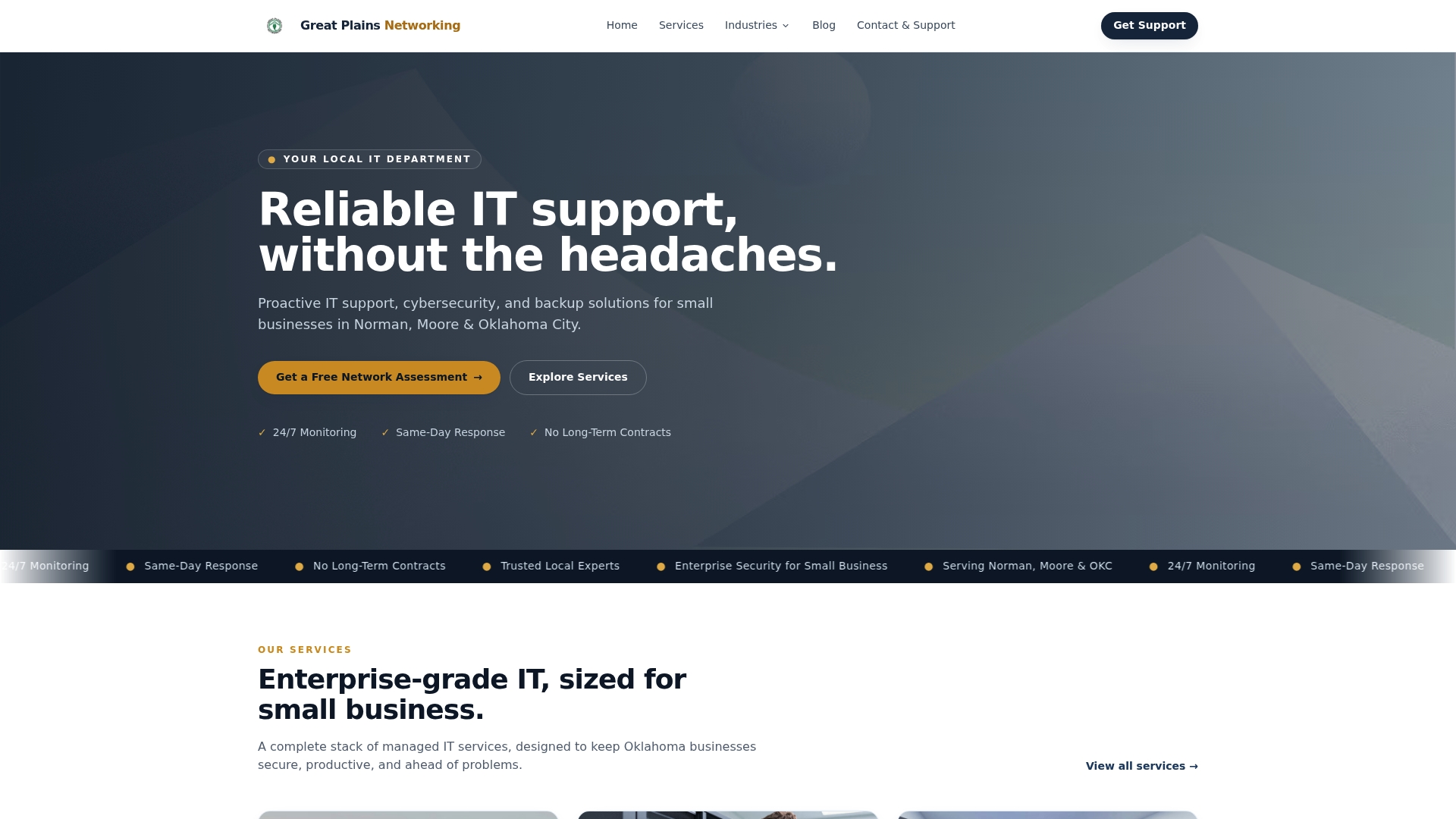
Every engagement starts with a scoping conversation that covers your current environment, your compliance requirements, and your onboarding timeline. You receive a transparent quote that identifies what is included in the monthly fee and what would trigger a separate project invoice. There are no auto-renewal traps and no proprietary offboarding. If you want to see what a plan built for your business looks like, contact Greatplainsnetworking to schedule a no-obligation assessment.
Useful sources and further reading
The following sources informed the research and recommendations in this article. Each is worth reviewing directly if you want to go deeper on a specific topic.
- NDISAC SMB MSP Shopping Questionnaire — A structured vetting questionnaire covering data location, incident response, SRM inclusion, and offboarding requirements for SMB buyers evaluating MSPs.
- 25 Essential Questions to Ask a Potential MSP Before Signing — Practitioner-level guidance on SLA metrics, Time to Resolution benchmarks, and fixed-fee model incentives.
- Top 10 Questions to Ask Before Hiring an MSP — Covers incident response documentation, offboarding policies, and how to distinguish mature providers from reactive ones.
- MSP Checklist for SMBs: How to Choose the Right Provider — Buyer checklist focused on contract clarity, inclusion/exclusion definitions, and pricing transparency.
- Types of Managed IT Services — Overview of core service pillars including managed security, cloud infrastructure, NOC, help desk, BDR, and vCIO consulting.
- Managed IT Services Pricing Overview — Analysis of per-user, per-device, and tiered pricing models with guidance on matching model to operational profile.
- Questions to Ask an MSP Before You Sign — Covers onboarding fee expectations, asset inventory requirements, and what a standard onboarding phase includes.
- Managed Services — Wikipedia — Background reference on the managed services model and its evolution from break/fix IT support.
Recommended
Want help putting this into practice?
We'll audit your security, speed, and hardware in under an hour — no commitment, no sales pitch. Just a clear roadmap of what to fix and why.