
Why IT Budgeting Matters for Small Businesses

IT budgeting for small businesses is the practice of planning, allocating, and controlling financial resources specifically for technology expenses to maintain stability and support growth. Most owners treat it as an afterthought, folding software subscriptions and hardware replacements into a general expense line until a surprise renewal or system failure drains the account. The industry term is technology financial planning, and it sits at the intersection of cash flow management and strategic investment. Poor cash flow management is linked to 82% of small business failures, which means the way you handle IT costs is not a minor operational detail. It is a survival decision.
Why IT budgeting matters for small businesses' financial stability
Technology expenses carry a timing problem that most other costs do not. A software license renews annually on a fixed date. A server replacement hits all at once. A cybersecurity upgrade does not spread itself evenly across twelve months. These lump-sum outflows can destroy a cash position that looked healthy on paper just weeks before.
The Federal Reserve and JPMorgan Chase research consistently show that small businesses hold roughly a 14-day cash buffer, which is barely enough to cover payroll, let alone an unexpected IT expense. Two weeks of runway means a single unplanned technology cost can force a business to delay vendor payments, miss payroll, or take on high-interest debt. That is not a cash flow problem. That is a planning problem.

IT budgeting solves this by making technology costs visible weeks before they arrive. When you know a Microsoft 365 renewal lands in week six and a firewall replacement is scheduled for week ten, you can manage inflows and outflows around those dates. Without that visibility, you are reacting instead of managing.
Three specific benefits come from treating IT costs as a formal budget category:
- Cash gap prevention: Mapping IT expenses onto a weekly cash timeline surfaces shortfalls 4 to 8 weeks before they occur, giving you time to adjust.
- Cost control: A documented IT budget creates a baseline. You can see whether actual spending tracks the plan, and you can identify subscriptions or licenses that no longer deliver value.
- Aligned priorities: When IT spending is explicit, you can weigh it against other business priorities. A $500 per month security tool competes visibly with a $500 per month marketing spend. Without a budget, both just disappear into overhead.
"A 13-week cash flow forecast models cash inflows and outflows for the next quarter, updated weekly, enabling tactical liquidity management over strategic annual budgeting." — Eightx
This is the core argument for why IT budgeting is critical for growth. It converts unpredictable technology costs into a managed, visible line item that supports confident financial decisions rather than reactive ones.
What budgeting methods work best for IT expenses
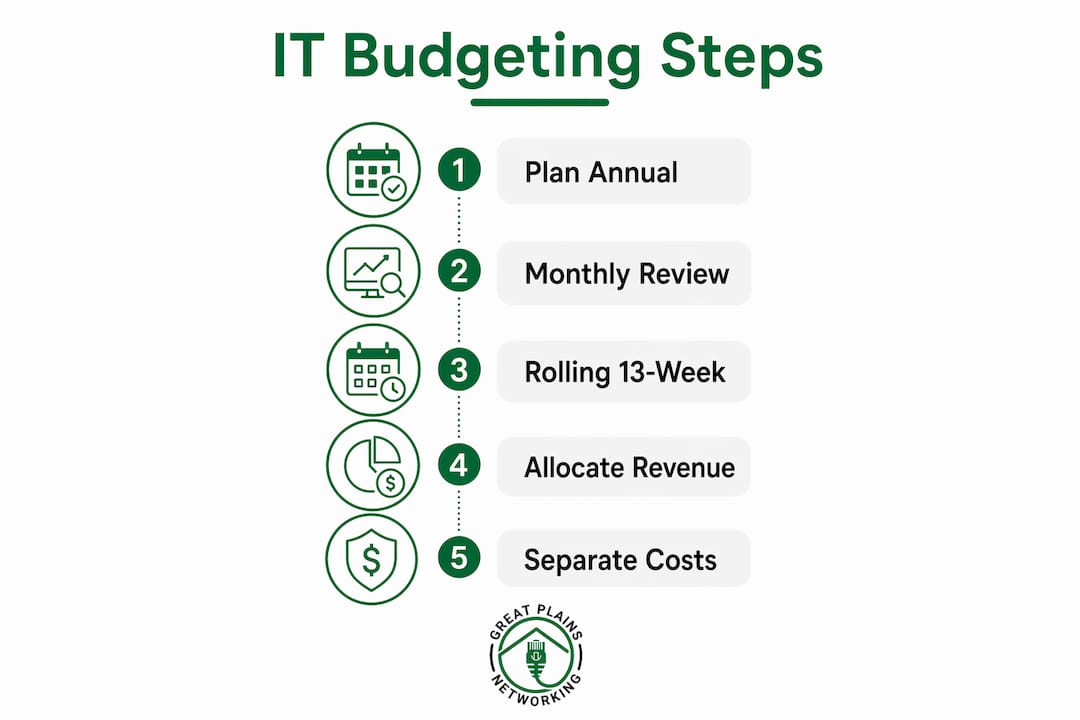
Not all budgeting approaches handle IT costs equally well. Annual budgets, monthly budgets, and rolling 13-week forecasts each serve a different purpose, and the most effective small business financial planning uses all three in combination.
| Method | Update frequency | Primary purpose | Precision level |
|---|---|---|---|
| Annual budget | Once per year | Strategic planning and goal-setting | Low (directional) |
| Monthly budget | Monthly | Operational cost tracking | Medium |
| 13-week rolling forecast | Weekly | Tactical cash timing and gap prevention | High (weeks 1-4), directional (weeks 5-13) |
The annual budget sets the ceiling. It answers the question: how much should we spend on IT this year? Monthly budgeting tracks whether you are staying within that ceiling. The 13-week rolling forecast is the operational tool that prevents cash crises by surfacing gaps 4 to 8 weeks in advance.
The mechanics of the 13-week model matter. Each week, you drop the week that just passed and add a new week at the far end, incorporating actual cash movements rather than projected ones. Weeks 1 through 4 carry high precision, while weeks 5 through 13 reflect directional accuracy. This distinction is practical. You act on the near-term precision and use the outer weeks to prepare, not to commit.
For IT-specific allocation, the 70-20-10 revenue framework provides a useful starting structure. Allocate 70% of revenue to daily operations, 20% to new opportunities, and 10% to long-term investments such as IT research and infrastructure upgrades. This keeps technology investment intentional rather than reactive.
Pro Tip: When building your IT budget, separate recurring costs (subscriptions, licenses, support contracts) from one-time capital costs (hardware, major software upgrades). Recurring costs belong in your weekly cash forecast. Capital costs need their own reserve line so they do not surprise you.
For practical tools, spreadsheet-based templates from providers like Eightx or OnBalance work well for the 13-week model. Accounting platforms like QuickBooks and Xero can pull actual cash data to feed those templates weekly, reducing manual entry and improving accuracy.
How IT budgeting integrates with overall financial planning
IT budgeting does not exist in isolation. It connects directly to your profit and loss statement, your cash flow statement, and your balance sheet. A business that manages IT costs well creates a cleaner financial picture across all three.
On the profit and loss side, categorizing IT expenses precisely allows you to see true operating margins. Many small businesses underestimate their technology spend because costs are scattered across multiple categories. Consolidating them reveals the actual cost of running your technology infrastructure, which is often 8 to 15 percent of total operating expenses for service businesses.
The connection to growth planning is equally direct. When you present a loan application or seek a line of credit, lenders at institutions like Bank of America or local Oklahoma credit unions look for coherent financial planning. A business that can show a documented IT budget, a 13-week cash forecast, and a clear technology roadmap signals financial discipline. That credibility translates into better terms and faster approvals.
Tax planning also intersects with IT budgeting. Recent legislative changes, including provisions in the One Big Beautiful Bill Act (OBBBA), affect how businesses can deduct or depreciate technology investments. Knowing your IT spend in advance allows your accountant to plan deductions strategically rather than scrambling at year-end.
Four integration points that small business owners often overlook:
- Linking IT costs to revenue drivers: If a CRM tool like Salesforce or HubSpot directly supports sales, its cost belongs in a revenue-generating category, not pure overhead.
- Aligning IT upgrades with growth phases: A business planning to hire five people in Q3 needs to budget for additional licenses, devices, and security seats before that quarter begins.
- Building IT reserves into the balance sheet: A cash reserve of 3 to 6 months of operating expenses should include a technology component, not just payroll and rent.
- Reviewing IT contracts at budget cycles: Annual budget reviews are the right time to audit software renewals and cut unnecessary costs before they auto-renew.
You can find a detailed breakdown of how to structure these connections in Greatplainsnetworking's IT budget planning guide, which covers the 2026 framework specifically for small businesses in Oklahoma and beyond.
Common IT budgeting mistakes and how to fix them
Most IT budgeting failures follow a predictable pattern. Recognizing these mistakes early saves significant money and stress.
-
Confusing profitability with cash availability. A business can show a net profit on its income statement while running out of cash because revenue has not yet been collected. IT expenses, however, are almost always cash-out events on a fixed schedule. Treating a profitable month as a safe month to defer IT planning is the most common and most damaging mistake.
-
Skipping weekly forecast updates. Updating a rolling forecast weekly by replacing the actualized week with a new projected week is what makes the model useful. Owners who update monthly lose the precision that prevents cash shortfalls. A forecast that is four weeks stale is not a forecast. It is a guess.
-
Ignoring seasonal variation. A dental practice in Norman, Oklahoma sees patient volume drop in summer. A retail business spikes in November and December. IT costs do not adjust automatically to these patterns, but your cash reserves must. Budget for IT maintenance and upgrades during high-cash periods, not during seasonal troughs.
-
Underestimating subscription creep. Software subscriptions accumulate quietly. A business that started with three SaaS tools often has twelve within two years, with several delivering minimal value. An annual audit of every recurring IT charge is a non-negotiable budgeting discipline.
-
No cash buffer for IT emergencies. Hardware fails. Ransomware happens. A cybersecurity incident can cost a small business tens of thousands of dollars in recovery time and data restoration. Without a dedicated IT reserve, those costs come directly out of operating cash.
Pro Tip: Before signing any new software contract, run a 90-day pilot and track actual usage. If fewer than 70% of intended users are active after 90 days, cancel before the annual commitment locks in.
Monthly budgeting combined with forecasting helps small businesses avoid cash crunches and use debt as a deliberate tool rather than an emergency response. That discipline starts with treating IT costs as a first-class budget category, not a residual line item.
Key takeaways
IT budgeting is the single most controllable lever small businesses have for preventing cash crises caused by technology costs, and it works only when integrated with weekly cash forecasting and overall financial planning.
| Point | Details |
|---|---|
| IT costs create timing risk | Software renewals and hardware replacements hit as lump sums; map them to a weekly cash forecast. |
| 13-week forecasts prevent crises | Rolling weekly updates surface cash gaps 4 to 8 weeks early, giving you time to act. |
| 70-20-10 guides allocation | Assign 10% of revenue to long-term IT investment to keep technology spending intentional. |
| Integration builds credibility | A documented IT budget strengthens loan applications and supports strategic tax planning. |
| Subscription audits cut waste | Review every recurring IT charge annually; unmanaged subscriptions are a silent cash drain. |
What I've learned from watching small businesses manage IT costs
After working with small businesses across Norman, Moore, and Oklahoma City, one pattern stands out clearly. The owners who treat IT budgeting as a financial discipline, not a technology task, consistently outperform those who do not. They are not necessarily spending more on technology. They are spending with intention.
The most common mistake I see is owners who wait until a system fails or a renewal invoice arrives to think about IT costs. By that point, the decision is reactive and the options are limited. The businesses that build a 13-week cash forecast with IT line items visible from the start make better decisions. They negotiate vendor terms from a position of knowledge. They time hardware replacements to high-cash months. They do not borrow to cover a software renewal that they could have planned for six weeks earlier.
My honest recommendation for any small business owner reading this: start simple. A spreadsheet with your recurring IT costs mapped to their renewal dates, combined with a basic 13-week cash model, is enough to change your financial posture. You do not need enterprise software or a full-time CFO. You need visibility and the discipline to update the model weekly. Once you have that, the benefits of managed IT support become much easier to evaluate because you can see exactly what you are paying and what you are getting in return.
The businesses that grow confidently are not the ones with the biggest IT budgets. They are the ones who know precisely what their technology costs, when those costs land, and how they fit into the broader financial picture.
— Nicholas
How Greatplainsnetworking supports your IT budget planning
Greatplainsnetworking works with small businesses in Norman, Moore, and Oklahoma City to make IT costs predictable and manageable. Their managed IT services replace unpredictable repair bills and emergency response costs with a fixed monthly fee, which is exactly what a cash forecast needs: a known number, not a variable surprise. The team provides same-day response, 24/7 monitoring, and customized IT plans built around your business size and budget. There are no long-term contracts, which means you stay in control of your spending. If you want to understand what your IT infrastructure actually costs and where you can reduce waste, contact Greatplainsnetworking for a tailored IT audit and budget review.
FAQ
What is IT budgeting for small businesses?
IT budgeting is the process of planning and controlling all technology-related expenses, including software, hardware, subscriptions, and support costs, within a defined financial period. It connects technology spending directly to cash flow management and business priorities.
How does a 13-week cash flow forecast help with IT costs?
A 13-week rolling forecast tracks actual cash inflows and outflows weekly, surfacing IT-related cash gaps 4 to 8 weeks before they occur. This gives small business owners time to adjust spending or build reserves before a shortfall hits.
How much cash reserve should a small business hold for IT expenses?
Financial advisors recommend a total cash reserve of 3 to 6 months of operating expenses, with a dedicated portion allocated to technology costs. IT-specific reserves cover emergency hardware replacement, cybersecurity incidents, and unplanned software migrations.
What is the 70-20-10 rule in IT budgeting?
The 70-20-10 framework allocates 70% of revenue to daily operations, 20% to new growth opportunities, and 10% to long-term investments including IT infrastructure and research. It provides a structured way to keep technology investment intentional and proportional.
Why do small businesses fail at IT budgeting?
The most common failure is treating IT costs as overhead rather than a cash-timing issue, which leads to missed renewals, emergency purchases, and cash shortfalls. Regular weekly forecast updates and an annual subscription audit are the two practices that correct this most reliably.
Recommended
Want help putting this into practice?
We'll audit your security, speed, and hardware in under an hour — no commitment, no sales pitch. Just a clear roadmap of what to fix and why.