
Why Remote Work Risks Law Firm Security in 2026

Remote work is the leading amplifier of cybersecurity risk for law firms today. Every attorney working from a home office, coffee shop, or hotel room extends the firm's digital perimeter far beyond what traditional IT controls can cover. Approximately 39% of law firms reported a breach in the past year, with 8% losing sensitive client data. That scale of exposure reflects a profession sitting on extraordinarily valuable information, operating across networks and devices that were never designed with legal confidentiality in mind. Understanding why remote work risks law firm security is the first step toward building a defense that actually holds.
Why remote work risks law firm security: the core vulnerabilities
Remote work expands a law firm's attack surface in ways that office-based security controls cannot address. The moment an attorney logs in from a home network, the firm's data travels through infrastructure the firm does not own, monitor, or control. Several specific threat vectors drive the majority of incidents.
- Unsecured home and public networks. Home routers rarely receive firmware updates. Public Wi-Fi at airports and coffee shops offers no encryption between the device and the access point. Both environments expose client files and email to interception.
- Personal devices without controls. Attorneys and staff who use personal laptops or phones for work create what security professionals call shadow IT. These devices bypass the firm's monitoring tools, antivirus policies, and patch schedules entirely.
- Ransomware and business email compromise. Professional services firms accounted for 18.9% of ransomware attacks in late 2025, with average initial ransom demands spiking to $4.2 million. Business email compromise targeting trust accounts carries the highest dollar loss of any single threat category.
- Uncontrolled post-access data handling. Granting remote access does not end the security obligation. Attorneys routinely save files locally, forward documents to personal email, or share via consumer cloud services. Each action removes the file from firm oversight.
- Sophisticated phishing and vishing. Attackers send emails that convincingly mimic court notifications, opposing counsel, or internal IT staff. Voice phishing, known as vishing, exploits the urgency of a "help desk call" to extract credentials in real time.
Pro Tip: Require attorneys to use a firm-provisioned VPN before accessing any case management system, even from home. A VPN alone does not solve every problem, but it closes the most common interception window on unsecured networks.
How do ethical obligations shape law firm cybersecurity duties?

Cybersecurity for law firms is not optional. It is a professional obligation codified in ethics rules that carry real disciplinary consequences. ABA Model Rule 1.6(c) requires attorneys to make reasonable efforts to prevent unauthorized disclosure of client information. ABA Comment 18 extends that duty to technology competence, meaning attorneys must understand the security implications of the tools they use.
Forty states have adopted a duty-of-technology-competence standard modeled on ABA Comment 18. That adoption rate means most law firms in the United States operate under binding obligations to implement proactive cybersecurity safeguards. Failure to do so can trigger disciplinary proceedings even when no breach has occurred. The standard is the effort, not just the outcome.
Practical compliance under these rules requires specific controls:
- Encryption for all client communications and stored data
- Multi-factor authentication (MFA) on every platform that holds client information
- Written policies governing remote access, device use, and data handling
- Documented vendor agreements that address data security for any cloud service the firm uses
The legal industry compliance landscape has shifted from reactive to proactive. Firms that treat ethics rules as a minimum floor, rather than a ceiling, build the kind of documented security posture that protects both clients and the firm itself in any disciplinary review.
What technical controls protect law firms working remotely?
A layered security architecture is the only reliable defense against the range of threats law firms face. No single tool stops every attack. The following controls form the baseline technology stack for any remote-capable firm.
- Multi-factor authentication (MFA). Deploy MFA on email, case management systems, document storage, and remote access tools. MFA blocks the majority of credential-based attacks even when passwords are compromised.
- Encrypted communications and storage. Use TLS for email in transit and full-disk encryption on every device that touches client data. Encrypted backups prevent ransomware from making recovery impossible.
- Endpoint detection and response (EDR). EDR tools monitor device behavior in real time and flag anomalous activity before it escalates. Deploy EDR on every remote device, including personal devices used for work.
- VPN or zero-trust network access. A VPN creates an encrypted tunnel between the remote device and firm systems. Zero-trust architecture goes further by verifying every user and device on every access attempt, regardless of location or prior authentication.
- Mobile Device Management (MDM). MDM platforms like Microsoft Intune allow firms to enforce security policies, push updates, and remotely wipe work data from a lost or stolen device. Containerization separates firm and personal data on the same device, which addresses attorney privacy concerns that often block MDM adoption.
- Regular patch management. Unpatched software is the entry point for a significant share of successful attacks. Establish a documented patch cycle and verify compliance across all remote endpoints.
- Cloud-based practice management. Cloud infrastructure supports secure file access, identity protection, and business continuity when properly configured. The key phrase is "properly configured." Cloud migration without ongoing management creates new vulnerabilities.
Pro Tip: Do not rely on attorneys to self-report device issues. Use a centralized dashboard that shows patch status, MFA enrollment, and EDR health for every remote endpoint in real time.
| Control | Primary threat addressed | Complexity to deploy |
|---|---|---|
| MFA | Credential theft, account takeover | Low |
| Full-disk encryption | Device theft, data exposure | Low |
| EDR | Malware, ransomware, insider threats | Medium |
| VPN / zero-trust | Network interception, unauthorized access | Medium |
| MDM with containerization | Personal device risk, shadow IT | Medium |
How does firm culture affect remote work security?
Technology controls fail when people bypass them. The human element remains the most exploited vulnerability in law firm security, and remote work makes that problem worse by removing the informal oversight that exists in a shared office.
Vishing attacks impersonating IT staff have increased sharply. An attacker calls an attorney, claims to be from the help desk, and creates urgency around a "security incident" that requires immediate remote access. Without a verified callback procedure, attorneys often comply. The attacker then has direct access to the firm's systems.
Effective countermeasures focus on behavior, not just awareness:
- Phishing simulations and role-specific training. Simulations reduce the effectiveness of social engineering by building muscle memory for skepticism. Generic annual training does not achieve this. Monthly simulations with targeted feedback do.
- Verify-first protocols. Every request for remote access or credential reset must be verified through a secondary channel. Attorneys should call the IT desk back on a known number, not the number provided by the caller.
- Addressing partner resistance. Senior attorneys often resist security controls they perceive as slowing them down. Frame controls in terms of malpractice exposure and client trust, not IT policy. That framing changes the conversation.
- Eliminating shadow IT through better alternatives. Attorneys use consumer file-sharing tools because firm-approved tools are inconvenient. Provide a fast, accessible, approved alternative and the workaround disappears.
Pro Tip: Run a quarterly tabletop exercise where a partner plays the role of the attacker. Seeing how easily a vishing call succeeds in a controlled setting motivates behavioral change faster than any policy document.
What does a secure remote work framework look like for law firms?
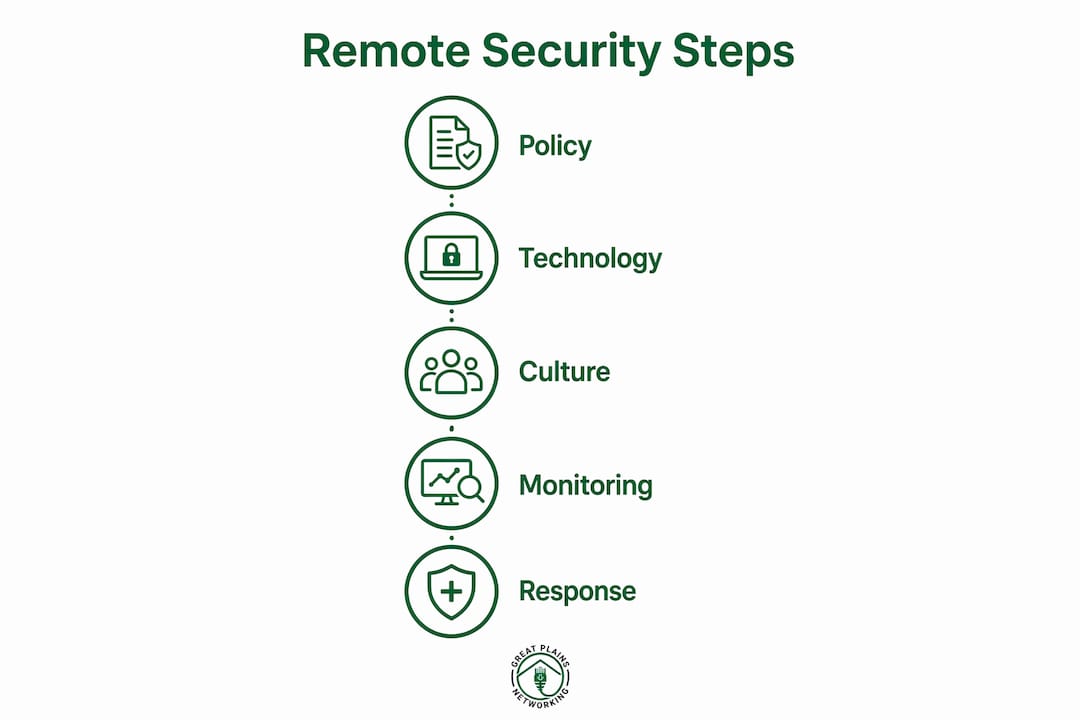
Securing remote legal work requires policy, technology, and culture to operate together. Technology alone leaves gaps. Policy without enforcement creates false confidence. Culture without tools creates friction that drives workarounds.
A documented remote work policy covers four areas: approved devices and operating systems, required security software, acceptable data handling procedures, and consequences for non-compliance. The policy must be reviewed annually and updated when the threat environment changes.
Monitoring and auditing close the gap between policy and practice. Log all remote access events, review third-party vendor connections regularly, and conduct periodic vulnerability assessments. Firms that understand why they are prime targets for cybercriminals invest in monitoring before an incident forces the issue.
Incident response planning for remote environments differs from office-based planning. Attorneys may be in multiple time zones. Devices may be physically inaccessible. The response plan must account for remote containment, remote evidence preservation, and remote communication with clients when systems are compromised.
Cybersecurity also functions as a client-facing business asset. Firms that communicate their security posture clearly attract clients who handle sensitive matters and expect confidentiality to be protected. Outdated technology and vague security practices drive those same clients away.
The uncomfortable reality of law firm remote security
Law firms are not losing ground to attackers because the technology is too complex. They are losing ground because the culture has not caught up with the threat. I have seen firms with excellent written policies and zero enforcement. I have seen partners who refuse MFA because it adds thirty seconds to their login, then spend weeks managing a breach that costs the firm six figures and two client relationships.
The firms that get this right treat security as a leadership issue, not an IT issue. When the managing partner requires MFA and follows the verify-first protocol personally, the rest of the firm follows. When security is delegated entirely to a junior IT contact or an outside vendor with no internal champion, it stagnates.
Remote work is not going away. The attorneys who work from home, from courthouses in other cities, and from client offices are delivering real value. The goal is not to restrict that flexibility. The goal is to build the controls and the culture that make flexibility safe. Firms that view cybersecurity for local law firms as a business investment, rather than a compliance cost, consistently outperform their peers on both security outcomes and client retention.
— Nicholas
How Greatplainsnetworking supports law firm remote security
Law firms in Norman, Moore, and Oklahoma City face the same remote work security threats as firms in major markets, with fewer internal IT resources to address them.
Greatplainsnetworking provides managed IT support built specifically for small businesses, including law firms that need 24/7 monitoring, MFA deployment, encrypted backup, and endpoint security without a full-time IT department. Their cybersecurity services align with ABA ethical obligations and cover the practical controls attorneys need to work remotely without exposing client data. Same-day response times and no long-term contracts mean firms get reliable protection without the overhead. Contact Greatplainsnetworking to schedule a security assessment for your firm.
FAQ
What is the biggest cybersecurity risk for remote law firm work?
Unsecured personal devices and home networks are the most common entry points for attackers. Shadow IT, where attorneys use unapproved tools, compounds the risk by removing firm visibility over client data.
Does remote work violate ABA ethics rules?
Remote work does not automatically violate ABA Model Rule 1.6(c), but it requires firms to implement reasonable safeguards. Forty states have adopted a duty-of-technology-competence standard that mandates proactive security measures for any remote work setup.
How does ransomware specifically threaten law firms?
Ransomware encrypts firm data and demands payment for restoration. Double-extortion variants also threaten to publish stolen files, which risks waiving attorney-client privilege and triggering malpractice claims.
What is zero-trust architecture and why do law firms need it?
Zero-trust architecture verifies every user and device on every access attempt, regardless of prior authentication or network location. Law firms need it because remote work eliminates the trusted perimeter that traditional network security assumes.
How often should law firms conduct security training?
Annual training is not sufficient. Monthly phishing simulations combined with role-specific training produce measurable reductions in social engineering susceptibility and are considered a baseline best practice for legal environments.
Key takeaways
Remote work expands a law firm's attack surface across networks, devices, and human behaviors that traditional office security cannot control, making layered technical and cultural defenses the only reliable protection for client data.
| Point | Details |
|---|---|
| Remote work multiplies exposure | Home networks, personal devices, and shadow IT remove firm control over client data. |
| Ethics rules require action | ABA Model Rule 1.6(c) and 40 state standards mandate proactive cybersecurity, not just breach response. |
| Layered controls are non-negotiable | MFA, EDR, VPN, encryption, and MDM must work together; no single tool is sufficient. |
| Human behavior drives most breaches | Vishing, phishing, and shadow IT require ongoing simulation-based training, not annual policy reviews. |
| Security is a client retention issue | Firms with documented, communicated security postures attract and keep clients who handle sensitive matters. |
Recommended
Want help putting this into practice?
We'll audit your security, speed, and hardware in under an hour — no commitment, no sales pitch. Just a clear roadmap of what to fix and why.