
Why Law Firms Need Network Monitoring in 2026

Network monitoring is the proactive practice of continuously observing a law firm's IT infrastructure to detect threats, protect client data, and meet compliance mandates. Why law firms need network monitoring has never been clearer: cyber incidents in the legal sector increased by 43% in 2025, and 39% of law firms reported a security breach within the last year. ABA Rule 1.6 and ABA Resolution 109 set explicit expectations for data protection, and cyber insurers now require verified endpoint monitoring as a condition of coverage. For law firm decision-makers, this is not a technology question. It is a business survival question.
Why law firms need network monitoring more than ever
Law firms hold some of the most sensitive data in any industry. Client communications, case strategies, financial records, and settlement details all live on firm networks. That concentration of privileged information makes legal practices a high-value target for cybercriminals.
The attack methods are well-documented. Phishing emails impersonate clients or courts to steal credentials. Ransomware encrypts entire case management systems until a ransom is paid. Average ransomware demands for law firms now exceed $4 million, a figure that reflects how much attackers believe legal data is worth. A single successful attack can shut down a firm's operations for days or weeks.
The threat surface is expanding beyond direct attacks. Third-party vendors were involved in 25% of legal sector security breaches, meaning the cloud storage provider, billing software vendor, or document management platform your firm uses could be the entry point. That statistic reframes vendor relationships as a security risk, not just a business convenience.

AI-enhanced attacks add another layer of urgency. Cybercriminals now use generative AI to craft more convincing phishing messages and automate vulnerability scanning. At the same time, unauthorized use of generative AI tools by employees, known as shadow AI, introduces data leakage risks that most firms have not yet addressed. An attorney who pastes confidential client details into an unsanctioned AI tool may not realize the data is being stored or shared externally.
Continuous network monitoring counters these threats by detecting anomalies in real time. When a user account suddenly accesses thousands of files at 2:00 AM, or when an unknown device connects to the network, monitoring tools flag the activity before damage spreads. This is the core benefit: early detection converts a potential catastrophe into a contained incident. Learn more about why law firms are targeted and what makes their networks particularly attractive to attackers.
Pro Tip: Set behavioral baseline alerts for your firm's network. Any deviation from normal user patterns, such as off-hours logins or bulk file downloads, should trigger an immediate review.
How does network monitoring support legal compliance?
Compliance is not optional for law firms. ABA Rule 1.6 requires attorneys to make reasonable efforts to prevent unauthorized disclosure of client information. ABA Resolution 109 goes further, urging firms to adopt specific cybersecurity frameworks and incident response plans. Failing to meet these expectations risks breach notifications, malpractice claims, and loss of professional liability coverage. Network monitoring is the mechanism that makes compliance verifiable, not just aspirational.
The compliance requirements translate into four concrete obligations for most firms:
- Documented access controls. Monitoring logs show who accessed what data and when, creating an audit trail that satisfies both ABA standards and state bar requirements.
- Incident response readiness. Regulators and insurers expect firms to detect breaches quickly and notify affected clients within defined timeframes. Real-time monitoring makes that timeline achievable.
- Vendor oversight. Firms must verify that third-party providers meet security standards. Monitoring vendor access points is a direct control, not a paper exercise.
- Continuous improvement. Compliance is not a one-time certification. Ongoing monitoring data feeds into regular security reviews, which satisfy the "reasonable efforts" standard under Rule 1.6.
The insurance dimension is equally significant. Cyber insurance providers require 24/7 endpoint detection and response (EDR) to approve coverage and prevent higher premiums. Without documented monitoring, firms face either denial of coverage or premiums that reflect the full, unmitigated risk of operating without controls. Legal industry experts confirm that without active network monitoring, firms face challenges obtaining or affording cyber insurance at any reasonable rate.
"A law firm's ethical duty to protect client confidences extends to the digital infrastructure that holds those confidences. Monitoring is not a technical nicety. It is a professional obligation."
Review the legal compliance examples that show how monitoring maps directly to ABA and state bar requirements.
What monitoring tools and approaches work best for law firms?
Not all monitoring solutions fit every firm. The right approach depends on firm size, budget, and the sensitivity of the cases handled. Three categories cover most of the options available.
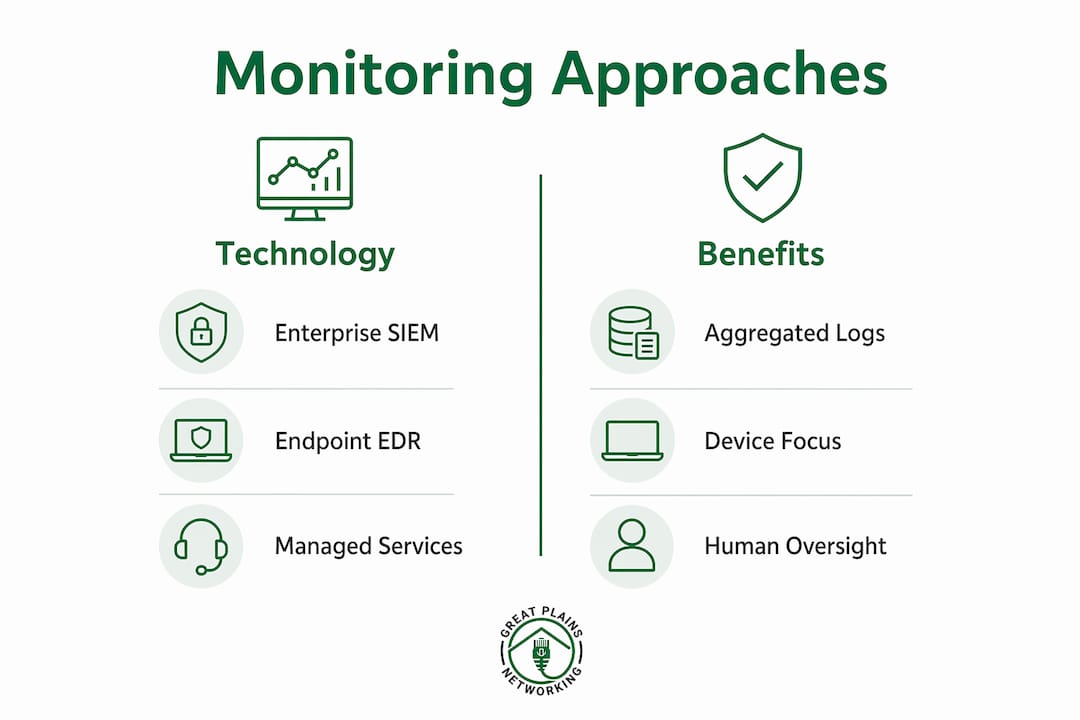
Security Information and Event Management (SIEM) platforms aggregate log data from across the network, correlate events, and generate alerts. Enterprise SIEM tools provide deep visibility but require dedicated security staff to interpret the data. For most small and midsize law firms, the operational overhead of running a SIEM in-house is prohibitive.
Endpoint Detection and Response (EDR) focuses on individual devices: laptops, desktops, and mobile endpoints. EDR tools monitor process behavior, block malicious activity, and provide forensic data after an incident. Insurers specifically name EDR as a coverage requirement, making it a non-negotiable baseline for any firm seeking cyber insurance.
Managed network monitoring services combine technology with human oversight. A managed security provider monitors the firm's network around the clock, interprets alerts, and responds to incidents. This model suits law firms that lack internal IT staff with security expertise.
| Approach | Best for | Key benefit | Primary limitation |
|---|---|---|---|
| Enterprise SIEM | Large firms with IT staff | Deep event correlation | High operational cost |
| EDR tools | All firm sizes | Insurer-required baseline | Device-level only |
| Managed monitoring | Small to midsize firms | 24/7 coverage, no internal staff needed | Requires trusted provider |
Proactive monitoring outperforms reactive monitoring on every meaningful metric. Continuous network monitoring combined with incident response preparedness reduces operational disruptions and reputational harm. Reactive monitoring, which reviews logs only after a reported problem, misses the window where most breaches can be contained.
Vendor security verification belongs in any monitoring strategy. Firms should obtain SOC 2 reports or equivalent documentation from every technology provider that touches client data. Independent security audits of IT vendors are essential because a vendor's weak controls become the firm's liability.
Pro Tip: Request a current SOC 2 Type II report from every software vendor your firm uses. A vendor that cannot produce one within 30 days is a vendor worth replacing.
How to implement network monitoring in your law firm
A sound implementation starts with an honest assessment of the current security posture. Before deploying any monitoring tool, map every device, application, and user account on the network. Unknown assets cannot be monitored, and unmonitored assets are the ones attackers exploit first.
- Identify high-risk areas first. Client portals, email servers, and case management systems hold the most sensitive data. Start monitoring there before expanding to lower-risk systems.
- Choose internal or outsourced monitoring based on capacity. Firms with fewer than 50 employees rarely have the internal staff to run effective 24/7 monitoring. Outsourcing to a managed IT provider delivers consistent coverage without the hiring overhead.
- Train every attorney and staff member. Technology alone does not stop phishing attacks. Regular training on recognizing suspicious emails, reporting anomalies, and following data handling procedures reduces the human risk that monitoring cannot fully address.
- Establish controls around AI tool usage. Define which AI applications are approved, prohibit client data from entering unapproved tools, and use monitoring to detect shadow AI activity on the network.
- Run penetration tests and tabletop exercises annually. Penetration testing and ongoing vulnerability assessments benchmark the effectiveness of monitoring and uncover unknown risks. Tabletop exercises test whether the incident response plan actually works before a real breach forces the question.
The shift from reactive to proactive security is the single most important change a firm can make. The rapid increase in ransomware and AI-enhanced attacks demands a shift from reactive to proactive cyber resilience strategies in law firms. Waiting for an alert from a client that their data appeared on the dark web is not a security strategy. Continuous monitoring is. For firms concerned about ransomware specifically, the ransomware defense guide covers the technical and procedural controls that complement monitoring.
Pro Tip: Schedule a quarterly review of your monitoring alerts and incident logs. Patterns in low-level alerts often signal a developing threat that has not yet triggered a high-priority flag.
Key Takeaways
Law firms that deploy continuous network monitoring reduce their exposure to breaches, satisfy ABA compliance obligations, and qualify for cyber insurance coverage that reactive security postures cannot support.
| Point | Details |
|---|---|
| Rising threat level | Cyber incidents in the legal sector rose 43%, with 39% of firms reporting a breach last year. |
| Ransomware cost | Average ransom demands exceed $4 million, making prevention far cheaper than recovery. |
| Compliance obligation | ABA Rule 1.6 requires reasonable data protection efforts; monitoring creates the documented proof. |
| Insurance requirement | Cyber insurers mandate 24/7 EDR monitoring as a condition of coverage approval. |
| Vendor risk | 25% of legal sector breaches involve third-party providers, requiring monitored vendor access. |
The blind spot most law firms still have in 2026
From my experience working with small and midsize firms in Oklahoma, the most common mistake is treating network security as an IT problem rather than a leadership problem. Partners sign off on malpractice insurance without question, but they resist the same level of investment in the monitoring that prevents the malpractice claim from happening in the first place.
The second blind spot is vendor complacency. Firms negotiate contracts carefully but rarely ask their document management or billing software vendors for a SOC 2 report. That gap is where 25% of breaches enter. The vendor's security posture is your security posture, whether you acknowledge it or not.
The firms I see handle incidents best are the ones that treated monitoring as a continuous practice, not a one-time setup. They run tabletop exercises. They review alert logs quarterly. They update their incident response plans when their vendor roster changes. That discipline is what separates a contained incident from a front-page breach.
The threat landscape in 2026 is not going to simplify. AI-enhanced attacks will keep improving. Shadow AI risks inside firms will grow as attorneys adopt new tools faster than IT policies can keep up. The firms that build monitoring into their operations now will be the ones that stay ahead of that curve.
— Nicholas
Greatplainsnetworking provides law firm network monitoring in OKC
Law firms in Norman, Moore, and Oklahoma City face the same escalating threats as firms in major markets, often with fewer internal IT resources to respond. Greatplainsnetworking delivers managed IT support built specifically for small businesses, including legal practices that need 24/7 monitoring without the cost of an in-house security team.
Greatplainsnetworking monitors endpoints, detects threats in real time, and responds the same day. The firm's cybersecurity services are designed to meet ABA compliance expectations and satisfy cyber insurer requirements for EDR coverage. There are no long-term contracts and no technical jargon. If your firm needs a straightforward security assessment and a monitoring plan that fits your practice, contact Greatplainsnetworking to get started.
FAQ
Why do law firms need network monitoring?
Law firms store privileged client data that cybercriminals actively target. Continuous monitoring detects intrusions early, satisfies ABA Rule 1.6 compliance requirements, and is now required by most cyber insurers as a condition of coverage.
What is the average ransomware demand for law firms?
Average ransomware demands for law firms now exceed $4 million. That figure makes proactive monitoring a far more cost-effective investment than paying a ransom or absorbing the operational losses from a prolonged shutdown.
Does ABA Rule 1.6 require network monitoring?
ABA Rule 1.6 requires attorneys to make reasonable efforts to protect client data. While it does not name specific tools, regulators and courts interpret continuous monitoring as a core component of meeting that standard in 2026.
How do third-party vendors create network security risks for law firms?
Third-party vendors were involved in 25% of legal sector breaches. Any provider with access to firm systems or client data represents a potential entry point, which is why monitoring vendor access and requiring SOC 2 reports are both standard practice.
Can a small law firm afford managed network monitoring?
Managed monitoring services are priced for small businesses and cost significantly less than the average ransomware demand or the premium increase that follows a breach. Firms without internal IT staff benefit most from outsourced 24/7 monitoring.
Recommended
Want help putting this into practice?
We'll audit your security, speed, and hardware in under an hour — no commitment, no sales pitch. Just a clear roadmap of what to fix and why.