
How to Prevent Data Breach in Your Law Office

A data breach in a law office is defined as any unauthorized access to confidential client information, and ABA Model Rule 1.6(c) mandates that lawyers make reasonable efforts to prevent it. That rule is now adopted in 40 states, making cybersecurity compliance a legal and ethical obligation, not an optional upgrade. 40% of law firms have experienced a data security breach, with the average breach costing $5.08 million in 2026. For law office managers, the question is not whether to act. The question is where to start and how to build a data breach prevention strategy that holds up under scrutiny.
What baseline controls does a law office need to prevent data breaches?
The foundation of any law office data security solution is a set of verified, documented technical controls. These controls define what "reasonable efforts" looks like in practice under Rule 1.6(c). Without them, your firm is exposed to both cyberattacks and disciplinary action.
The core controls every law office should have in place include:
- Multi-factor authentication (MFA): Enforce MFA across email, case management systems, and remote access. Many cyber liability insurance policies exclude claims if MFA is absent, so this control is both a security measure and a coverage requirement.
- Encryption: Encrypt data at rest on all devices and in transit across all communications. This applies to client emails, document storage, and any cloud-based practice management platform.
- Endpoint protection with managed detection and response (MDR): Standard antivirus is not sufficient. MDR tools monitor endpoints continuously and alert your team to active threats in real time.
- 3-2-1-1 backup strategy: Maintain three copies of data, on two different media types, with one copy offsite and one copy immutable. Test restoration regularly. A backup that has never been restored is a hypothesis, not a safety net.
- Written incident response plan: Only 34% of surveyed law firms had an incident response plan in 2026. Firms with a tested plan save an average of $2.66 million per breach incident.
- Vendor management: Vendor-related incidents caused 25% of security events in 2025. Require SOC 2 Type II reports from any third party that handles client data.
- Security awareness training: Run mandatory training and simulated phishing campaigns for all staff. Automated phishing simulations reduce employee susceptibility and improve detection rates.
Pro Tip: Failure to revoke access during offboarding is one of the most common security gaps attackers exploit. Automate both provisioning and revocation of access rights as part of your HR workflow so no departing employee retains credentials.
Documentation of every control, including training attendance, vendor audits, and tabletop exercises, forms the evidentiary basis for compliance defense in ethical reviews or litigation. If you cannot prove a control exists, regulators and courts will treat it as if it does not.

How do you build a firm-wide data breach prevention strategy?
Technical controls alone do not prevent breaches. People and policies determine whether those controls actually work. Law office managers need a written information security policy that translates technical requirements into clear staff expectations.
- Write a plain-language information security policy. Define acceptable use of firm devices, email, and cloud storage. Specify password requirements, remote work rules, and data classification levels. Staff who understand the rules follow them more consistently.
- Develop a detailed incident response plan with named roles. Assign a response lead, a communications officer, and an outside counsel contact. Define escalation steps so no one wastes time deciding who calls whom during an active incident.
- Conduct mandatory security awareness training. Small and mid-size law firms are prime targets for AI-powered phishing because their defenses are weaker than large firms. Training must be regular, not a one-time onboarding checkbox.
- Establish client communication protocols. ABA Model Rule 1.4 requires prompt communication with clients. Draft your post-breach notification templates before an incident occurs so your team is not writing them under pressure.
- Adopt an AI governance policy. ABA Formal Opinion 512 addresses attorney use of AI tools. Any AI platform your firm uses must be evaluated for data handling, confidentiality risks, and vendor security practices.
Pro Tip: Engage breach counsel and a forensic partner before an incident occurs. Pre-engagement with forensic investigators through retained breach counsel allows forensic work to be classified as attorney work product, preserving confidentiality during the investigation.
The reasonable efforts standard under Rule 1.6(c) is a risk-management framework, not a fixed checklist. The sensitivity of the data, the cost of controls, and the realistic threat level all factor into what counts as reasonable for your firm. Understanding that distinction protects you from both over-spending and under-protecting.
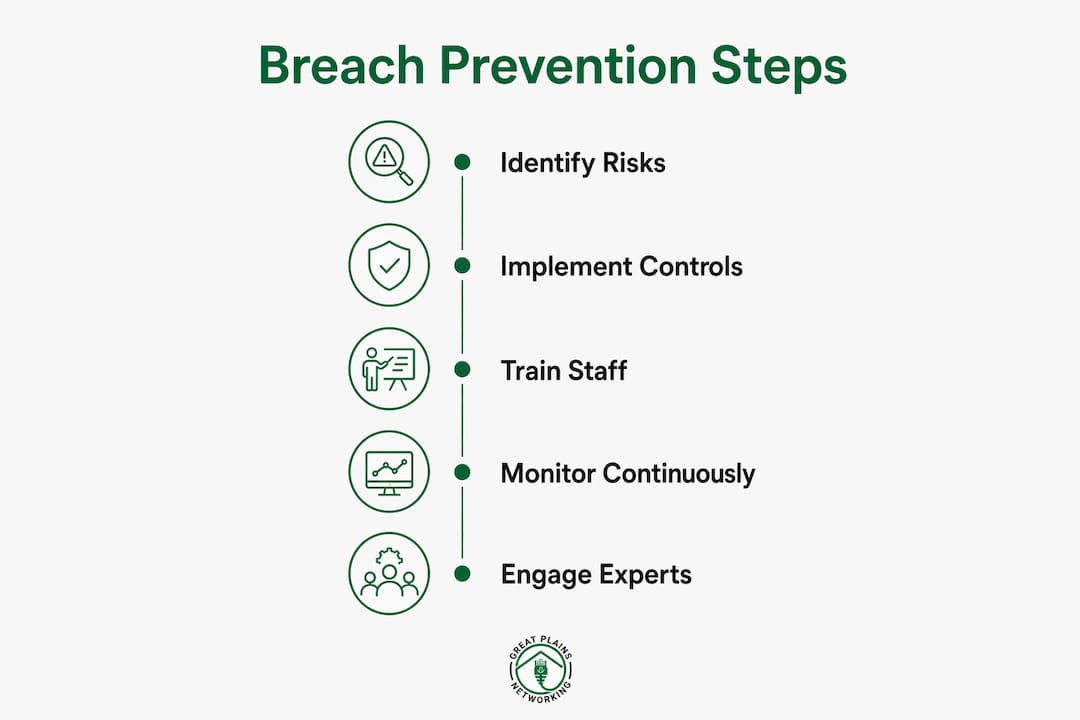
What ongoing monitoring and vendor oversight does your firm need?
Building controls is not enough. Sustained breach prevention requires continuous monitoring, regular testing, and disciplined vendor oversight. Firms that set controls and walk away create a false sense of security.
Operational practices that keep your defenses current include:
- Routine vulnerability scanning and penetration testing: Schedule quarterly vulnerability scans and at least one annual penetration test. These tests reveal gaps that internal teams miss.
- Continuous logging and audit trails: Log all access to client files, administrative systems, and network resources. Real-time monitoring catches anomalies before they become breaches.
- Vendor inventory and security reviews: Maintain a current list of every third party with access to firm data. Review each vendor's security posture annually and after any significant change to their services.
- Breach notification mapping: Track your notification obligations across every jurisdiction where your clients reside. State breach notification timelines vary widely, and missing a deadline creates independent legal liability.
- Zero trust access control: Apply zero trust principles by verifying every user and device before granting access, regardless of whether they are inside or outside the office network.
Law offices that learn why they are targeted gain a clearer picture of which assets attackers want most. Client financial records, litigation strategies, and merger details are high-value targets that warrant stricter access controls than general correspondence.
Common mistake: Firms frequently neglect vendor risk until after an incident. A vendor with weak security is an open door into your network. Require written security attestations from vendors annually, not just at onboarding.
How should a law office respond if a breach occurs?
A tested response plan limits damage, fulfills ethical duties, and reduces legal exposure. The steps below apply whether the breach is a ransomware attack, a misdirected email, or a compromised vendor.
- Isolate affected systems immediately. Disconnect compromised devices from the network. Revoke credentials for any accounts that may have been accessed. Speed here directly limits the scope of data exposure.
- Engage outside counsel to lead the investigation. Conducting the investigation through breach counsel preserves attorney-client privilege over findings. This matters when regulators or plaintiffs later request investigation records.
- Determine notification obligations. ABA Formal Opinion 483 requires firms to notify current and former clients whose data was accessed. State breach notification laws impose additional timelines, some as short as 30 days.
- Document everything. Record every action taken, every system affected, and every decision made during the response. This documentation supports both your defense and your post-incident review.
- Conduct a lessons-learned review. Update your incident response plan, patch the vulnerability that was exploited, and retrain any staff whose actions contributed to the breach.
Firms with incident response plans save an average of $2.66 million per breach incident. That figure reflects faster containment, lower legal costs, and reduced regulatory penalties. The plan pays for itself the first time you need it.
Pro Tip: Review your cyber liability insurance coverage before a breach, not after. Many firms lack adequate coverage or hold policies that exclude claims when basic controls like MFA were not in place at the time of the incident.
Key Takeaways
Preventing data breaches in a law office requires documented technical controls, firm-wide policy, continuous monitoring, and a tested incident response plan that together satisfy ABA Model Rule 1.6(c).
| Point | Details |
|---|---|
| ABA Rule 1.6(c) sets the standard | Reasonable efforts require documented, risk-based controls, not just a basic checklist. |
| Incident response plans save money | Firms with tested plans save an average of $2.66 million per breach incident. |
| Vendor risk is a top exposure | 25% of security events in 2025 traced back to third-party vendors; annual audits are required. |
| Offboarding is a critical gap | Automate access revocation at departure to eliminate a commonly exploited vulnerability. |
| Documentation is your legal defense | Records of training, audits, and tabletop exercises prove compliance in disciplinary reviews. |
Why cybersecurity is a client trust issue, not just an IT cost
Law offices that treat cybersecurity as a line item to minimize are misreading the risk entirely. Client trust is the core asset of any law firm, and a single breach can destroy relationships that took decades to build. I have seen firms recover from financial setbacks, but the firms that lose client confidence after a breach rarely return to their prior standing.
The firms that fare best are the ones that treat security as a dynamic, ongoing process. They schedule annual penetration tests, update their incident response plans after every tabletop exercise, and review vendor contracts with security requirements in mind. That discipline is not expensive relative to the cost of a breach. It is the cost of doing business responsibly.
Demonstrating a strong cybersecurity program is also a competitive differentiator. Clients, especially corporate clients, increasingly ask about data protection practices before signing engagement letters. A firm that can answer those questions with documented evidence wins business that less-prepared competitors lose.
Smaller firms should not try to build this infrastructure alone. Specialized managed security providers bridge the resource gap and implement controls like zero trust in cost-effective phases. Partnering with a provider that understands legal sector requirements is faster, more reliable, and ultimately less expensive than assembling the capability in-house.
— Nicholas
Greatplainsnetworking supports law offices with proactive cybersecurity
Law offices in Norman, Moore, and Oklahoma City face the same breach risks as large firms but with smaller IT teams and tighter budgets. Greatplainsnetworking provides managed IT support built specifically for small businesses, including law firms that need 24/7 monitoring, incident response expertise, and compliance-focused security controls.
Greatplainsnetworking delivers dedicated cybersecurity services covering MFA enforcement, endpoint protection, backup and recovery, and vendor risk management. There are no long-term contracts and no technical jargon. You get plain-language guidance, same-day response times, and a team that understands what ABA compliance actually requires. Contact Greatplainsnetworking to schedule a security assessment for your law office.
FAQ
What does ABA Model Rule 1.6(c) require for data security?
ABA Model Rule 1.6(c) requires lawyers to make reasonable efforts to prevent unauthorized access to client data. The standard is risk-based, meaning controls must match the sensitivity of the data and the realistic threat level your firm faces.
How common are data breaches at law firms?
40% of law firms have experienced a data security breach, with 56% of those incidents involving sensitive client data. The average breach cost reached $5.08 million in 2026.
What is the first step in building a law office incident response plan?
Assign named roles for response lead, communications, and outside counsel contact, then document escalation steps before any incident occurs. Firms with written, tested plans save an average of $2.66 million per breach.
Why do small law firms face higher breach risk than large firms?
Small and mid-size law firms are prime targets for AI-powered phishing and social engineering because their defenses are typically weaker than those at large firms. Attackers view them as high-value targets with lower barriers to entry.
Does cyber liability insurance cover all law firm breaches?
Not automatically. Many firms hold policies that exclude claims if basic controls like MFA were not active at the time of the breach. Review your policy terms and confirm your controls meet the insurer's requirements before a claim arises.
Recommended
Want help putting this into practice?
We'll audit your security, speed, and hardware in under an hour — no commitment, no sales pitch. Just a clear roadmap of what to fix and why.