
Legal IT Business Continuity Plan: What You Need to Know

A legal IT business continuity plan (BCP) is a documented framework that keeps an organization's critical IT systems and business operations running during disruptions such as cyberattacks, power outages, or natural disasters. The industry standard term is IT business continuity management (BCM), governed by ISO 22301:2019 and regulatory frameworks like DORA. For law firms and business owners in Oklahoma, understanding what is a legal IT business continuity plan means recognizing that it coordinates people, processes, technology, vendors, and compliance obligations into one tested strategy. Without it, IT downtime costs can reach devastating levels before anyone knows what to do next.
What is a legal IT business continuity plan?
A legal IT business continuity plan is a structured, compliance-aware strategy that defines how an organization maintains or rapidly restores IT-dependent operations when something goes wrong. It goes beyond a simple backup policy. Comprehensive IT continuity plans integrate people, processes, technology, facilities, and vendors into a resilience architecture. That means your plan must account for every layer of your operation, not just your servers.
The legal dimension matters because regulators, insurers, and courts increasingly expect documented, tested plans. Frameworks like DORA (the EU Digital Operational Resilience Act) and ISO 22301:2019 set the bar for what "adequate preparation" looks like. A plan that exists only on paper and has never been tested is not a plan. It is a liability.

For law firms and professional service businesses in Norman, Moore, and Oklahoma City, the stakes are especially high. Client data, case files, and billing systems are all IT-dependent. A ransomware attack or server failure without a verified recovery path puts client relationships, regulatory standing, and revenue at risk simultaneously.
What are the essential components of a legal IT business continuity plan?
An effective plan covers six core areas. Each one must be documented, assigned to a named owner, and tested regularly.
- Roles and responsibilities. Every plan needs a named incident commander, a technical recovery lead, and a communications officer. Management retains personal accountability and cannot delegate oversight to IT staff alone.
- Critical operations prioritization. Not all systems are equal. Identify which processes must resume within hours (client intake, billing, case management) versus which can wait days (archival storage, internal reporting).
- Technology elements. This includes verified data backups, defined Recovery Time Objectives (RTO) and Recovery Point Objectives (RPO), network redundancies, and failover systems. RTO is the maximum acceptable downtime; RPO is the maximum acceptable data loss measured in time.
- Vendor and third-party dependencies. Document every SLA (Service Level Agreement) with cloud providers, software vendors, and internet service providers. A plan that ignores third-party failures will collapse the first time a vendor goes down.
- Crisis communication templates. Pre-written communication templates for clients, regulators, and partners eliminate decision paralysis during a crisis. Your team should never be drafting notifications from scratch at 2 a.m.
- Compliance documentation. Maintain audit-ready records of plan reviews, test results, and incident responses. Regulators and insurers will ask for these.
Pro Tip: Assign a deputy for every critical role in your plan. If your incident commander is unreachable during a crisis, the plan must not stall. Name the backup before you need them.
How does a legal IT business continuity plan differ from disaster recovery?
These three terms are often used interchangeably. They are not the same thing, and confusing them creates dangerous gaps.
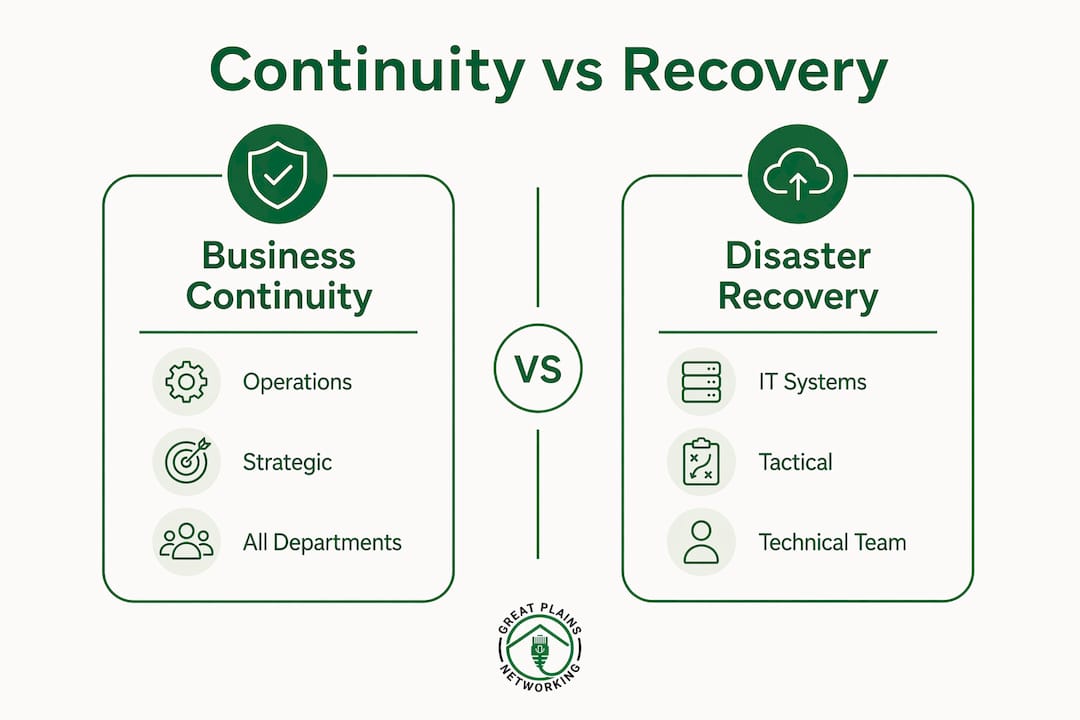
| Concept | Focus | Scope | Who Leads |
|---|---|---|---|
| Business Continuity | Maintaining operations during disruption | Whole organization: people, processes, IT, vendors | Senior leadership |
| Disaster Recovery | Restoring IT systems and data after failure | IT infrastructure and data | IT team |
| Crisis Management | Executive response and communications during emergencies | Stakeholders, media, regulators | C-suite and legal counsel |
Business continuity is strategic; disaster recovery is tactical IT restoration. Business continuity asks, "How do we keep serving clients?" Disaster recovery asks, "How do we get the servers back online?" Both questions matter, but they require different plans, different owners, and different timelines.
A critical insight: an IT business continuity plan cannot replace disaster recovery. Both complement each other. Business continuity keeps the organization delivering services while disaster recovery restores the underlying IT infrastructure. Running only one of the two is like having a fire extinguisher but no evacuation plan.
Organizations often fund disaster recovery but fail to adequately support business continuity, leading to failures in real crises. The IT team restores the servers, but no one knows which clients to call, which processes to run manually, or who has authority to make decisions. That gap is where reputations are lost.
What are the key legal and regulatory requirements for IT plans?
Regulatory pressure on IT continuity is increasing, and ignorance of the requirements is not a defense.
- DORA (Digital Operational Resilience Act). DORA requires financial entities to review ICT risk management and business continuity plans at least annually and after significant incidents. Management retains non-delegable personal accountability. This is not a checkbox exercise.
- ISO 22301:2019. This international standard emphasizes operational continuity policies over mere documentation. Plans must evolve with organizational changes, not sit static in a shared drive.
- Annual testing mandates. Regulatory frameworks require annual testing of business continuity and disaster recovery plans, including realistic scenarios that simulate third-party failures. Test results must be documented.
- Board and executive accountability. Failing to prepare for operational risks can lead to regulatory scrutiny and legal consequences for board members and executives. The plan is a governance document, not just an IT document.
- Insurance and audit documentation. Cyber insurers increasingly require proof of a tested, documented BCP before issuing or renewing policies. A plan that has never been tested will not satisfy an underwriter or a regulator.
Pro Tip: Store your BCP and all test records in a location accessible outside your primary network. If your servers are down, your recovery plan must still be reachable, whether that means a cloud document vault or a printed binder in a secure offsite location.
What are best practices for creating and maintaining your plan?
Building a plan that actually works in a crisis requires more than filling out a template. These are the practices that separate verified resilience from false security.
- Conduct a Business Impact Analysis (BIA) first. The BIA should quantify financial losses from IT disruptions to justify investment to executives. Translate downtime into dollars, not just hours. A CFO responds to a $14,000-per-minute exposure calculation; they do not respond to "our email might go down."
- Define RTO, RPO, and MTPD. Maximum Tolerable Period of Disruption (MTPD) is the outer limit beyond which the business cannot recover. Set these numbers before you design your recovery architecture, not after.
- Engage stakeholders beyond IT. Legal counsel, operations managers, and HR all have roles in a real incident. Get their input during plan creation so they are not reading their responsibilities for the first time during a crisis.
- Test with realistic scenarios. Tabletop exercises are a start. Full simulation tests that include third-party vendor failures, ransomware scenarios, and staff unavailability reveal gaps that tabletops miss.
- Update after every test and every incident. A plan that is not updated is a plan that is getting less accurate every day.
| Testing Method | Frequency | What It Reveals |
|---|---|---|
| Tabletop exercise | Quarterly | Decision-making gaps, role confusion |
| Technical failover test | Annually | RTO/RPO accuracy, backup integrity |
| Full simulation | Annually | Third-party dependencies, communication failures |
| Post-incident review | After every incident | Real-world gaps vs. documented assumptions |
Generic or check-the-box plans provide false security and often fail regulatory or insurance audits. The goal is a plan your team can execute under pressure, not a document that looks good on a shelf.
What are the financial and operational benefits of a tested plan?
The financial case for IT continuity planning is direct and measurable. Downtime costs average over $14,000 per minute for mid-sized businesses and exceed $23,750 per minute for large enterprises. Those numbers make the cost of building and maintaining a BCP look modest by comparison.
"Firms with tested business continuity plans can save approximately $3 million during crises compared to unprepared organizations." — IT Business Continuity Plan (BCP): 2026 Resilience Guide
The BIA as a financial modeling tool translates technical risks into CFO and board-level language. When leadership understands that a 4-hour outage costs more than the annual IT budget, investment decisions change. That is the real value of a well-constructed BIA.
Beyond cost avoidance, a tested plan improves client trust. Law firms and professional service businesses that can demonstrate verified recovery capabilities have a competitive advantage in client retention and new business development. Clients want to know their data and matters are protected. A documented, tested BCP is proof of that commitment. It also reduces cyber insurance premiums and strengthens your position during regulatory examinations. The importance of IT business continuity extends well beyond IT. It protects your balance sheet, your reputation, and your client relationships at the same time.
Why legal accountability changes everything about continuity planning
Most IT continuity plans I review are written by IT teams for IT teams. They are technically detailed and operationally useless in a real crisis. The moment a partner at a law firm or a business owner needs to make a decision under pressure, the plan offers no guidance. That is the gap that legal accountability closes.
When board members and executives carry personal liability for operational failures, the plan stops being an IT document and becomes a governance document. That shift changes who reviews it, who approves it, and how seriously it gets tested. I have seen organizations spend significant money on backup infrastructure and then discover during a real incident that no one knew who had authority to declare a disaster and activate the plan. The technology worked. The governance did not.
For legal professionals specifically, the communication strategy inside a BCP is as important as the technical recovery steps. Pre-written client notifications, regulator disclosures, and partner communications are not optional extras. They are the difference between a controlled response and a reputational crisis. Treat your BCP as a living framework. Review it after every significant change to your business, your vendors, or your regulatory environment. A plan that was accurate 18 months ago may be dangerously outdated today.
— Nicholas
How Greatplainsnetworking supports your IT continuity plan
Building a verified, compliant IT business continuity plan requires more than good intentions. It requires 24/7 monitoring, tested backup systems, and a team that knows your business before a crisis hits.
Greatplainsnetworking provides managed IT support for small businesses in Norman, Moore, and Oklahoma City, covering proactive monitoring, rapid incident response, and data backup and recovery built to meet compliance requirements. From law firms to dental practices, Greatplainsnetworking builds customized IT plans in plain language, with same-day response times and no long-term contracts. If your current continuity plan has never been tested or does not address your regulatory obligations, that is the right place to start.
FAQ
What is a legal IT business continuity plan?
A legal IT business continuity plan is a documented, compliance-aware framework that defines how an organization maintains critical IT operations and meets regulatory obligations during disruptions. It integrates people, processes, technology, vendors, and communication strategies into one tested plan.
How often should a business continuity plan be reviewed?
DORA and ISO 22301:2019 both require at least annual reviews, plus an immediate review after any significant incident. Plans that are not updated after organizational changes or incidents become unreliable.
What is the difference between RTO and RPO?
RTO (Recovery Time Objective) is the maximum acceptable time to restore a system after failure. RPO (Recovery Point Objective) is the maximum acceptable amount of data loss measured in time, such as 4 hours of transactions.
What happens if a business has no continuity plan?
Without a tested plan, downtime costs can exceed $14,000 per minute for mid-sized businesses. Executives and board members may also face regulatory scrutiny and personal legal liability for failing to prepare.
Does a business continuity plan replace disaster recovery?
No. Business continuity keeps operations running during a disruption; disaster recovery restores IT systems after a failure. Both are required for full organizational resilience and must be coordinated, not treated as substitutes for each other.
Key takeaways
A legal IT business continuity plan protects your organization by combining tested technical recovery with documented legal accountability, compliance readiness, and pre-built communication strategies.
| Point | Details |
|---|---|
| BCP is a governance document | Management holds personal accountability and cannot delegate oversight to IT staff alone. |
| BIA drives investment decisions | Quantify downtime in dollars per minute to secure leadership buy-in and justify continuity spending. |
| Testing is legally required | Annual testing under DORA and ISO 22301:2019 must include realistic scenarios and documented results. |
| BCP and DR are not interchangeable | Business continuity maintains operations; disaster recovery restores IT systems. Both are required. |
| Communication templates prevent paralysis | Pre-written client and regulator notifications must be part of the plan before a crisis occurs. |
Recommended
Want help putting this into practice?
We'll audit your security, speed, and hardware in under an hour — no commitment, no sales pitch. Just a clear roadmap of what to fix and why.