
Five Tier BIA Driven Disaster Recovery Testing for IT Teams and SMBs

Disaster recovery testing proves whether your systems, people, and runbooks meet stated recovery targets, not whether the plan looks good on paper. The recommended approach is a tiered cadence: frequent automated backup restores, periodic functional tests for Tier 1 applications, and periodic full failovers where the business risk justifies the cost. Every test needs measured RTO and RPO results against pass/fail criteria, and every failure needs mandatory remediation with an owner and a deadline.
TL;DR:
- Regular automated backup checks and periodic functional tests are essential, with full failovers scheduled only when business impact justifies the cost.
- Disaster recovery testing involves five tiers of rigor, from simple checklist reviews to full interruptions, each suited to different criticality levels.
- Tests should measure specific RTO and RPO targets, with documented evidence and clear pass/fail criteria to ensure meaningful validation.
- Most failures stem from human errors, configuration drift, or hidden dependencies, not technology issues, emphasizing the need for frequent practice.
- Small businesses can implement an effective yet lean DR testing program with a prioritized BIA, routine sandbox restores, tabletop exercises, and clear documentation.
Table of Contents
- What Does Disaster Recovery Testing Actually Involve?
- How Do You Choose the Right Test Level and Cadence?
- Preparing and Running a DR Test Without Causing an Outage
- What Counts as a Passing Result?
- Where DR Tests Go Wrong
- Turning Test Results Into a Real Report
- A Practical DR Testing Checklist for Small Businesses
- What Is Disaster Recovery Testing, Really?
- How Does DR Testing Fit Into Business Continuity Management?
- Do Compliance Rules Require Disaster Recovery Testing?
- Author Perspective: Why Testing Culture Matters More Than the Test Itself
- Get Help Running Tests That Actually Prove Something
- Sources
- FAQ
What Does Disaster Recovery Testing Actually Involve?
Disaster recovery testing isn't one activity. It's a spectrum of five distinct exercises, each proving something different and carrying a different risk profile. Picking the wrong tier for a given system either wastes budget on excessive rigor or, worse, gives you false confidence backed by an exercise too shallow to catch real failure points.
According to TechTarget's definition, a proper DR test examines each step in the recovery plan to confirm data can be recovered, critical applications restored, and operations continued. That standard applies whether you're running a five-minute checklist review or a full-scale interruption, supported by IT asset recovery best practices for compliant hardware retirement.
The five recognized tiers, in order of rigor:
- Checklist review: Team members read through the disaster recovery plan and confirm contact lists, access credentials, and documented steps are current. Low cost, low coordination, catches only obvious gaps.
- Tabletop exercise: A facilitated walkthrough where the team talks through a scenario step by step without touching production or backup systems. It proves whether people know their roles.
- Simulation test: The team executes recovery steps in an isolated sandbox environment, restoring real data without involving live production infrastructure.
- Parallel test: Recovery infrastructure is fully activated and validated for correctness while production stays live and serving users.
- Full interruption test: Production is deliberately failed over to the recovery environment, proving the complete failover chain under real conditions.
Each tier de-risks the next, a progression Obsium recommends as the standard maturity path. A simulation test is appropriate when you need to validate data integrity without production risk. Parallel testing earns its place as the workhorse tier for critical systems because it validates the entire recovery environment's behavior without stopping the business.
How Do You Choose the Right Test Level and Cadence?
Your business impact analysis (BIA) does the heavy lifting here. It ranks systems by criticality, assigns RTO and RPO targets to each, and determines how much testing rigor a given application warrants. A payroll system with a four-hour RTO needs a different test regimen than an internal wiki that can tolerate a two-day outage. Setting RTO and RPO targets before you test anything keeps the whole program grounded in actual business risk instead of guesswork.
NIST SP 800-34 recommends testing at organization-defined intervals, tied to system criticality rather than a single blanket schedule. Here's a cadence that satisfies that guidance in practice:
- Automated backup integrity checks at a frequent cadence confirm the backup job actually completed and the data is readable.
- Periodic selective restore tests pull sample files or databases from backup to confirm recoverability at the file level.
- Functional tests for Tier 1 applications, typically simulation or parallel tests, confirm the application works after restoration on a regular basis.
- Full failover tests for mission-critical systems conducted periodically when the cost of downtime justifies the coordination overhead.
N-able documents this exact cadence as standard MSP practice for small and mid-market IT environments.
Beyond the calendar, build trigger-based testing into policy. Any major infrastructure change, a new application deployment, a merger, or a real incident should force an out-of-cycle test. Document the trigger and the resulting test in your continuity policy so auditors see a defensible, rule-based system instead of an ad hoc one.
Preparing and Running a DR Test Without Causing an Outage
A test that isn't planned in writing is a test that will surprise someone at the worst possible moment. Before you touch anything, lock down five things: the objective (what are you proving?), the scope (which systems, which data sets), the participants and their roles, the maintenance window, and explicit success and fail criteria. Write down what a "pass" looks like before you start. Otherwise you'll argue about it afterward.
Here's the operational sequence that keeps a test controlled from planning through execution:
- Build or update the runbook. Keep it version controlled and store an offline copy. If the primary system is down, a runbook stored only on that system is useless.
- Draft a communications plan. Use a pre approved template so status updates during the test don't turn into ten people improvising messages to leadership.
- Assign an incident commander. One person owns go/no go decisions during the test. Nobody else overrides that call mid exercise.
- Set abort conditions before you start. Document specific triggers, like failure to connect to a critical database within a set number of minutes, that stop the test and trigger rollback.
- Execute and log everything with timestamps. Every step, every delay, every deviation from the runbook gets a timestamp. This becomes your evidence.
- Validate immediately post recovery. Don't declare success the moment systems come back online. Run functional checks against real workflows before closing the test.
- Roll back cleanly. If the test used a parallel or full interruption method, confirm production traffic has fully returned to the primary environment before standing down.
Pro Tip: Document your abort conditions as specific, measurable triggers, not vague judgment calls. "If the database connection fails after 15 minutes, abort and roll back" is testable. "Abort if things look bad" is not, and it's exactly the kind of ambiguity that turns a scheduled test into an unplanned outage.
The AWS documentation on testing disaster recovery for cloud workloads makes a point worth repeating for any cloud-hosted environment: your provider's SLA covers their infrastructure, not your application configuration or your cross-account access setup. Test your own layer, not just the platform underneath it.
What Counts as a Passing Result?
A DR test without measured criteria is a rehearsal, not a test. You need hard numbers, not a feeling that things went fine.
Track these during every exercise:
- RTO (Recovery Time Objective): Timestamp the moment the disruption starts and the moment the system is fully functional again. Compare that elapsed time against your stated target.
- RPO (Recovery Point Objective): Confirm exactly how much data was lost, measured from the last valid recovery point to the point of failure, and compare it to your target.
- Functional validation: Confirm real user workflows work, not just that a server responds to a ping. Test the actual application login, a transaction, an integration handshake with a third-party API.
- Evidence capture: Collect logs, restore completion reports, screenshots of functional checks, and written sign-offs from the incident commander and test participants.
According to NIST SP 800-34, tiered testing rigor should scale with system criticality, and that principle extends directly to how strictly you enforce pass/fail thresholds. Schedule a remediation task and a retest date before the postmortem meeting ends, not sometime "next quarter."
Where DR Tests Go Wrong
Most DR test failures aren't technology failures. They're process and people failures that only show up once you actually run the exercise.
- Human readiness gaps. Staff who haven't practiced their role freeze or improvise under pressure, which is exactly why tabletop exercises matter even for teams that already run parallel tests.
- Configuration drift. The sandbox or DR environment quietly diverges from production over months, so a restore that worked in January fails in June because nobody patched the recovery environment.
- Hidden third-party dependencies. A restore stalls because an API key expired, a vendor's sandbox credentials weren't renewed, or a licensing seat cap blocks the recovery environment from spinning up.
- No rollback plan. A parallel or full interruption test without a documented rollback mechanism can strand production traffic on the recovery environment, turning your test into the outage you were trying to prevent.
Sandbox and parallel tests are complementary rather than redundant. A sandbox validates data and application integrity in isolation, while a parallel test proves the recovery environment holds up under real configuration alongside live production.
Turning Test Results Into a Real Report
A test that isn't documented might as well not have happened, especially when an auditor or a client asks for proof. The report is the deliverable, not the exercise itself.
A usable report needs, at minimum:
- Date, scope, and objectives stated plainly enough that someone outside the test team understands what was attempted.
- Measured RTO and RPO results against the stated targets, with the gap called out explicitly if there is one.
- Evidence attachments: logs, restore completion timestamps, screenshots, and sign-offs.
- Action items with a named owner and a due date for every gap found, no exceptions.
- Runbook updates capturing anything that changed during execution, so the next test starts from an accurate document.
Prioritize remediation by business impact, not by ease of fix. A Tier 1 application missing its RTO by two hours outranks a cosmetic runbook typo, regardless of which one takes less time to fix. These reports double as audit evidence for frameworks like HIPAA or CMMC, and for insurers and clients asking whether your continuity program is more than a document sitting in a drawer.
A Practical DR Testing Checklist for Small Businesses
Most small businesses don't need an enterprise-grade DR program. They need a lean version that actually gets run. Here's what that looks like in practice:
- Run a lightweight BIA to identify your two or three truly critical systems, not all twenty.
- Prioritize backup verification for those systems first, then work down the list.
- Perform sandbox restore tests regularly for anything client-facing or revenue-generating.
- Hold tabletop exercises periodically, rotating scenarios to cover different failure modes.
- Run parallel or full tests periodically for applications that would have significant impact if unavailable for an extended period.
- Keep runbooks version controlled and store an offline copy your team can access if the network itself is the thing that's down.
Some managed IT providers build this exact structure into managed IT engagements for small businesses, pairing response commitments with documented, repeatable test cycles instead of a once-a-year fire drill nobody remembers doing.
What Is Disaster Recovery Testing, Really?
Disaster recovery testing is the practice of deliberately exercising a disaster recovery plan to confirm it works as written, under conditions that resemble a real disruption as closely as is safe to simulate. The purpose isn't to check a compliance box. It's to find the gap between what your documentation claims and what actually happens when a server goes down, a ransomware attack encrypts a file share, or a data center loses power.
A disaster recovery plan (DRP) is a hypothesis about how your organization will respond to disruption. Testing is the only way to know whether that hypothesis holds up. Untested plans routinely fail on details nobody thought to write down: a service account password rotated last month and never updated in the runbook, a vendor contact who left the company, a restore procedure that assumes an on-premises server that was decommissioned two years ago.
The distinction between disaster recovery and business continuity matters here too. Disaster recovery testing focuses narrowly on restoring IT systems and data. Business continuity testing is broader, covering how the whole organization keeps functioning, including non-IT functions like staffing, facilities, and customer communication during a disruption. Both need testing, but they're not interchangeable exercises, and treating a DR test as a substitute for full continuity planning leaves gaps in areas IT doesn't own.
How Does DR Testing Fit Into Business Continuity Management?
DR testing is a subset of a larger continuity program, not a parallel track running alongside it. Continuity of operations testing has to account for people, facilities, suppliers, and communication chains that IT recovery alone doesn't touch. If your DR test proves systems come back online in three hours but nobody has a plan for staff who can't reach the office, you've validated half the picture.
The BIA that drives your DR test tiering should be the same BIA feeding your broader continuity plan. Running two separate impact analyses, one for IT and one for the rest of the business, creates conflicting priorities and duplicated effort. A single BIA that ranks both systems and business functions by criticality keeps DR test scope aligned with what leadership actually cares about protecting.
Reporting should flow the same way. A DR test report documenting a missed RTO on the customer database isn't just an IT concern. It's a continuity risk that belongs in front of whoever owns the overall business continuity plan, because a three-hour database outage might mean a law firm can't bill clients or a dental practice can't pull patient records for scheduled appointments. Feeding DR test results into continuity plan reviews, rather than letting them sit in an IT ticketing system, is what turns isolated technical testing into an organization-wide readiness program.
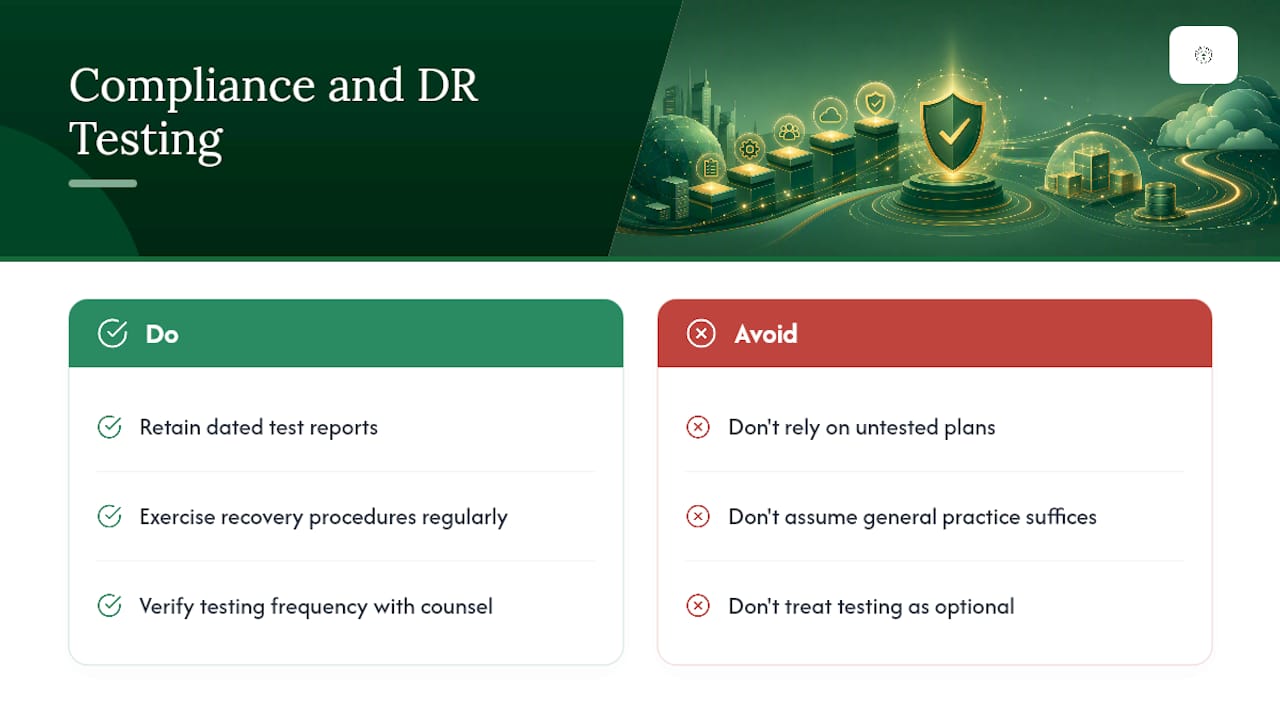
Do Compliance Rules Require Disaster Recovery Testing?
Several regulatory frameworks either require or strongly imply DR testing as part of an organization's obligations, and the specifics depend heavily on your industry and the data you handle. HIPAA's Security Rule requires covered entities and their business associates to have a contingency plan, and testing that plan is treated as an expected part of the administrative safeguards, evaluated during audits. Organizations pursuing CMMC certification for defense contracts face documented recovery capability requirements as part of the broader control set, with expectations that recovery procedures are exercised, not just written.
None of this makes DR testing itself a matter of criminal or civil liability in the way, say, failing to report a data breach might be. But an untested plan that fails during an actual incident can turn into a compliance finding, a failed audit, or grounds for a client or insurer to argue negligence, particularly in regulated fields like healthcare, legal services, and financial accounting where a documented but unverified recovery capability doesn't satisfy an auditor asking for evidence.
Retain your test reports specifically because of this. A dated report showing measured RTO, RPO, and remediation follow-through is what a regulator, a cyber insurance underwriter, or a client's own compliance team wants to see, not a policy document claiming testing happens. If your organization operates under a specific framework, verify testing frequency and documentation requirements with that framework's current guidance or legal counsel rather than relying on general industry practice.
Author Perspective: Why Testing Culture Matters More Than the Test Itself
The organizations that handle real disasters well aren't the ones with the most detailed runbook. They're the ones where testing is routine enough that nobody panics when a drill gets called. Small, frequent exercises build muscle memory. A single annual full-scale test, however well executed, doesn't.
I'd rather see a business run a scrappy quarterly tabletop than a flawless full interruption test once a year that nobody remembers by month three. Frequency beats spectacle. If your team has never practiced under pressure, the first real incident is a bad time to find that out.
If you're building this cadence and want a second set of eyes on it, Great Plains Networking is a reasonable place to start that conversation.
— Nicholas
Get Help Running Tests That Actually Prove Something
Running a real DR test program takes time most small business IT teams don't have between helpdesk tickets and daily operations. Managed IT support providers build testing into their offerings for small businesses, combining monitoring with backup verification, restore testing, and responsive support so a failed check gets fixed before it becomes a client-facing outage.
Beyond monitoring, the team helps plan test scope, define RTO and RPO targets appropriate to your budget, and run the tabletop and restore exercises that most small businesses never get around to scheduling on their own. That includes backup and recovery services built around plain-language documentation instead of jargon nobody on your staff can act on during an actual incident. If your last DR test was "we assume the backups work," talk to Great Plains Networking about managed IT support and get an actual test scheduled.
Sources
- What is a disaster recovery (DR) test? - TechTarget
- Testing disaster recovery - AWS Documentation
- Disaster recovery testing: how to run one that actually proves something - Obsium
FAQ
How Often Should You Run a Disaster Recovery Test?
Cadence should match system criticality: automated backup checks daily or weekly, selective restores monthly, periodic functional tests for Tier 1 applications, and periodic full failovers for mission-critical systems, per NIST SP 800-34's risk-tiered approach.
What's the Difference Between a Tabletop Test and a Full Interruption Test?
A tabletop test is a discussion-based walkthrough of the recovery plan with no systems touched, while a full interruption test actually fails production over to the recovery environment under real conditions.
What Should a Disaster Recovery Test Report Include?
At minimum: date, scope, objectives, measured RTO and RPO results, supporting evidence like logs and sign-offs, and action items with named owners and due dates for every gap identified.
Can Small Businesses Run Meaningful DR Tests Without a Dedicated Team?
Yes. A lightweight BIA, quarterly sandbox restores, and a rotating tabletop exercise cover most small business risk, and providers like Great Plains Networking can operationalize the process for teams without in-house continuity staff.
Is Disaster Recovery Testing Legally Required?
Requirements vary by industry. Frameworks like HIPAA and CMMC expect a tested contingency capability as part of their broader control requirements, so verify specific obligations with current framework guidance or legal counsel for your sector.
Recommended
Want help putting this into practice?
We'll audit your security, speed, and hardware in under an hour — no commitment, no sales pitch. Just a clear roadmap of what to fix and why.