
ABA Cybersecurity Guidance: What Attorneys Must Know

ABA cybersecurity guidance establishes the ethical and professional obligations attorneys carry to protect client data through competence, reasonable safeguards, and continuous adaptation to evolving threats. Rooted in the ABA Model Rules of Professional Conduct, this framework is not optional guidance. It is a codified professional duty.
The core ethical foundation rests on two rules:
- Model Rule 1.1, Comment 8 requires attorneys to maintain technological competence, including an understanding of cybersecurity risks relevant to their practice.
- Model Rule 1.6(c) mandates that lawyers make reasonable efforts to prevent unauthorized access to or disclosure of client confidential information.
- Formal Ethics Opinions 477R, 483, 495, and 512 translate these rules into specific, practical obligations covering electronic communications, breach response, remote practice, and AI use.
- The American Bar Association's Cybersecurity Legal Task Force produces handbooks, checklists, and resources that help firms of all sizes apply these obligations in practice.
Understanding ABA cybersecurity standards begins here. The sections below break down each component attorneys need to know.
What ABA Model Rules govern your cybersecurity obligations?
Several Model Rules work together to define a lawyer's cybersecurity duties, and none of them operate in isolation.
- Model Rule 1.1, Comment 8 ties technological competence directly to the broader duty of competent representation. Attorneys must keep current with the benefits and risks of technology relevant to their practice, including cybersecurity threats.
- Model Rule 1.6(c) is the confidentiality anchor. It requires reasonable efforts to prevent inadvertent or unauthorized disclosure of client information, whether stored on a server, transmitted by email, or accessed through a cloud platform.
- Model Rules 5.1, 5.2, and 5.3 extend cybersecurity duties beyond the individual attorney. Supervising lawyers must ensure that subordinate attorneys and nonlawyer staff follow cybersecurity policies. Supervision duties also apply to third-party technology vendors.
- Model Rule 1.4 requires clear client communication about security matters, including how the firm protects client data and what clients should expect if a breach occurs.
- Model Rule 1.15 extends the duty to safeguard property to electronic client files, requiring the same professional fiduciary care applied to physical documents.
Pro Tip: Review your firm's technology use against each of these rules annually. A gap in one area, such as vendor oversight under Rule 5.3, can create ethical exposure even when your own systems are secure.
How do ABA Formal Ethics Opinions shape cybersecurity practice?
The ABA Formal Ethics Opinions function as a living framework, translating broad Model Rule duties into specific guidance as technology evolves. Four opinions are central to understanding ABA cybersecurity requirements.
-
Formal Opinion 477R (2017) addresses securing electronic communications. It concludes that lawyers must analyze, on a case-by-case basis, how they communicate electronically about client matters. Unencrypted email is not always sufficient. Factors include the sensitivity of the information, likelihood of disclosure, cost of additional safeguards, and whether those safeguards would impair the attorney's ability to represent the client.
-
Formal Opinion 483 (2018) covers lawyer duties after a data breach. It establishes that attorneys must monitor systems for breaches and notify current clients when material confidential information is misappropriated, destroyed, or compromised. Critically, not every cyber incident triggers notification. A ransomware attack that locks files without exposing client data may not require client notice, but a breach involving actual or reasonably suspected access to material client information does.
-
Formal Opinion 495 (2020) addresses virtual and remote practice. It confirms that all existing ethical duties, including competence, confidentiality, and supervision, apply fully when attorneys work remotely. Firms must have clear virtual practice policies and ensure staff compliance.
-
Formal Opinion 512 (2024) tackles generative AI tools. It requires attorneys to understand how AI platforms handle client data, whether that data is used for training, and what confidentiality risks the technology introduces.
The ABA's archive of formal opinions continues to grow as new threats emerge, making it a resource attorneys should revisit regularly rather than treat as a static reference.
What does "reasonable efforts" actually require from your firm?
The reasonable efforts standard is not a checklist. It is a fact-specific, risk-based inquiry that scales to your firm's size, the sensitivity of client data you handle, and the realistic threat environment you operate in.
- Risk assessment first. Identify what data you hold, where it lives, who can access it, and what threats are most likely. This assessment drives every safeguard decision that follows.
- Proportional safeguards. A solo practitioner handling routine real estate closings faces different obligations than a firm managing active litigation with sensitive financial records. The standard adjusts accordingly.
- Documented decisions. Ethical compliance after a breach hinges on whether reasonable, documented effort was made beforehand. Undocumented decisions are difficult to defend.
- Continuous updating. The standard requires that safeguards be continually updated in response to new developments. A program built in 2020 and never reviewed does not meet the current standard.
- Competence through collaboration. Attorneys are not required to become IT experts. The ABA is clear that consulting qualified professionals satisfies the competence obligation when the attorney lacks the technical knowledge to assess risks independently.
How can your law firm build a defensible cybersecurity program?
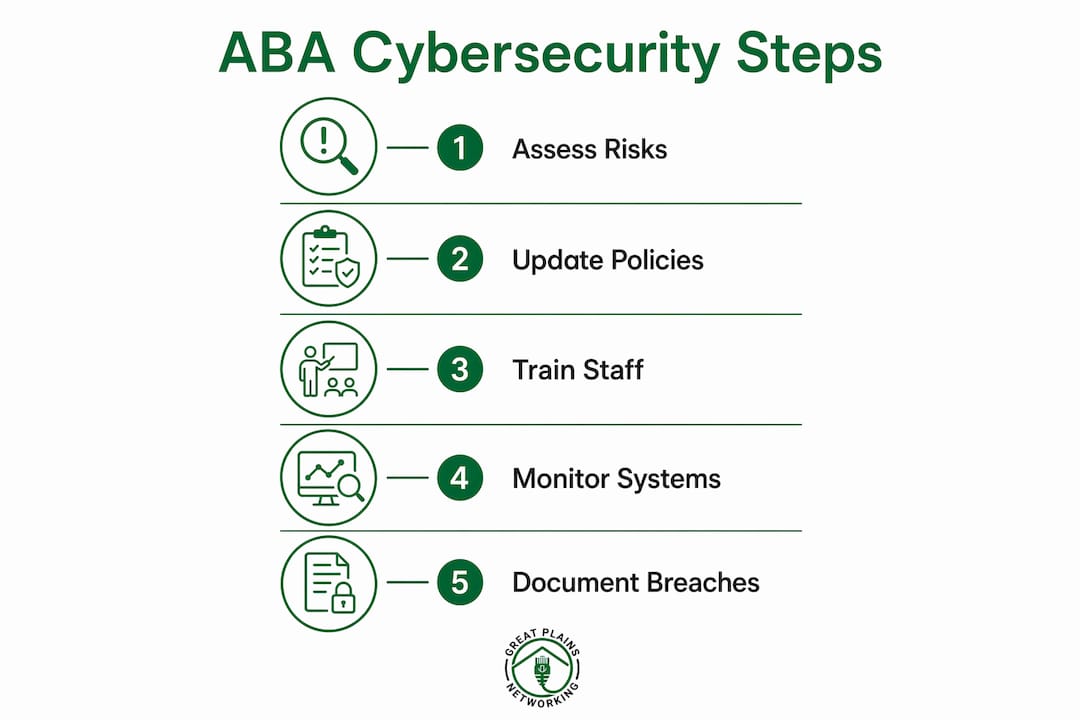
A defensible program covers five core functions: identify, protect, detect, respond, and recover. The ABA recommends basing your program on recognized frameworks such as those published by the National Institute of Standards and Technology (NIST) or the International Organization for Standardization (ISO), scaled to your firm's size and the sensitivity of client data you manage.
Practical steps that align with ABA cybersecurity compliance guidance include:
- Asset inventory and risk assessment before implementing any controls. You cannot protect what you have not identified.
- Written policies and procedures covering acceptable use, remote access, password management, and incident response. Policies that exist only in practice, not on paper, offer no ethical protection.
- Attorney and staff training conducted regularly, not just at onboarding. Formal Opinion 477R specifically calls for training lawyers and nonlawyer assistants on secure communication methods.
- Vendor due diligence under Model Rule 5.3. Inadequate vendor security does not absolve the supervising attorney. Contracts with technology providers should explicitly require confidentiality safeguards.
- Incident response planning before a breach occurs. Formal Opinion 483 makes clear that firms must have pre-planned response strategies, including knowing when client notification is required.
- Regular audits and updates to confirm that controls remain effective as threats evolve. A law firm cybersecurity audit conducted at least annually helps identify gaps before they become ethical violations.
- Cyber insurance as a component of the overall program, not a substitute for technical safeguards.
When documenting a breach for potential legal proceedings, the quality of your pre-breach documentation directly affects your exposure. Resources on documenting cyber incidents can help firms build that paper trail correctly.
Pro Tip: Document every risk assessment, policy update, and training session with dates and attendees. If a breach occurs, your ability to demonstrate reasonable prior effort is what determines whether an ethical violation has occurred.

Greatplainsnetworking provides cybersecurity services built specifically for small businesses and law firms in Norman, Moore, and Oklahoma City. From 24/7 monitoring to incident response planning, the team delivers practical protection without the jargon.

Key Takeaways
ABA cybersecurity guidance requires attorneys to maintain documented, risk-based safeguards under Model Rules 1.1 and 1.6, with Formal Opinions 477R, 483, 495, and 512 defining specific obligations across communications, breaches, remote work, and AI use.
| Point | Details |
|---|---|
| Ethical foundation | Model Rules 1.1 and 1.6 require competence and reasonable efforts to protect client confidential information. |
| Formal Opinions | Opinions 477R, 483, 495, and 512 provide specific guidance on communications, breach response, remote practice, and AI. |
| Reasonable efforts standard | The standard is risk-based and fact-specific, not a fixed checklist, and scales to firm size and data sensitivity. |
| Vendor responsibility | Model Rule 5.3 holds attorneys accountable for the cybersecurity practices of third-party technology vendors. |
| Documentation matters | Documented risk assessments and policies are the primary defense when an ethical review follows a breach. |
Recommended
Want help putting this into practice?
We'll audit your security, speed, and hardware in under an hour — no commitment, no sales pitch. Just a clear roadmap of what to fix and why.