
8 Steps to Reduce Manufacturing Network Downtime

Apply these 8 prioritized steps now to cut network-related manufacturing downtime by reducing exposure, improving visibility, and speeding recovery. The sequence matters: start with mapping and prioritization, then layer in monitoring, redundancy, and documented recovery procedures before moving to proactive maintenance and testing.
The 8-step checklist:
- Map production-critical technology dependencies
- Prioritize failure points by operational impact
- Deploy monitoring that alerts the floor before visible failures
- Build redundancy where downtime costs the most
- Establish clear ownership and escalation paths
- Document recovery procedures and runbooks
- Schedule proactive maintenance and predictive analytics
- Test and simulate failure scenarios regularly
Urgent 24-hour actions if production is at risk: isolate any suspect device from the OT network immediately, enable containment rules on your perimeter firewall or managed switch, and contact your on-call vendor or IT support with a documented description of the fault.
Downtime cost context: Industry analysis from the Uptime Institute documents that the costs and consequences of unplanned outages are worsening across sectors, with production environments facing the steepest financial exposure per hour of stoppage. Rockwell Automation's resilience whitepaper cites unplanned downtime as one of the heaviest cost drivers in manufacturing, recommending layered defenses and real-time change management to contain incidents before they reach the floor.
Key Takeaways
Reducing manufacturing network downtime requires mapping production-critical assets first, then layering in monitoring, redundancy, documented runbooks, and tested escalation paths in a sequenced 30/60/90-day plan.
| Point | Details |
|---|---|
| Map and prioritize first | Inventory critical assets using documentation and interviews before any remediation work begins. |
| Monitor with production-impact alerts | Target MTTD under 5 minutes and MTTR under 60 minutes for Tier 1 production-critical paths. |
| Build redundancy at the highest-cost failure points | Redundant network paths and UPS coverage for every production-critical device deliver the highest uptime return. |
| Runbooks and SLAs must be production-specific | Vendor SLAs need Tier 1 response windows of 15 minutes acknowledgment and 30 minutes active engagement, 24/7. |
| Greatplainsnetworking | Provides 24/7 monitoring, backup and recovery, and cybersecurity for small manufacturers in the Oklahoma City metro area. |
Table of Contents
- Why small network faults can stop your entire production line
- Common failure points on the manufacturing floor
- Step-by-step actions to reduce manufacturing network downtime
- Monitoring, KPIs, and the tools that matter for manufacturing networks
- OT-specific tradeoffs: segmentation, patching, and change management
- What you should expect from IT support and vendors in production environments
- A local perspective on applying this guidance
- Greatplainsnetworking supports your uptime goals with local managed IT
- Sources
Why small network faults can stop your entire production line
The answer is tight control loops. In operational technology (OT) environments, a Human-Machine Interface (HMI) communicates with a Programmable Logic Controller (PLC) on a cycle measured in milliseconds. When that communication path breaks, the PLC either faults to a safe state or continues running blind. Either outcome stops production.
Here is a concrete cascade: a single misconfigured VLAN change disconnects the HMI from the PLC on Line 3. The PLC loses its command stream and faults. The conveyor stops. Downstream assembly buffers empty within minutes. The line supervisor sees a red status light but no error message because the HMI is offline. The controls engineer is paged, but the root cause is an IT change made two hours earlier with no operations sign-off. Recovery takes 90 minutes, not because the fix is hard, but because nobody owns the bridge between IT change management and plant operations.
This is why IT-centric severity scoring fails on the plant floor. A "medium" severity switch failure that IT would schedule for next week's maintenance window is a production-stopping event if that switch carries PLC traffic. Operational-impact prioritization reframes every fault by asking one question first: does this affect a running production cell? That single reframe redirects budget and response time to what actually reduces costly stoppages, as Salas O'Brien's OT resilience guidance recommends.
Common failure points on the manufacturing floor
The following failure points account for the majority of network-related production stoppages. Each entry includes a one-line mitigation and the team that should own it.
- Single-path network links between IT and OT zones. A single unredundant fiber or copper run between the enterprise network and the plant floor is a single point of failure that can stop production for hours. Mitigation: add a redundant path or managed switch failover. Owner: IT/controls engineering.
- Aging PLC and HMI firmware. Unpatched firmware introduces both stability bugs and exploitable vulnerabilities. Mitigation: schedule firmware updates inside planned maintenance windows with a tested rollback image. Owner: controls engineering.
- Misconfigured or uncontrolled remote access. Vendor VPN sessions left open, shared credentials, and flat remote-access architectures allow both accidental misconfigurations and adversary lateral movement. Mitigation: enforce jump hosts, time-limited sessions, and role-based access. Owner: IT security.
- UPS and generator gaps. A power event that IT infrastructure survives can still drop a PLC or managed switch that lacks adequate UPS coverage. Mitigation: audit UPS coverage for every production-critical device; test generator transfer under load annually. Owner: facilities/IT.
- Unauthorized temporary connections. A technician's laptop plugged directly into the OT network for a one-time calibration task can introduce malware or disrupt network addressing. Mitigation: enforce a written connection authorization process with IT sign-off. Owner: operations/IT.
- Poorly controlled vendor access. Third-party maintenance vendors with standing remote credentials represent an unmonitored entry point. Mitigation: use time-limited, monitored vendor access accounts and revoke immediately after each session. Owner: IT security.
- Ineffective or absent network segmentation. A flat network where IT and OT traffic share the same broadcast domain means a ransomware infection or misconfiguration can propagate directly to PLCs. Mitigation: implement VLAN segmentation with a DMZ between IT and OT zones. Owner: IT/controls engineering.
Step-by-step actions to reduce manufacturing network downtime
Sequencing matters here. Steps 1 and 2 produce the map and priority list that every subsequent step depends on. Never begin patching or redundancy work without completing the inventory first.
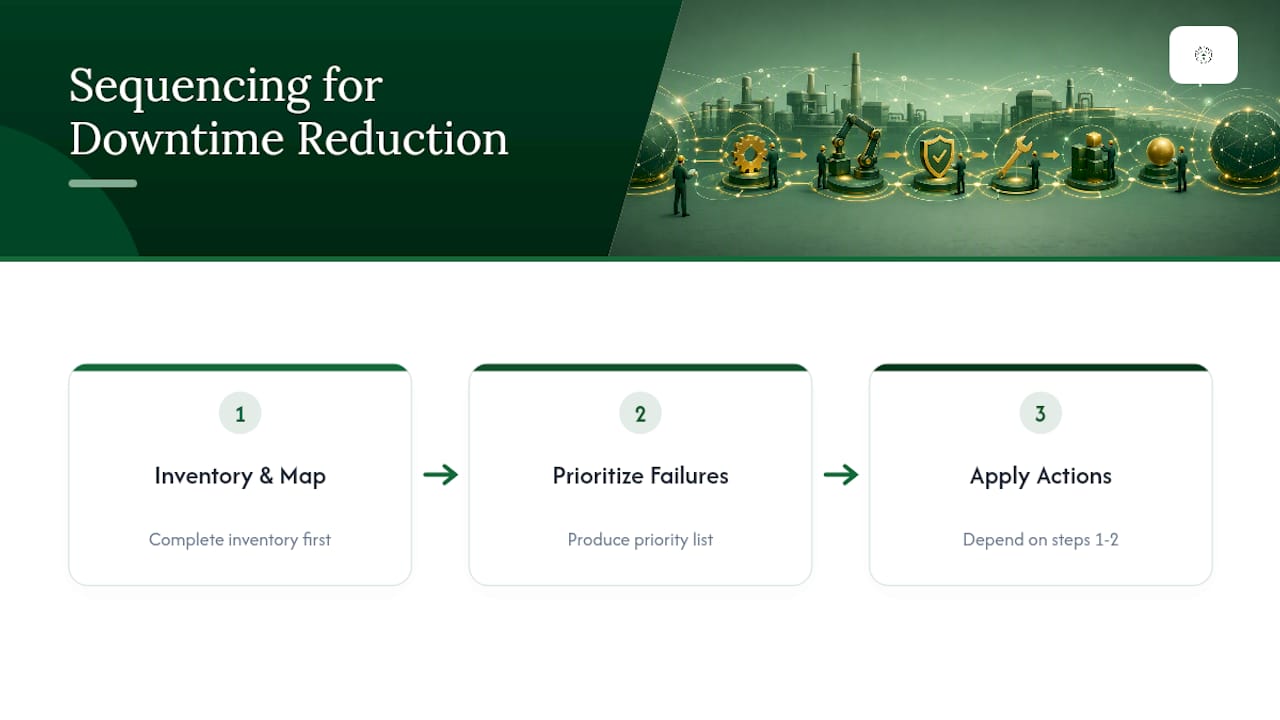
Step 1: Map production-critical technology dependencies
Owner: Controls engineering. Metric: Percentage of critical assets inventoried.
Start with existing drawings, configuration exports, and stakeholder interviews rather than active scanning. Active scanning tools can crash legacy PLCs. Salas O'Brien's OT resilience guide recommends building an architectural baseline from documentation and interviews, then keeping it current as the shop floor changes.
Step 2: Prioritize failure points by operational impact
Owner: Operations + IT jointly. Metric: Percentage of identified risks ranked by production-impact tier.
Rank every identified gap by its effect on running production, not by a generic IT severity score. The NIST/CISA IR 8183 implementation guidance recommends creating current and target Cybersecurity Framework profiles, performing a gap analysis, and prioritizing mitigation by mission impact.
Step 3: Deploy monitoring that reaches the floor before failures do
Owner: IT/managed services. Metric: Mean Time to Detect (MTTD) for production-critical alerts.
Passive network visibility tools and ICS-aware intrusion detection systems (IDS) can identify anomalous traffic patterns before a PLC faults. Alerts should reach the operations center and the floor supervisor simultaneously, not just the IT helpdesk.

Step 4: Build redundancy where downtime costs the most
Owner: IT + facilities. Metric: Number of single points of failure eliminated per quarter.
Redundant network paths, dual-homed managed switches, and UPS coverage for every production-critical device are the highest-return investments for manufacturing network uptime. NIST SP 800-82 Rev. 3 recommends redundant components for critical functions and graceful degradation architectures.

Step 5: Establish clear ownership and escalation paths
Owner: Operations manager + IT manager. Metric: Time from fault detection to correct team notification.
Every production-critical system needs a named owner, a backup owner, and a documented escalation path that reaches the right vendor within a defined window. Without named ownership, faults sit in a queue while production bleeds.
Step 6: Document recovery procedures and runbooks
Owner: IT + controls engineering. Metric: Percentage of critical failure scenarios with a tested runbook.
A runbook converts institutional knowledge into a repeatable procedure anyone on shift can execute. The table below is a starting template your team can copy and expand.
| Action | Owner | Expected Time | Rollback Condition |
|---|---|---|---|
| Isolate suspect device from OT network | IT on-call | 5 min | Revert VLAN assignment if isolation causes wider outage |
| Restore last known-good switch config | Controls engineer | 15 min | Roll back to previous config backup if line remains down |
| Verify PLC communication to HMI | Controls engineer | 10 min | Escalate to vendor if PLC remains faulted after comms restored |
| Confirm production restart with supervisor | Operations supervisor | 5 min | Do not restart until supervisor sign-off is documented |
CISA's federal incident response playbooks provide structured decision trees and role-based response steps that adapt well to manufacturing runbook design.
Step 7: Schedule proactive maintenance and predictive analytics
Owner: Controls engineering + IT. Metric: Mean Time Between Failures (MTBF) for planned assets.
Sequence firmware updates and configuration changes strictly inside planned maintenance windows. The most common mistake is applying IT patch cycles to OT systems without coordinating with operations, which turns a routine update into an unplanned outage. Predictive analytics tools that monitor switch port error rates, PLC CPU load, and UPS battery health can surface degradation weeks before a failure.
Step 8: Test and simulate failure scenarios regularly
Owner: IT + operations jointly. Metric: Number of tabletop or live failover tests completed per year.
CISA's Critical Manufacturing Sector resources include business continuity planning tools and recommend regular exercises to validate readiness. A tabletop exercise that walks through the runbook for a switch failure costs two hours and can reveal gaps that would otherwise surface during a real outage.
Monitoring, KPIs, and the tools that matter for manufacturing networks
The right metrics for manufacturing are not the same as the right metrics for a corporate IT environment. Prioritize MTTD, MTTR, availability percentage, and production-impact metrics over generic IT-only alert counts.
Key KPIs to track:
- MTTD (Mean Time to Detect): How long from fault occurrence to first alert. Target: under 5 minutes for production-critical paths.
- MTTR (Mean Time to Repair): How long from detection to restored operation. Target: under 60 minutes for Tier 1 production assets.
- Availability %: Uptime of production-critical network paths. Target: 99.9% or better for Tier 1 cells.
- % critical assets with active telemetry: What share of your inventoried critical assets are actively monitored. Target: 100% for Tier 1, 80%+ for Tier 2.
- MTBF (Mean Time Between Failures): Tracks reliability trends for planned assets over time.
| KPI | Tier 1 Target | Tier 2 Target | Review Cadence |
|---|---|---|---|
| MTTD | < 5 minutes | < 15 minutes | Weekly |
| MTTR | < 60 minutes | < 4 hours | Weekly |
| Availability % | 99.9% | 99.5% | Monthly |
| Assets with telemetry | 100% | 80% | Monthly |
Tool classes that fit manufacturing environments:
- Passive network visibility (e.g., Claroty, Dragos, Nozomi Networks): Monitors OT traffic without sending packets that can destabilize legacy PLCs. Fits the plant floor directly.
- ICS-aware IDS/NDR: Detects anomalous command sequences and unauthorized device connections in protocols like Modbus, EtherNet/IP, and PROFINET.
- Centralized logging/SIEM adapted to OT: Aggregates logs from firewalls, switches, and HMIs into a single pane. Splunk and Microsoft Sentinel both support OT log sources with appropriate parsers.
- Endpoint/agent telemetry: Where agents can be deployed on Windows-based HMIs, endpoint detection tools add process-level visibility that passive tools miss.
Pro Tip: Design alerts in tiers. Tier 1 alerts (PLC communication loss, firewall policy violation) should page the floor supervisor and IT on-call simultaneously. Tier 2 alerts (high switch port error rate, UPS battery below threshold) should create a ticket and notify IT during business hours. Noisy, undifferentiated alerts train operators to ignore them, which defeats the purpose of monitoring entirely.
For a deeper look at 24/7 network monitoring for manufacturers, the monitoring design principles above apply directly to what a managed service provider should be delivering on your behalf.
OT-specific tradeoffs: segmentation, patching, and change management
The recommended starting point is an operational-impact-driven decision framework, sometimes called SSVC (Stakeholder-Specific Vulnerability Categorization), that asks whether a vulnerability is exploitable in your environment and what the production consequence of exploitation would be before assigning a remediation timeline.
Segmentation and Zero Trust overlays:
IC3/CSA Zero Trust guidance for OT recommends treating segmentation as a dynamic, enforceable security policy rather than a one-time network design decision. Practical steps include:
- Implement VLAN segmentation with a DMZ between IT and OT zones.
- Deploy firewalls and jump hosts at the IT/OT boundary to control and log all cross-zone traffic.
- Use data diodes for unidirectional data flows where OT systems need to send telemetry to IT without allowing return traffic.
- Apply Zero Trust overlays to legacy OT protocols by wrapping them in authenticated tunnels where possible, reducing lateral movement risk without requiring immediate hardware replacement.
Safe OT patching practices:
Coordinate every patch with operations and schedule it inside a planned maintenance window. Test in a non-production environment when one exists. Where patching is too risky during a production run, deploy compensating controls (additional firewall rules, IDS signatures) and document the risk acceptance formally. Hot-spare architectures, where a pre-configured spare PLC or switch can be swapped in during a window, reduce the time pressure that leads to rushed, untested patches.
Management-of-change checklist:
- Obtain written sign-off from operations and controls engineering before any network configuration change.
- Take a full backup of affected device configurations before the change begins.
- Document the change, the expected impact, and the rollback plan in a change record.
- Execute the change during a scheduled maintenance window with operations present.
- Take a post-change backup and verify production communications before closing the window.
- Retain all change records for audit purposes.
IC3/CSA guidance is explicit: take full backups before and after configuration changes to support safe, auditable rollbacks.
Pro Tip: Build your architectural baseline from existing drawings, configuration exports, and stakeholder interviews before deploying any active scanning tool. Active scanners can send unexpected packets that crash legacy PLCs or trigger safety system responses. A documentation-first baseline is safer and often more complete than a scan-first approach, as Salas O'Brien's OT resilience research confirms.
For a practical walkthrough of applying the Cybersecurity Framework to manufacturing, the gap analysis and profiling steps map directly to the prioritization work in Steps 1 and 2 above.
What you should expect from IT support and vendors in production environments
SLAs written for corporate IT environments do not protect manufacturing operations. A four-hour response window is acceptable for a broken email client. It is not acceptable for a downed network link that stops a production cell.
SLA template fields for production environments:
- Priority tiers tied to production impact: Tier 1 = production stopped or safety risk; Tier 2 = production degraded; Tier 3 = no immediate production impact.
- Response time commitments: Tier 1 should require acknowledgment within 15 minutes and active remote engagement within 30 minutes, 24/7.
- Escalation times: Define when the vendor must escalate to senior engineering or dispatch on-site support.
- On-site vs. remote windows: Specify which actions the vendor may take remotely and which require on-site presence with operations sign-off.
- Scope of access: Document exactly which systems the vendor may access, under what conditions, and with what logging requirements.
- Handoff conditions: Define when the vendor hands off to the controls engineer or plant maintenance team and what documentation is required at handoff.
Escalation matrix example:
- Tier 1 event (production stopped): Operations supervisor notifies IT on-call immediately. IT on-call engages vendor within 15 minutes. If not resolved within 30 minutes, IT manager and plant manager are paged. Vendor dispatches on-site if remote resolution fails within 60 minutes.
- Tier 2 event (production degraded): IT on-call opens a ticket and notifies vendor. Vendor acknowledges within 30 minutes. Escalate to Tier 1 if degradation worsens or persists beyond two hours.
- Tier 3 event (no production impact): Standard ticket queue. Vendor responds within next business day.
Vendors should also be contractually responsible for maintaining hot spares for critical network hardware, coordinating backup verification with plant maintenance, and providing documented runbooks for the systems they manage. If your current vendor cannot describe their escalation path for a Tier 1 manufacturing event, that is a gap worth addressing before the next outage.
A local perspective on applying this guidance
Small and mid-sized manufacturers in the Oklahoma City metro area face the same OT/IT boundary challenges as larger plants, but with leaner IT teams and tighter budgets. The 8-step approach above is designed to be sequenced across a 30/60/90-day plan rather than executed all at once. The most immediate wins for most small manufacturers are Steps 1 and 2 (mapping and prioritization) and Step 5 (ownership and escalation), because those cost almost nothing to implement and immediately reduce the time it takes to respond when something breaks.
Greatplainsnetworking works directly with small manufacturers in Norman, Moore, and Oklahoma City on the services that execute this checklist: 24/7 monitoring, backup and recovery, and OT-aware patch coordination. The monitoring service is designed to surface Tier 1 alerts to both the IT contact and the plant floor simultaneously, which is the single most common gap we see in small manufacturing shops.
Greatplainsnetworking supports your uptime goals with local managed IT
Manufacturing uptime depends on having the right monitoring, recovery, and escalation capabilities in place before a fault occurs, not after. For small manufacturers in Norman, Moore, and Oklahoma City, Greatplainsnetworking delivers the managed IT support that turns this checklist into a running capability.
Specific services that map directly to the 8-step playbook include 24/7 network monitoring with production-impact alerting, backup and recovery with verified restore testing, and cybersecurity services built for OT-aware environments. There are no long-term contracts, and same-day response is standard for Tier 1 events. Contact Greatplainsnetworking today to schedule a network assessment and get a prioritized remediation roadmap for your facility.
Sources
- SP 800-82 Rev. 3, Guide to Operational Technology (OT) Security — NIST
- Adapting Zero Trust Principles to Operational Technology — IC3/CSA (public draft)
- From Chaos To Control — The Ultimate Cybersecurity Whitepaper for Resilient Operations — Rockwell Automation
- Critical Manufacturing Sector Cybersecurity Framework Implementation Guidance — NIST / CISA (IR 8183)
Recommended
Want help putting this into practice?
We'll audit your security, speed, and hardware in under an hour — no commitment, no sales pitch. Just a clear roadmap of what to fix and why.