
Manufacturing Cybersecurity Framework Explained for 2026

Manufacturing is the most targeted industry for ransomware globally, with 29% of all attacks hitting factories and production environments in Q1 2026 alone. Average breach costs have reached $8.7 million per incident. Yet many manufacturers still rely on standard IT security controls designed for office environments, leaving operational technology exposed to attacks that can halt production entirely. This article gives you a manufacturing cybersecurity framework explained in practical terms. You will learn what the leading frameworks are, how they differ, where most implementations fail, and what it actually takes to protect your production floor.
Table of Contents
- Key Takeaways
- The key frameworks for manufacturing cybersecurity
- Common implementation challenges in manufacturing OT
- Defensible architecture and operational strategies
- Regulatory compliance and certification requirements
- My perspective on where manufacturing cybersecurity is heading
- How Greatplainsnetworking supports your cybersecurity program
- FAQ
Key Takeaways
| Point | Details |
|---|---|
| IT security alone is insufficient | Manufacturing OT environments require dedicated frameworks beyond standard office IT security controls. |
| Three frameworks dominate | NIST CSF, IEC 62443, and CMMC each serve distinct but complementary roles in manufacturing security. |
| Silos create real exposure | Most manufacturers run IT and OT security separately, which opens paths for lateral threat movement. |
| Recovery readiness is now critical | Tested, immutable backups and documented recovery plans matter more than detection tools alone. |
| Compliance has business consequences | IEC 62443 and NIS2 compliance affects insurance eligibility, supply chain trust, and legal standing. |
The key frameworks for manufacturing cybersecurity
Understanding cybersecurity frameworks starts with knowing which ones apply to your environment. Three standards carry the most weight in manufacturing today.
NIST Cybersecurity Framework (CSF) 2.0 serves as the broadest governance layer. NIST CSF 2.0, released in 2024, organizes risk management around six functions: Govern, Identify, Protect, Detect, Respond, and Recover. It does not prescribe specific technical controls. Instead, it gives leadership a common language to assess risk posture, assign accountability, and set security priorities across the organization. Think of it as the management layer that ties everything together.
IEC 62443 goes several levels deeper and is specifically built for operational technology environments. It defines security levels (SL1 through SL4) based on threat sophistication, and it uses a zone and conduit model to segment networks into protected areas. For manufacturers operating in the European Union, IEC 62443 is effectively the technical compliance standard. 18 critical manufacturing sectors must meet EU NIS2 directive requirements, and IEC 62443 is the accepted path to demonstrating that compliance.
CMMC (Cybersecurity Maturity Model Certification) applies specifically to manufacturers in the U.S. defense supply chain. If your facility produces components for Department of Defense contracts, CMMC levels 1 through 3 define the minimum security practices required to maintain your contract eligibility. It draws heavily from NIST SP 800-171 and adds a third-party assessment requirement at higher levels.
Here is how the three frameworks compare at a glance:
| Framework | Primary Focus | Who It Applies To | Key Mechanism |
|---|---|---|---|
| NIST CSF 2.0 | Governance and risk management | Broad, all sectors | Six lifecycle functions |
| IEC 62443 | OT and ICS security | Industrial, critical infrastructure | Security levels, zone/conduit model |
| CMMC | Defense supply chain compliance | U.S. defense contractors | Maturity levels, third-party audits |
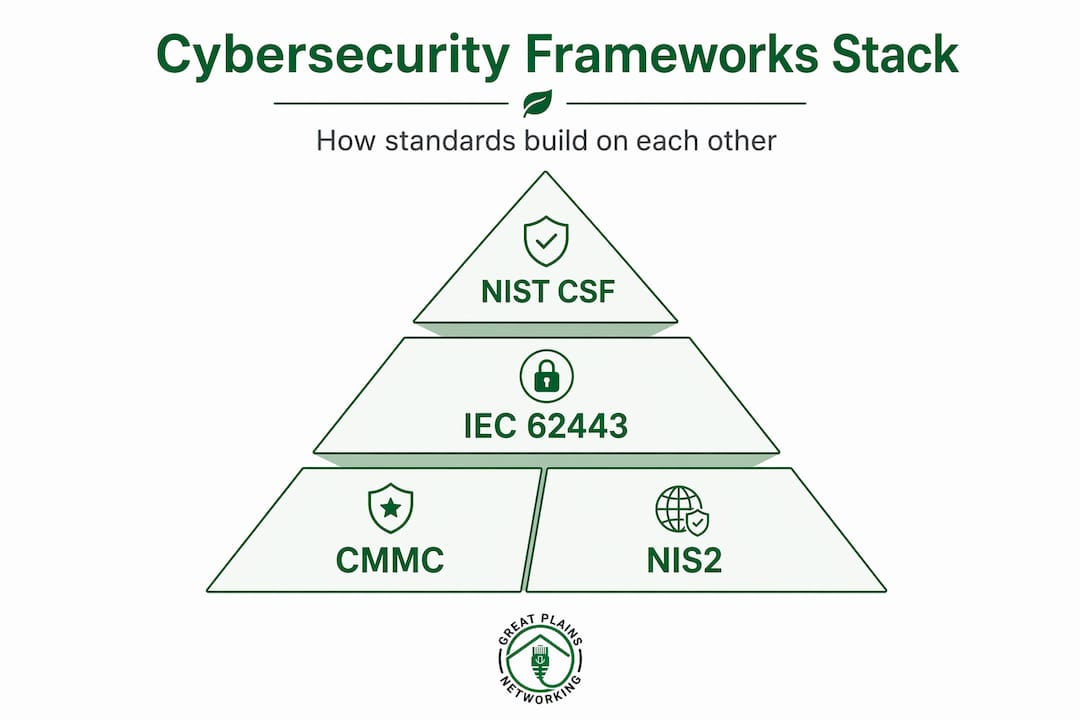
These frameworks are not competitors. They are designed to stack. NIST CSF provides governance direction. IEC 62443 delivers the technical OT architecture. CMMC certifies that the right practices are actually in place. Using only one while ignoring the others leaves gaps that attackers will find.
Common implementation challenges in manufacturing OT
Most manufacturers who attempt to apply these frameworks encounter the same set of obstacles. Knowing them in advance puts you in a much stronger position.
The most persistent problem is the IT/OT silo. 85 to 90% of manufacturing organizations still run IT and OT cybersecurity as separate programs. This creates flat or poorly segmented network architectures where a single compromised laptop can reach production controllers. A ransomware infection that starts in an email attachment can move laterally to a programmable logic controller within minutes if there is no enforced boundary between the office network and the plant floor.

The second challenge is remote access without proper controls. The most common breach vector is not a sophisticated zero-day exploit. It is stolen credentials used through a remote access gateway that lacks multi-factor authentication (MFA). Vendors, integrators, and remote employees regularly connect to OT systems with minimal verification. This is a solvable problem that most facilities have not solved.
A third challenge is the conflict between security controls and production uptime. Manufacturing environments operate on tight tolerances. You cannot patch a PLC during a production run. You cannot reboot a SCADA server without shutting down an entire line. Security teams used to IT environments often underestimate how disruptive standard controls can be on the plant floor.
Additional challenges manufacturers consistently face include:
- Lack of a documented asset inventory for OT devices, which makes risk assessment nearly impossible
- Absence of incident response plans tailored specifically to OT events
- Assuming that having asset visibility through a discovery tool means you are secure
- Using active network scanning tools designed for IT on fragile OT equipment, which can crash legacy PLCs
Pro Tip: Never deploy active scanning tools in OT environments without first consulting device manufacturers. Many industrial controllers will go offline or produce errors when hit with standard network scan traffic. Passive monitoring using switch-mirror-based traffic capture is the safe default.
Defensible architecture and operational strategies
Closing the gaps identified above requires specific architectural decisions and operational disciplines. Here is a practical sequence for how to implement cybersecurity in manufacturing that aligns with the frameworks.
-
Segment your network using the Purdue Model. IEC 62443 and the Purdue Model go hand in hand. Divide your environment into clearly defined zones: enterprise IT, demilitarized zone (DMZ), control network, and field devices. Flat networks allow a single compromised account to reach critical controllers, causing facility-wide outages. Enforced boundaries using firewalls and unidirectional gateways between each zone prevent this.
-
Enforce MFA on every remote access point. Every vendor, contractor, and remote employee connecting to your OT environment should authenticate through a managed jump server with MFA enforced. No exceptions. You can find additional guidance on network security setup that applies to this step directly.
-
Deploy passive OT monitoring tools. Passive, switch-mirror-based monitoring captures network traffic without sending any packets to your devices. Tools designed for ICS protocols (Modbus, DNP3, EtherNet/IP) can detect anomalies and unauthorized commands without touching your equipment. This is how you get visibility without risk.
-
Build and test recovery plans specific to OT. Immutable, offline backups of controller configurations, historian data, and SCADA projects are non-negotiable. Ransomware variants now specifically target backup systems to prevent recovery. Test your restoration process quarterly, not annually. Document the exact steps needed to restore each critical system.
-
Align IT, OT, and physical security under unified governance. The NIST CSF Govern function exists specifically for this reason. Assign a named owner for OT security who reports alongside the IT security function. Both teams need shared visibility into incidents, shared participation in tabletop exercises, and shared accountability for compliance outcomes.
Defensible architecture paired with tested recovery plans provides more real-world protection than any detection tool deployed on a flat network. The goal is survivability, not perfection.
For industrial cybersecurity strategies that translate these steps into operational programs, it helps to work with a partner who understands both the framework requirements and the realities of production environments.
Regulatory compliance and certification requirements
Understanding cybersecurity frameworks also means understanding the regulatory timeline you are operating under. For manufacturers in the EU, NIS2 is the primary driver. NIS2 mandates incident reporting within 24 hours of a significant disruption and 72 hours for a full initial report. Penalties for non-compliance reach €10 million or 2% of global turnover, whichever is higher.
IEC 62443 is the technical standard regulators and auditors point to when evaluating NIS2 compliance for industrial operators. Achieving even Security Level 2 (SL2), which addresses deliberate attacks using moderate resources, is a substantial program. Mid-sized manufacturers typically spend 12 to 24 months and between $500,000 and $1.5 million reaching that threshold.
In the U.S., NIST SP 800-82r3 provides federal guidance specifically for industrial control systems and serves as the technical reference for OT risk management in sectors outside the defense supply chain.
Here is a practical overview of the compliance landscape by region and framework:
| Regulation / Standard | Region | Timeline / Requirement | Linked Framework |
|---|---|---|---|
| EU NIS2 Directive | European Union | 24/72-hour incident reporting, active now | IEC 62443 |
| CMMC Level 2/3 | United States | Third-party assessment required for DoD contracts | NIST SP 800-171 |
| NIST SP 800-82r3 | United States | Federal ICS guidance, voluntary but referenced | NIST CSF |
| IEC 62443 SL2 | Global | 12 to 24 months to implement | Zone/conduit architecture |
Compliance with IEC 62443 and NIS2 is no longer just a legal concern. Cyber insurers now require documented OT security programs as a condition of coverage. Tier-1 OEMs and critical infrastructure operators increasingly require IEC 62443 attestation from suppliers as part of their vendor qualification process. Failing to meet these standards can directly affect your ability to win or retain contracts.
The practical steps to prepare for compliance audits include conducting a formal gap assessment against IEC 62443 or CMMC, documenting your current zone architecture, maintaining an updated OT asset inventory, and establishing a continuous improvement program rather than treating compliance as a one-time project.
My perspective on where manufacturing cybersecurity is heading
I have spent years watching organizations treat cybersecurity in manufacturing as a documentation exercise. Get the gap assessment done, write the policies, check the boxes. What I see consistently is that the facilities that actually survive ransomware incidents are not the ones with the most mature detection programs. They are the ones that knew exactly how to restore their systems and had practiced doing it.
The frameworks give you the structure, and that structure genuinely matters. But the gap I see most often is not in detection or visibility. It is in the space between an alert going off and someone actually knowing what to do with it in an OT environment. Most incident response plans are built for IT. They assume you can isolate a system, wipe it, and redeploy. You cannot do that with a PLC controlling a production line. The response playbook has to be different, and most organizations have not written that version yet.
What the manufacturing cybersecurity operational era is moving toward is a focus on resilience over theoretical readiness. That means tested backups, documented recovery procedures, and leadership that treats OT security as a production continuity issue, not just a compliance line item. When a plant manager understands that a flat network is a production risk, not just an IT risk, that is when security programs actually get resourced properly.
The cultural shift is the hardest part, and no framework handles it for you.
— Nicholas
How Greatplainsnetworking supports your cybersecurity program
Translating frameworks into working security programs takes more than reading a standard. Greatplainsnetworking works directly with manufacturers and industrial operators to close the gap between framework requirements and operational reality.

Greatplainsnetworking provides managed IT services that unify IT and OT security oversight, enforce MFA on remote access, and deploy monitoring solutions appropriate for production environments. The team supports compliance preparation for CMMC and IEC 62443 programs, maintains documented recovery plans, and tests backup restoration so you know exactly how long recovery will take before an incident ever forces the question. For manufacturers in Norman, Moore, and Oklahoma City looking to build a defensible, production-aligned security program, manufacturing IT support is available with no long-term contracts and same-day response times. Contact Greatplainsnetworking to schedule a consultation and find out where your current program stands against the frameworks that matter most.
FAQ
What is a manufacturing cybersecurity framework?
A manufacturing cybersecurity framework is a structured set of guidelines and controls designed to protect both IT and operational technology environments in production settings. The most widely used frameworks include NIST CSF, IEC 62443, and CMMC.
How is IEC 62443 different from NIST CSF?
NIST CSF provides governance and risk management structure for the whole organization, while IEC 62443 delivers specific technical controls for OT and industrial control systems. Most manufacturers need both working together.
How long does it take to implement IEC 62443?
Achieving IEC 62443 Security Level 2 compliance typically takes 12 to 24 months for a mid-sized manufacturing site, depending on the complexity of existing architecture and the scope of the asset inventory.
Does CMMC apply to all manufacturers?
CMMC applies specifically to manufacturers in the U.S. defense supply chain who handle federal contract information or controlled unclassified information. Manufacturers outside that supply chain are not directly required to certify under CMMC.
What is the biggest cybersecurity risk in manufacturing?
The most common breach vector is stolen credentials used through remote access gateways that lack MFA, not sophisticated exploits. Combined with flat network architectures, this creates direct paths to production controllers from compromised vendor accounts.
Recommended
Want help putting this into practice?
We'll audit your security, speed, and hardware in under an hour — no commitment, no sales pitch. Just a clear roadmap of what to fix and why.