
Oklahoma Data Breach Law Explained: 2026 Business Guide

Oklahoma data breach law is defined as the legal framework requiring any entity that owns or licenses computerized personal information of Oklahoma residents to notify those residents and, in significant cases, the state Attorney General when a security breach occurs. The formal name is the Oklahoma Security Breach Notification Act, and its 2026 amendments represent the most significant expansion since the law's original passage. As of january 1, 2026, the law covers broader categories of personal data, introduces mandatory Attorney General reporting for breaches affecting 500 or more residents, and sets civil penalties up to $150,000 per breach. For businesses in Norman, Moore, and Oklahoma City, understanding what is Oklahoma data breach law is no longer optional. It is a compliance requirement with real financial consequences.
What does Oklahoma data breach law protect in 2026?
Oklahoma data breach law protects "personal information," defined as a person's first name or initial combined with their last name, plus at least one sensitive identifier. The 2026 amendments expanded this definition significantly beyond the original law's scope.
The updated definition of personal information now includes:
- Social Security numbers, driver's license numbers, and state ID numbers
- Financial account numbers combined with access codes or passwords
- Medical and health insurance information
- Biometric identifiers such as fingerprints, retina scans, and voiceprints
- Unique electronic identifiers and routing codes
- Security codes and passwords that permit access to financial accounts
These expansions matter because many businesses collect biometric data for time tracking or access control without realizing it now triggers breach notification duties. A dental practice using fingerprint scanners, or a law firm using electronic signature platforms, now holds data that falls squarely under Oklahoma privacy regulations.
Pro Tip: Audit every data collection point in your business, including third-party apps and HR platforms, to identify whether you now hold newly protected categories under the 2026 law.

What are the notification requirements under Oklahoma data breach law?
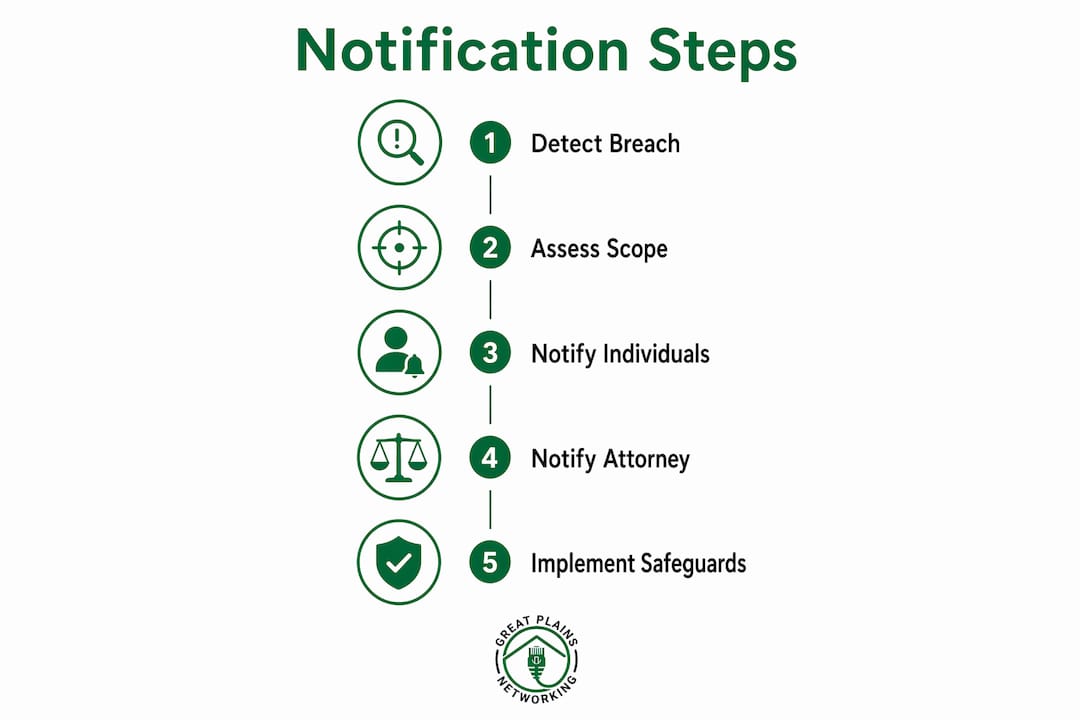
Notification timing and recipients are the most operationally demanding part of Oklahoma data breach notification requirements. The law requires notice to affected individuals "without unreasonable delay," which courts and regulators interpret as prompt action once a breach is confirmed.
The notification structure follows a tiered approach based on how many Oklahoma residents are affected:
- Individual notification: Required for all breaches involving personal information of Oklahoma residents, sent without unreasonable delay after the breach is confirmed.
- Attorney General notification: Required within 60 days of notifying affected individuals when a breach impacts 500 or more Oklahoma residents.
- Credit bureau notification: Required when a breach affects more than 1,000 Oklahoma residents, in addition to individual and Attorney General notices.
What the Attorney General notification must include
The Attorney General notification is not a simple form. It must contain specific details, and missing any of them creates compliance risk.
| Required Element | Description |
|---|---|
| Date breach was determined | The confirmed date your organization identified the breach |
| Nature of the breach | How the breach occurred and what systems were affected |
| Types of personal information involved | Which categories of protected data were exposed |
| Number of affected residents | Total count of Oklahoma residents impacted |
| Estimated monetary impact | Financial harm estimate to affected individuals |
| Reasonable safeguards employed | Documentation of security measures in place at the time |
Law enforcement considerations also apply. If a law enforcement agency determines that notification would impede a criminal investigation, the entity may delay individual notice. That delay ends when law enforcement confirms notification will no longer interfere.
Pro Tip: Assign a designated communication lead before a breach occurs. The Attorney General notification requires specific data points that take time to compile under pressure.
What are the penalties for non-compliance with Oklahoma data breach law?
Civil penalties under Oklahoma data breach law reach up to $150,000 per breach. That ceiling applies to entities that fail to implement reasonable safeguards and fail to provide required notice. The penalty structure creates a direct financial incentive for documented security investment.
The law provides an affirmative defense for entities that implement reasonable safeguards. An entity that can demonstrate it had appropriate security measures in place at the time of the breach can use that documentation to defend against civil penalties entirely. This defense is not automatic. It requires proof.
Entities that fail to implement reasonable safeguards but still provide required breach notice face a reduced penalty cap of $75,000 per breach. Those that neither implement safeguards nor provide notice face the full $150,000 ceiling. The difference between these outcomes is documented, layered security.
The penalty structure rewards preparation and punishes neglect. A business that invests in security documentation, employee training, and incident response planning stands in a fundamentally different legal position than one that treats data security as an afterthought.
How the penalty tiers compare
| Scenario | Maximum Civil Penalty |
|---|---|
| Reasonable safeguards implemented and documented | Affirmative defense available |
| No safeguards, but notice provided | $75,000 per breach |
| No safeguards and no notice provided | $150,000 per breach |
The Oklahoma Attorney General enforces these penalties. There is no private right of action under the current law, meaning individuals cannot sue directly. Enforcement runs through the state.
How should businesses manage compliance with Oklahoma data breach law?
Compliance with Oklahoma data protection laws requires a documented, ongoing security program. A one-time review does not satisfy the law's reasonable safeguards standard. The definition of reasonable safeguards includes policies and practices appropriate to the entity's size, data profile, and risk exposure.
Practical compliance steps include:
- Risk assessments: Conduct formal assessments at least annually to identify vulnerabilities in systems that hold personal information.
- Layered technical defenses: Deploy encryption, multi-factor authentication (MFA), and network segmentation as baseline controls.
- Employee training: Train staff on phishing recognition, data handling procedures, and breach reporting protocols.
- Incident response plans: Write, test, and update a plan that assigns roles and timelines for breach containment and notification.
- Vendor contract review: Assess third-party contracts for breach notification duties to confirm vendors share accountability for data they access.
The first 24 hours after a suspected breach are the most critical. The Oklahoma Bar Association guidance identifies four immediate actions: determine which systems are affected, isolate those systems, preserve forensic evidence, and designate a communication lead. These steps directly affect your ability to meet notification timelines and invoke the affirmative defense.
Pro Tip: Run a tabletop breach simulation with your team once a year. Practicing the response before a real incident reveals gaps in your plan that documentation alone will not catch.
Businesses in regulated industries face compounding obligations. A dental or medical practice must satisfy both Oklahoma breach notification requirements and federal HIPAA rules. An accounting firm handling tax records faces similar dual obligations. Dental and medical providers in the Oklahoma City metro area should map their compliance obligations across both frameworks to avoid gaps.
Key Takeaways
Oklahoma data breach law requires documented reasonable safeguards, tiered notification to individuals and the Attorney General, and carries civil penalties up to $150,000 per breach for non-compliant entities.
| Point | Details |
|---|---|
| Notification tiers matter | Breaches affecting 500+ residents require Attorney General notice within 60 days of individual notification. |
| 2026 expanded definitions | Biometric data, electronic identifiers, and account security codes are now protected personal information. |
| Reasonable safeguards = legal defense | Documented security programs provide an affirmative defense against civil penalties. |
| Penalty range is significant | Civil penalties range from $75,000 to $150,000 per breach depending on safeguard status. |
| Vendor accountability is required | Third-party contracts must assign breach notification duties to avoid compliance gaps. |
Oklahoma's data breach law is more demanding than most businesses realize
The shift to mandatory Attorney General reporting is the change I see businesses underestimate most. Before 2026, Oklahoma's breach law was largely reactive. You notified affected individuals and moved on. The new Attorney General notification requirement changes that dynamic entirely. Now the state has visibility into every significant breach, and that visibility creates accountability pressure that did not exist before.
The businesses I see struggle most are those that treat compliance as a legal checkbox rather than an operational discipline. They have a policy document somewhere, but no one has tested the incident response plan, no one has reviewed vendor contracts for notification duties, and no one has updated the data inventory since the 2026 amendments added biometric data to the protected categories. When a breach happens, they discover the gaps under the worst possible conditions.
The 2026 amendments align Oklahoma with a national trend toward stronger state-level enforcement. States that once had minimal breach laws are adding Attorney General reporting, expanding personal information definitions, and increasing penalties. Oklahoma is now in that group. Businesses that built mature data governance programs for other state laws are better positioned here. Those starting from scratch face real urgency.
My honest advice: do not wait for a breach to discover what your obligations are. The affirmative defense is only available to entities that can prove they had reasonable safeguards in place before the breach occurred. You cannot build that proof after the fact. For law firms in Oklahoma especially, where client confidentiality is foundational, the reputational cost of a breach far exceeds the civil penalty.
— Nicholas
How Greatplainsnetworking helps Oklahoma businesses stay compliant
Oklahoma's updated breach notification law puts real pressure on small businesses that lack dedicated IT and security staff. Greatplainsnetworking provides managed IT support built specifically for small businesses in Norman, Moore, and Oklahoma City, with 24/7 monitoring designed to catch threats before they become reportable breaches.
Greatplainsnetworking's cybersecurity services directly address the reasonable safeguards standard the law requires. That includes risk assessments, MFA deployment, employee training, and documented incident response planning. These are not add-ons. They are the core of what Greatplainsnetworking delivers to clients every day. If your business needs a clear picture of where it stands under Oklahoma's 2026 requirements, Greatplainsnetworking offers a focused SB 626 readiness audit to identify gaps and prioritize fixes.
FAQ
What is Oklahoma data breach law?
Oklahoma data breach law is the Oklahoma Security Breach Notification Act, which requires entities holding computerized personal information of Oklahoma residents to notify affected individuals and, for significant breaches, the state Attorney General.
When must businesses notify the Attorney General?
Businesses must notify the Attorney General within 60 days of notifying affected individuals when a breach impacts 500 or more Oklahoma residents.
What are the data breach penalties in Oklahoma?
Civil penalties reach up to $150,000 per breach for entities without reasonable safeguards. Entities that lack safeguards but provide notice face a reduced cap of $75,000 per breach.
Does Oklahoma data breach law cover biometric data?
Yes. The 2026 amendments added biometric identifiers, unique electronic identifiers, and account security codes to the definition of protected personal information.
What counts as a reasonable safeguard under Oklahoma law?
Reasonable safeguards include risk assessments, layered defenses, employee training, and documented incident response plans appropriate to the entity's size and data profile.
Recommended
Want help putting this into practice?
We'll audit your security, speed, and hardware in under an hour — no commitment, no sales pitch. Just a clear roadmap of what to fix and why.