
Why Manufacturers Need Reliable IT Networks in 2026

Reliable IT networks are production infrastructure. They protect throughput, safety, and revenue just as directly as any piece of plant equipment. If your network fails, your line stops, your quality data disappears, and your supply-chain partners lose visibility into your output. That is not a technology problem — it is a business problem.
TL;DR: The five reasons manufacturers need reliable IT networks
- Avoid unplanned downtime — downtime costs can be very high across enterprise sectors, and manufacturing sits near the top of that range.
- Deterministic latency for closed-loop control — jitter, not average latency, is the primary threat to control systems; even millisecond spikes can break a control loop.
- Secure IT/OT convergence — manufacturing is the most targeted sector for cyberattacks; segmentation and consistent policy are non-negotiable.
- IIoT and edge AI — 79% of newly installed manufacturing network nodes in 2026 use Industrial Ethernet, and AI workloads at the edge demand predictable, low-latency connectivity.
- Supply-chain visibility — MES and ERP synchronization depend on always-on connectivity; a dropped link means missed shipments and compliance gaps.
Standards like the NIST Cybersecurity Framework and ISA/IEC 62443 provide the architecture and security controls that turn these requirements into verifiable, auditable practice. Greatplainsnetworking helps manufacturers in Norman, Moore, and Oklahoma City apply exactly these controls without requiring an in-house network engineering team.
Table of Contents
- 1. How unreliable networks disrupt day-to-day manufacturing operations
- 2. Why network reliability is also a security and compliance control
- 3. The measurable business cost of unreliable networks
- 4. 2026 industry trends that change the network's role in manufacturing
- 5. How manufacturers design, deploy, and maintain reliable IT/OT networks
- Key Takeaways
- The case for treating your network like a production asset
- Greatplainsnetworking: managed network reliability for manufacturers in Oklahoma
- Useful sources and standards for deeper reading
1. How unreliable networks disrupt day-to-day manufacturing operations
Specific network failures translate directly into production hits — line stops, quality defects, and missed shipments. The mechanism is rarely dramatic; it is usually a slow accumulation of jitter, packet loss, or bandwidth saturation that nobody notices until a line goes down.
Production-line control and latency sensitivity
Closed-loop control systems — PLCs, SCADA, DCS — depend on deterministic timing. Jitter is a greater threat than average latency to these systems; a stable, low-jitter stream is more valuable than a lower average latency with occasional spikes. When a control-loop packet arrives 20 milliseconds late because a backup job saturated the uplink, the controller may fault, the line stops, and the root cause takes hours to trace. OT networks often require nanosecond response times to keep production running without interruption.
IIoT and edge device connectivity
IoT sensors, vision systems, and edge inference nodes generate continuous telemetry. A dropped connection to a vision camera means the quality-control frame is lost; a defective part moves downstream undetected. Telemetry delays also compress the predictive maintenance window — if a vibration sensor's data arrives 30 seconds late, the algorithm's alert may come after the bearing has already failed.
Supply-chain and MES/ERP synchronization
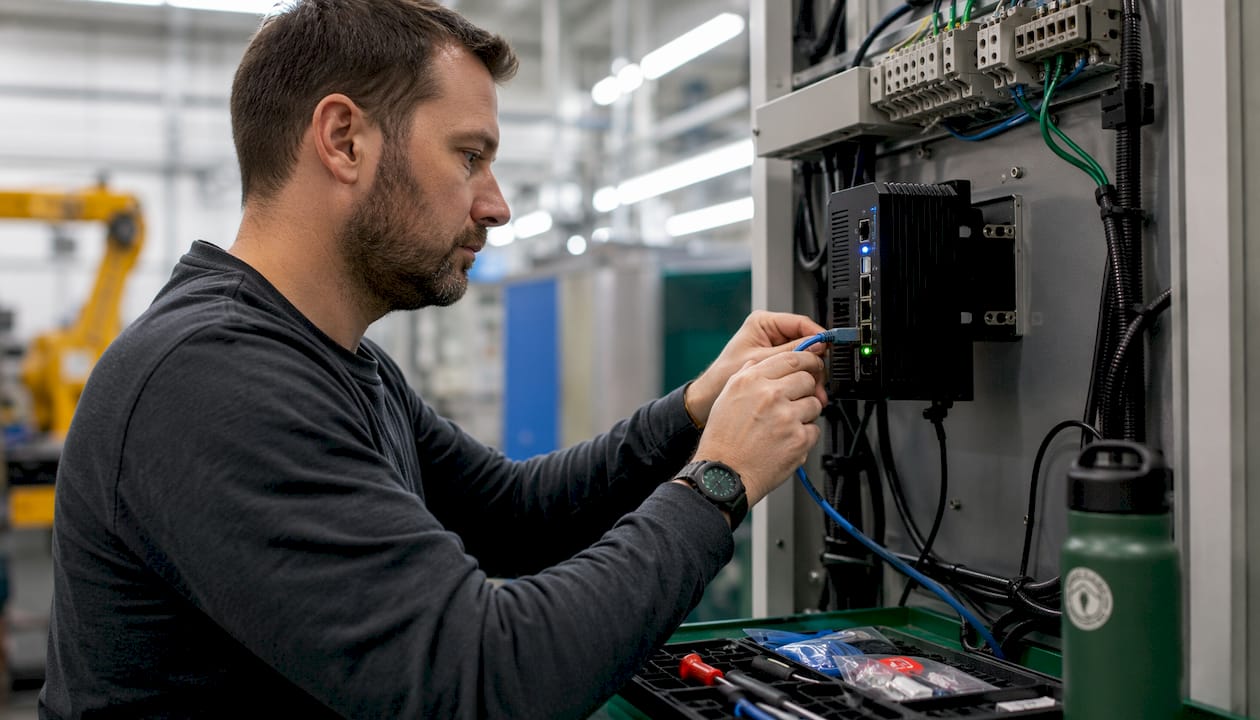
MES and ERP systems push production orders, pull inventory counts, and confirm shipments in near real time. When the network link between the plant floor and the ERP server drops, transactions queue, timestamps drift, and inventory records go stale. Supply-chain partners lose visibility, and the manufacturer may trigger contractual penalties for late or inaccurate shipment data. Automated data extraction workflows that depend on stable connectivity are equally vulnerable.
In-plant services: voice, video, and remote vendor access
Remote vendor access for equipment maintenance is now standard practice. When that VPN session drops mid-firmware update, the result can be a bricked controller. Video-based quality inspection, shift-change briefings over Teams or Zoom, and remote monitoring of satellite facilities all share the same network. Bandwidth saturation from one workload can degrade all the others simultaneously.
Proactive monitoring detects capacity limits, rising latency, and device issues early — before any of these failure modes reach the production floor.
2. Why network reliability is also a security and compliance control
A reliable network enforces segmentation and consistent security policy. Reliability and security are paired controls, not separate programs. A network that is poorly segmented or inconsistently monitored is simultaneously less reliable and less secure.
OT-specific cyber risks that exploit unreliable or poorly segmented networks:
- Unmanaged IIoT devices — sensors and edge nodes added without inventory or patching create persistent entry points.
- Remote vendor access without MFA — third-party technicians connecting over unsecured tunnels are a documented ransomware vector.
- Ransomware propagation from IT to OT — flat networks allow malware to move from a compromised office workstation to a PLC network in minutes.
- Legacy OT protocols over shared infrastructure — Modbus, PROFINET, and EtherNet/IP were not designed with authentication; exposing them on a shared VLAN creates interception risk.
Manufacturing is the most targeted sector for cyberattacks, with vulnerabilities in legacy systems and ransomware targeting OT cited as the top challenges. Connecting OT and IT without VLAN segmentation and traffic prioritization creates both security and performance bottlenecks; deep packet inspection (DPI) is often necessary to distinguish industrial protocols and troubleshoot timing issues.
Recommended controls that improve both reliability and security:
- VLAN segmentation separating IT, OT, and guest/vendor zones.
- QoS policies that prioritize control traffic over bulk data transfers.
- MFA for all remote access sessions, including vendor tunnels.
- DPI where industrial protocols (Modbus, PROFINET, OPC-UA) are present.
- Centralized policy management (SASE or equivalent) for consistent enforcement across sites.
Standards to validate against:
The NIST Cybersecurity Framework maps to five functions — Identify, Protect, Detect, Respond, Recover — each of which has a direct network-architecture counterpart. The ISA/IEC 62443 standard goes further, defining security levels for industrial control systems and specifying zone-and-conduit models that align with VLAN segmentation practice. Auditors and cyber-insurance underwriters increasingly ask for evidence of both.
Time-synchronized logging and continuous monitoring also produce the evidence trail needed for compliance audits and insurance claims. For a deeper look at protecting plant data, the manufacturing cybersecurity guide covers mitigations specific to industrial environments.
3. The measurable business cost of unreliable networks
Network failures carry measurable financial consequences that typically exceed the cost of the upgrade that would have prevented them. That is not a theoretical claim — it is arithmetic.
A simple downtime cost formula:
- Labor cost — hourly wages and benefits for every worker idled by the outage.
- Lost output value — units not produced multiplied by margin per unit.
- Supply-chain penalties — contractual late-delivery fees triggered by missed shipments.
- Expedited recovery costs — overtime, rush freight, emergency vendor calls.
- Quality and scrap costs — defects produced during the unstable period before the line stopped.
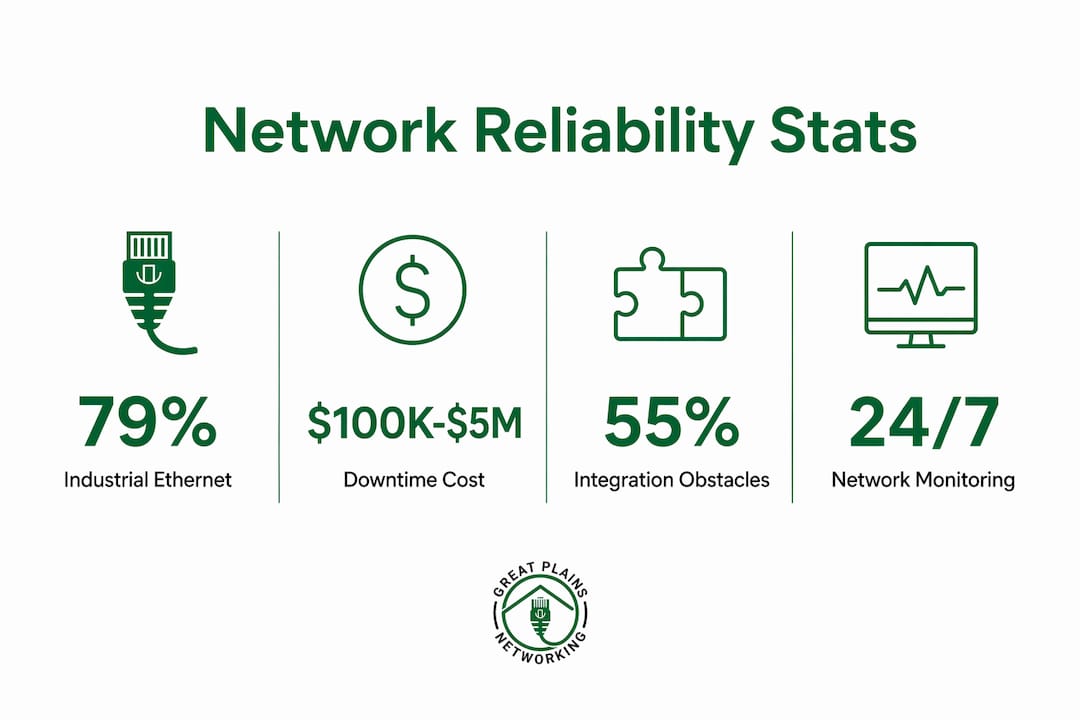
Add those five figures and you have a per-incident cost. Enterprise downtime costs range from $100,000 to over $5 million per hour across sectors, with manufacturing among the highest-cost categories. Even a single two-hour outage at the lower end of that range funds a significant network modernization project.
MTTR and OEE as the two key metrics:
Mean Time to Repair (MTTR) measures how long it takes to restore service after a failure. Every minute shaved off MTTR is a minute of production recovered. Overall Equipment Effectiveness (OEE) captures availability, performance, and quality in one number; network-induced stops show up directly in the availability component. Improving proactive monitoring and redundancy typically reduces MTTR and lifts OEE availability scores.
Practical exercise for decision-makers: Identify your top three production-critical network paths — the connections between your PLC network and your MES, your MES and your ERP, and your plant and your primary logistics partner. Map each path to its single points of failure. Price one four-hour outage on each path using the formula above. That total is your minimum justified investment in redundancy and monitoring for those paths. For business continuity planning tied to these paths, the IT disaster recovery guide for manufacturers provides a structured framework.
4. 2026 industry trends that change the network's role in manufacturing
The network now carries the most mission-critical workloads in a modern plant. Three converging trends in 2026 make that statement more consequential than it was even two years ago.
| Trend | 2026 Data Point | Implication for Decision-Makers |
|---|---|---|
| Industrial Ethernet dominance | 79% of new manufacturing network nodes use Industrial Ethernet | Fieldbus expertise is becoming a niche skill; Ethernet and TSN readiness are now baseline procurement criteria |
| IT/OT separation as a liability | 35% of manufacturers are actively increasing IT/OT collaboration to overcome growth obstacles | Siloed teams weaken both performance and security; shared visibility tools and joint governance are the fix |
| AI at the edge | Over 51% of manufacturers expect AI to improve network management across IT and OT | Edge inference requires predictable, low-latency connectivity; network instability directly blocks AI ROI |
The IT/OT separation problem is particularly acute in North America, where 55% of manufacturers cite integration obstacles as a major barrier to growth. Shared visibility and IT/OT collaboration are the recommended path forward for AI adoption and operational success.
Edge AI and hybrid cloud placements add another layer of complexity. AI workloads and edge inference require predictable networking and consistent security policy across edge, on-premises, and cloud environments simultaneously. Operational AI agents that make real-time decisions on the plant floor are only as reliable as the network they run on. Time-Sensitive Networking (TSN) extensions to Industrial Ethernet address the deterministic timing requirements that AI-driven control loops demand. The network is now a revenue-generating asset — instability translates directly to lost throughput and missed deadlines.
5. How manufacturers design, deploy, and maintain reliable IT/OT networks
A reliable manufacturing network combines sound architecture, continuous monitoring, and consistent operational practice. The following checklist is sequenced from quick wins to major projects so you can act this quarter while planning longer-term work.
Implementation checklist:
- Audit current architecture — document every network segment, device, and connection path; identify single points of failure and undocumented OT connections. Most production-floor outages trace to architectural decisions, not random hardware failures.
- Implement VLAN segmentation — separate IT, OT, vendor/guest, and management traffic into distinct zones with firewall-enforced boundaries. This is the single highest-impact quick win.
- Deploy QoS policies — tag and prioritize control-plane traffic so a backup job or video call cannot saturate the link a PLC depends on.
- Enable DPI on OT-adjacent segments — use application-aware inspection to identify industrial protocols, detect anomalies, and shorten troubleshooting cycles.
- Add redundant links on critical paths — treat redundancy as plant infrastructure, not an afterthought. Budget it during design, not remediation.
- Deploy 24/7 network monitoring — proactive monitoring detects capacity limits, rising latency, and device issues before they cause outages. This is the operational practice that converts architecture into uptime.
- Establish an incident response playbook — define who owns network incidents, what the escalation path is, and what the recovery SLA is for each production-critical path.
- Validate with a staged pilot — run the new architecture on a single production cell first, measure MTTR and OEE impact over 30–60 days, then expand.
- Schedule continuous testing — quarterly failover tests, annual architecture reviews, and ongoing penetration testing for OT segments.
Pro Tip: Before any plantwide rollout, pilot the new segmentation and monitoring stack on one production cell. Define your KPIs upfront — target MTTR, OEE availability score, and number of unplanned stops — and measure them for 30 days. A pilot that cannot show improvement on one cell will not show it across the plant.
Vendor questions to ask:
- What uptime SLA do you guarantee, and how is it measured?
- What is your mean time to respond (MTTR) for production-critical incidents?
- Do you support DPI for industrial protocols (Modbus, PROFINET, OPC-UA)?
- Can you demonstrate TSN-capable switch configurations?
- How do you integrate SASE or centralized security policy across OT and IT segments?
- Can you provide references from industrial or manufacturing deployments?
- How do your designs align with ISA/IEC 62443 zone-and-conduit models and the NIST Cybersecurity Framework?
For practical guidance on connecting industrial equipment safely to your business network, including segmentation and access control specifics, that resource covers the bridging steps in detail.
Prioritization and expected outcomes:
| Action | Priority | Expected Outcome |
|---|---|---|
| VLAN segmentation | Quick win | Reduced lateral movement risk; cleaner traffic isolation |
| QoS for control traffic | Quick win | Fewer control-loop faults from bandwidth contention |
| 24/7 monitoring deployment | Quick win | Earlier detection; lower MTTR |
| Redundant links on critical paths | Medium project | Eliminated single points of failure; higher availability |
| DPI on OT segments | Medium project | Faster root-cause analysis; protocol-level security |
| TSN-enabled switches | Major project | Deterministic latency for AI and precision control |
| Edge/cloud architecture redesign | Major project | Consistent policy across all environments; AI readiness |
For a broader view of manufacturing network management best practices, that guide covers monitoring operations and factory network governance in depth.
Key Takeaways
Reliable IT networks are production infrastructure — manufacturers that treat them as a utility rather than a strategic asset absorb preventable downtime costs, security incidents, and blocked AI initiatives.
| Point | Details |
|---|---|
| Downtime costs are quantifiable | Enterprise downtime ranges from $100,000 to over $5 million per hour; map your top three critical paths and price one four-hour outage on each. |
| Jitter beats average latency as the threat | Closed-loop control systems need deterministic timing; a stable low-jitter stream protects production more than a lower average latency with spikes. |
| Industrial Ethernet is now the baseline | 79% of new manufacturing network nodes in 2026 use Industrial Ethernet; TSN readiness and DPI support are now standard vendor requirements. |
| Segmentation is both a reliability and security control | VLAN segmentation, QoS, and DPI aligned with ISA/IEC 62443 and the NIST Cybersecurity Framework reduce attack surface and improve traffic determinism simultaneously. |
| Greatplainsnetworking offers a local managed path | Greatplainsnetworking provides 24/7 monitoring, same-day response, and no long-term contracts for manufacturers in Norman, Moore, and Oklahoma City seeking a verified managed-service partner. |
The case for treating your network like a production asset
The most common mistake manufacturing leaders make is funding network upgrades reactively — after the outage, after the ransomware incident, after the AI pilot fails because the edge node keeps dropping its connection. By that point, the cost of the failure has already exceeded what the upgrade would have cost.
What the 2026 data makes clear is that the network is no longer background infrastructure. It carries control traffic, AI inference, quality telemetry, supply-chain transactions, and security policy simultaneously. When IT and OT teams operate in isolation, both performance and security suffer — the Cisco State of Industrial AI Report puts the IT/OT collaboration gap at the center of the growth obstacle for North American manufacturers. That is not a technology gap; it is an organizational one, and it requires a governance decision, not just a hardware purchase.
The standards exist to guide that decision. NIST and ISA/IEC 62443 give you a verifiable architecture to present to auditors, insurers, and customers. The checklist in this article gives you a sequenced path from quick wins to major projects. The only remaining variable is whether you treat the network as plant infrastructure in your capital planning — or wait for the next outage to make the case for you.
Greatplainsnetworking: managed network reliability for manufacturers in Oklahoma
Manufacturers in Norman, Moore, and Oklahoma City that need a verified managed-service partner — without the overhead of building an in-house network engineering team — have a direct option in Greatplainsnetworking.

Greatplainsnetworking's managed IT support is built around the exact problems this article covers: 24/7 network monitoring that detects latency and saturation before they reach the production floor, same-day response for production-critical incidents, and cybersecurity services that apply VLAN segmentation and access controls aligned with NIST and ISA/IEC 62443. There are no long-term contracts, so you can start with a network reliability assessment or a single-cell pilot and expand based on documented results. If you want to quantify your current downtime exposure and map your critical network paths before committing to a full project, request a network reliability assessment from Greatplainsnetworking and get a clear picture of where your production risk actually lives.
Useful sources and standards for deeper reading
The following resources were used in this article and are worth consulting directly for technical teams and procurement leads.
- Enterprise Connectivity Downtime Benchmarks by Industry 2026 — Cross-industry downtime cost benchmarks with per-hour figures by sector; use this to build your internal ROI case and justify network investment to finance leadership.
- HMS Networks: Industrial Ethernet 79% (The Volt Post) — 2026 data on Industrial Ethernet adoption rates; relevant for procurement teams evaluating switch and protocol compatibility.
- Cisco State of Industrial Networking in Manufacturing 2024 — Survey data on IT/OT collaboration gaps, cybersecurity investment, and AI adoption in manufacturing; useful for benchmarking your organization's maturity.
- Cisco State of Industrial AI Report 2026 — Manufacturing — Covers IT/OT separation as a barrier to AI scale and recommends shared visibility tools; essential reading for teams planning edge AI deployments.
- NETSCOUT: Modern Manufacturing Network Observability — Explains why DPI and application-aware observability are necessary for production-critical networks; useful for teams evaluating monitoring tools.
- NETSCOUT: Keeping Manufacturing Facilities Humming — Covers OT latency requirements, MTTR reduction, and the business case for packet-level monitoring in manufacturing environments.
- GTT: 10 Things Every Manufacturer Should Know About Real-Time Networks in 2026 — Covers deterministic latency, jitter, TSN, and managed-service models; practical reference for vendor evaluation and architecture decisions.
- PC Tech Magazine: Uptime Isn't Luck — Explains how most production-floor outages trace to architectural decisions rather than random failures; useful framing for capital planning conversations.
- Netlogic: How Network Monitoring Prevents Manufacturing Downtime — Practical overview of proactive monitoring techniques and how they shift maintenance from reactive to preventive.
- NIST Cybersecurity Framework (csrc.nist.gov) — The five-function framework (Identify, Protect, Detect, Respond, Recover) that maps directly to network architecture decisions; the baseline reference for compliance and insurance documentation.
- ISA/IEC 62443 — The industrial control systems security standard that defines zone-and-conduit models, security levels, and lifecycle requirements; the technical reference for OT network segmentation and vendor qualification.
Recommended
Want help putting this into practice?
We'll audit your security, speed, and hardware in under an hour — no commitment, no sales pitch. Just a clear roadmap of what to fix and why.