
Why Manufacturers Need IT Disaster Recovery in 2026

IT disaster recovery is defined as the coordinated process of restoring critical technology systems after a cyberattack, hardware failure, or other disruptive event. For manufacturers, this process is not optional. Manufacturing accounted for 62% of all industrial ransomware victims in Q1 2026, making it the most targeted sector in the industrial economy. The financial stakes are equally severe. Mid-sized manufacturers lose between $25,000 and $100,000 per hour of unplanned downtime. Understanding why manufacturers need IT disaster recovery starts with recognizing that production floors, supply chains, and customer commitments all depend on systems that can fail without warning.
What are the biggest IT risks that make disaster recovery essential for manufacturers?
Manufacturing faces a threat profile unlike any other industry. Production environments combine traditional IT networks with operational technology (OT), the control systems and sensors that run physical equipment. When either layer fails, the entire plant can stop.
Ransomware is the dominant threat. Ransomware represents 90% of total financial losses in manufacturing cyber insurance claims, despite accounting for only 12% of claim frequency. That gap reveals a hard truth: ransomware attacks are rare, but when they hit, the damage is catastrophic.
The risks manufacturers face fall into several distinct categories:
- Ransomware and targeted cyberattacks. Attackers specifically target manufacturers because production pressure creates urgency to pay ransoms quickly.
- Legacy OT system vulnerabilities. Legacy OT systems that cannot be patched without stopping production create persistent security gaps that attackers exploit.
- IT and OT interdependencies. A compromised IT network can cascade into OT systems, halting production lines that have no manual fallback.
- Unplanned downtime from non-cyber events. Power failures, hardware faults, and software corruption all trigger the same recovery challenge as a cyberattack.
The interconnected nature of modern manufacturing amplifies every risk. An ERP system that manages orders feeds data to a Manufacturing Execution System (MES) that schedules production runs. If either system goes down in the wrong sequence, recovery becomes exponentially harder. Manufacturers without a tested IT disaster recovery plan discover this the worst possible way.
How does an effective IT disaster recovery plan for manufacturing work?

A manufacturing IT disaster recovery plan is not a generic backup policy. It is a documented, tested framework that defines exactly which systems get restored first, who makes each decision, and how long each step should take.
The structure of an effective plan follows a clear sequence:
- Identify and prioritize critical systems. ERP, MES, and OT control systems sit at the top of every recovery sequence. Administrative systems like email and HR platforms can wait.
- Assign recovery time objectives (RTOs) per system. Production lines require RTOs measured in minutes, while back-office systems can tolerate hours or even days of downtime.
- Define the correct restoration sequence. Restoring ERP before MES can extend downtime significantly. The recovery playbook must specify the exact order based on system dependencies.
- Build a cross-functional recovery team. IT staff alone cannot restore a manufacturing environment. Production managers, OT engineers, and department leads all need defined roles in the recovery process.
- Test the plan under realistic conditions. A plan that has never been tested is a hypothesis, not a recovery strategy. Quarterly test restores validate backup integrity and expose gaps before a real disaster does.
The RTO concept deserves special attention. Most manufacturers set a single recovery target for all systems, which is a mistake. A CNC machine controller and a payroll system do not carry equal urgency. Assigning specific RTOs forces the organization to think clearly about what actually stops production versus what causes inconvenience.
Pro Tip: Run a tabletop exercise with your production manager, IT lead, and OT engineer at least once per year. Walk through a ransomware scenario step by step. The gaps you find in a conference room are far cheaper to fix than the gaps you find during an actual outage.
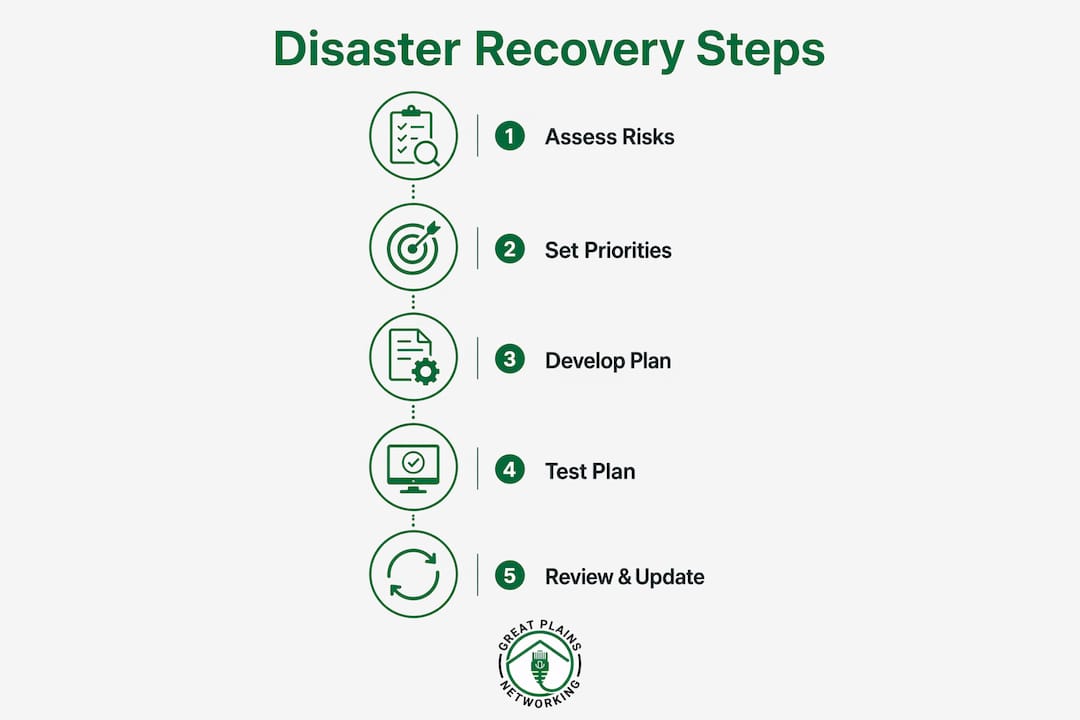
Manufacturers should also treat disaster recovery as enterprise infrastructure, not a side project owned by IT alone. When leadership treats the plan as a living document, it gets updated as systems change and threats evolve.
What are the operational and financial benefits of disaster recovery planning?
The benefits of disaster recovery planning extend well beyond avoiding a single bad day. A tested recovery plan changes how a manufacturer operates every day, not just during a crisis.
The most direct benefit is financial. At $25,000 to $100,000 per hour of downtime, even a two-hour reduction in recovery time saves a mid-sized manufacturer between $50,000 and $200,000 per incident. That figure alone justifies the cost of a well-built plan.
The operational benefits are equally significant:
- Supply chain continuity. Customers and suppliers depend on your production schedule. A fast recovery protects those relationships and prevents contract penalties.
- Compliance and quality control. Regulated manufacturers in sectors like aerospace, food processing, and medical devices must maintain documented records. A recovery plan preserves audit trails and quality data.
- Brand reputation protection. A manufacturer that recovers in hours rather than days signals reliability to customers. One that goes dark for a week signals fragility.
- Reduced cyber insurance premiums. Insurers increasingly require documented, tested recovery plans as a condition of coverage. A verified plan can lower premiums and improve coverage terms.
Manufacturing business continuity also depends on protecting the OT layer specifically. Production equipment, SCADA systems, and industrial controllers hold configuration data that takes days to rebuild manually if no backup exists. A recovery plan that covers OT system segmentation and isolated backups prevents a single compromised workstation from cascading into a full plant shutdown.
What common pitfalls should manufacturers avoid in IT disaster recovery?
Most manufacturers who struggle with recovery do not fail because they lacked technology. They fail because they made predictable, avoidable mistakes in how they planned and tested their approach.
The most common pitfalls include:
- Treating backups as a complete recovery plan. Backups alone do not constitute a disaster recovery plan. Recovery requires coordinated restoration of interdependent systems in the correct sequence, not just retrieving files from storage.
- Skipping realistic testing. Failure to test backups realistically often means discovering corrupted or incomplete data only when a real disaster strikes. By then, the damage compounds every hour.
- Ignoring legacy OT vulnerabilities. Older control systems that cannot accept patches without a production shutdown accumulate risk over time. Without network segmentation and isolated backups, one compromised legacy device can take down an entire line.
- No clear recovery playbook for interdependent systems. When IT and OT teams operate from separate, uncoordinated plans, they restore systems in the wrong order and create new failures in the process.
The legacy OT problem deserves direct attention. Many manufacturers run control systems that are 10 to 20 years old. Vendors no longer support these systems with security patches. Shutting them down to apply updates disrupts production, so the patches never happen. The result is a known vulnerability that sits inside the network indefinitely. A recovery plan must account for these systems with specific controls, not assume they will behave like modern IT infrastructure.
Pro Tip: Map every OT device in your facility and note its patch status and network connections. Any device that cannot be patched should sit on an isolated network segment with its own backup. This single step prevents the most common cascade failure pattern in manufacturing cyberattacks.
How manufacturers can recover from IT disasters also depends on documentation quality. If the recovery playbook lives in one person's head, and that person is unavailable during the incident, recovery stalls. Every step, every system dependency, and every contact number must be written down and stored somewhere accessible offline.
Key Takeaways
Manufacturers who invest in tested IT disaster recovery plans recover faster, lose less money, and protect their production commitments far more effectively than those who rely on backups alone.
| Point | Details |
|---|---|
| Manufacturing is the top ransomware target | 62% of industrial ransomware victims in Q1 2026 came from manufacturing, making recovery planning urgent. |
| Downtime costs are severe | Mid-sized manufacturers lose $25,000–$100,000 per hour of unplanned downtime, justifying recovery investment. |
| RTOs must be system-specific | Production lines need recovery in minutes; assigning one RTO to all systems delays the most critical restoration. |
| Backups are not a recovery plan | Coordinated, sequenced restoration of ERP, MES, and OT systems is required, not just data retrieval. |
| Testing is non-negotiable | Quarterly test restores validate backup integrity and expose gaps before a real disaster forces the discovery. |
What I've learned about disaster recovery that most manufacturers get wrong
After working with manufacturers on IT resilience, one pattern stands out above all others. Most operations leaders believe their backup system is their disaster recovery plan. It is not. A backup is raw material. A recovery plan is the construction process that turns that raw material into a running factory.
The manufacturers who recover fastest share one trait: they have practiced. Not theoretically, not in a slide deck, but in a room with the people who will actually make decisions during an outage. They know which system comes back first, who authorizes each step, and what happens when a system does not restore cleanly. That clarity is the product of deliberate preparation, not technology alone.
The emerging risk I watch most closely is the convergence of IT and OT networks. As manufacturers connect production equipment to cloud platforms and enterprise software, the attack surface grows. A vulnerability in a cloud-connected sensor can now reach systems that were once physically isolated. Recovery plans written three years ago almost certainly do not account for this. If yours has not been reviewed since your last major technology change, it needs a revision now.
Treating IT disaster recovery as a one-time project is the most expensive mistake a manufacturer can make. The plan needs to evolve with the business. Every new system, every new vendor connection, and every new cyber threat changes the recovery equation. The manufacturers who build that review cycle into their operations calendar are the ones who stay resilient.
— Nicholas
Managed IT support built for manufacturing environments
Greatplainsnetworking works with manufacturers in Norman, Moore, and Oklahoma City who need more than a backup drive and a hope. The team provides managed IT support that includes 24/7 monitoring, documented recovery planning, and tested restoration procedures built around the specific systems manufacturers depend on.
Greatplainsnetworking understands the difference between an ERP outage and a full OT shutdown, and builds recovery sequences that reflect that difference. For manufacturers who want a clear, verified plan without the technical complexity, the backup and recovery services at Greatplainsnetworking deliver exactly that. No long-term contracts, no jargon, and same-day response when it matters most. Reach out to learn what a manufacturing-specific recovery plan looks like in practice.
FAQ
Why do manufacturers need IT disaster recovery plans?
Manufacturers need IT disaster recovery plans because production downtime costs between $25,000 and $100,000 per hour, and manufacturing is the most targeted sector for ransomware attacks. A tested plan restores critical systems quickly and limits financial and operational damage.
What is the difference between a backup and a disaster recovery plan?
A backup stores copies of data, while a disaster recovery plan defines the full process for restoring interdependent IT and OT systems in the correct sequence. Backups alone cannot restart a production line if systems are restored out of order.
How often should manufacturers test their IT disaster recovery plan?
Manufacturers should conduct test restores quarterly to verify backup integrity and confirm that recovery procedures work under realistic conditions. Testing annually or less frequently leaves too much time for undetected failures to accumulate.
What systems should manufacturers prioritize in disaster recovery?
ERP and MES systems, along with OT control systems, carry the highest recovery priority because they directly drive production. Administrative systems like email and HR platforms can tolerate longer recovery windows without stopping output.
How does ransomware specifically threaten manufacturing operations?
Ransomware accounts for 90% of total financial losses in manufacturing cyber insurance claims despite being a relatively infrequent event. Attackers target manufacturers because production pressure creates urgency to pay ransoms fast, making a tested ransomware protection strategy a core part of any recovery plan.
Recommended
Want help putting this into practice?
We'll audit your security, speed, and hardware in under an hour — no commitment, no sales pitch. Just a clear roadmap of what to fix and why.