
How to Protect Manufacturing Data from Cyberattacks

Manufacturing faces a uniquely dangerous cybersecurity challenge. Unlike standard IT environments, factory floors run industrial control systems (ICS) and SCADA networks where a breach can halt production lines, damage equipment, or endanger workers. Protecting manufacturing data from cyberattacks requires a layered approach built around the specific demands of operational technology (OT). Here are the core strategies every manufacturing organization should act on now:
- Separate IT and OT networks using DMZ architectures and unidirectional gateways to prevent direct traffic between corporate and plant-floor systems
- Strengthen identity security with multi-factor authentication (MFA) and role-based access controls (RBAC) tailored to OT environments
- Patch ICS and OT devices on a tested, scheduled basis to close known vulnerabilities before attackers exploit them
- Prioritize vulnerabilities by risk, focusing remediation on threats to safety, integrity, and availability rather than treating every finding equally
- Build resilience into daily operations through incident response drills, air-gapped backups, employee training, and network segmentation
- Adopt the NIST CSF 2.0 Manufacturing Profile as a voluntary, risk-based roadmap structured around six core functions: Govern, Identify, Protect, Detect, Respond, and Recover
- Extend security requirements to your supply chain, demanding that vendors and product manufacturers meet defined security standards before connecting to your environment
Each of these strategies is explained in depth below, with practical guidance drawn from NIST, CISA, and real-world OT security frameworks.
How IT and OT collaboration protects your plant floor without creating new risks
IT and OT teams have historically operated in separate worlds, and that separation has created dangerous blind spots. When neither team has full visibility into the other's environment, attackers can move laterally from a compromised corporate laptop into a programmable logic controller (PLC) without triggering a single alert. Closing that gap requires deliberate collaboration, but it cannot come at the cost of OT reliability.
The NIST SP 800-82 Rev. 3 guide to OT security recommends using a demilitarized zone (DMZ) network architecture with firewalls to prevent direct traffic between corporate IT and OT networks. Unidirectional gateways go a step further, physically enforcing one-way data flow so that no external command can reach the OT side. These controls let IT and OT teams share threat intelligence and monitoring data without exposing production systems to corporate network risks.
Practical steps for coordinated IT/OT security:
- Establish a joint cybersecurity team that includes IT staff, control engineers, OT operators, and a physical security representative
- Use separate authentication credentials for corporate and OT network access
- Restrict remote access to OT systems through MFA-protected jump servers or bastion hosts
- Conduct joint tabletop exercises so both teams understand each other's incident response procedures
- Document all approved data flows between IT and OT zones, and audit them regularly
CISA's Secure by Demand guidance also recommends that OT operators push responsibility for security outcomes back to product manufacturers, rather than absorbing the full mitigation burden themselves. When purchasing new OT equipment, ask vendors directly how they protect operational data at rest and in transit.
Why identity security is your first line of defense in manufacturing
Credentials are the most common entry point for attackers in manufacturing environments. A compromised maintenance account with broad OT access can give an attacker the ability to modify PLC logic, disable safety systems, or exfiltrate engineering data without triggering obvious alarms. Tightening identity controls is one of the highest-return investments a manufacturing organization can make.

MFA for remote access to OT systems is a baseline requirement, not an optional upgrade. The challenge in manufacturing is deploying MFA in ways that do not slow down operators on the floor. Hardware tokens, smart cards, and proximity-based authentication all work in OT contexts where typing a code on a touchscreen is impractical. Role-based access controls (RBAC) should limit each user to only the systems and data their job requires, following the least-privilege principle.
Key identity security practices for manufacturing:
- Assign unique credentials to every user and service account; eliminate shared logins
- Apply MFA to all remote access sessions and privileged accounts
- Implement RBAC so operators, engineers, and administrators each have scoped permissions
- Monitor and log all user activity on OT systems, and review audit trails regularly
- Revoke access immediately when employees change roles or leave the organization
- Conduct periodic access reviews to catch privilege creep before it becomes a liability
Physical access control belongs in this conversation too. NIST SP 800-82 notes that unauthorized physical access to OT components can seriously disrupt manufacturing operations. Card readers, locks, and security guards at control room entrances are cybersecurity controls, not just physical ones.
Patch management for ICS and OT: how to update without stopping production
Unpatched software is one of the most exploited vulnerabilities in manufacturing. Ransomware groups specifically target ICS environments running outdated firmware because legacy OT devices often go years without updates. The operational reality is that patching a running production system carries risk, but leaving it unpatched carries more.

The NIST OT security framework recommends deploying security patches as quickly as possible after testing them under field conditions on a representative test system before applying them to live production. That testing step is non-negotiable in OT environments where a bad patch can take a line offline. Schedule patches during planned maintenance windows, and coordinate with control system vendors to confirm compatibility before deployment.
Patch management best practices for manufacturing:
- Maintain a complete inventory of all OT devices, firmware versions, and software versions
- Subscribe to vendor security advisories and CISA's Industrial Control Systems advisories for timely patch notifications
- Test every patch on a staging environment that mirrors production conditions before rollout
- Disable unused ports and services on OT devices after testing to confirm no operational impact
- Document every patch applied, including date, version, and the technician who performed it
- For legacy devices that cannot be patched, apply compensating controls such as network isolation and enhanced monitoring
Application allowlisting, behavior anomaly detection (BAD), and file integrity monitoring are technical controls that can partially compensate for devices that cannot be updated on a standard schedule. They deter unauthorized software execution and detect changes to ICS configurations before damage spreads.
How to prioritize vulnerabilities when everything feels urgent
Manufacturing environments generate more vulnerabilities than any team can remediate simultaneously. A risk-based approach cuts through that noise by focusing effort on the threats most likely to cause safety incidents, production outages, or data integrity failures.
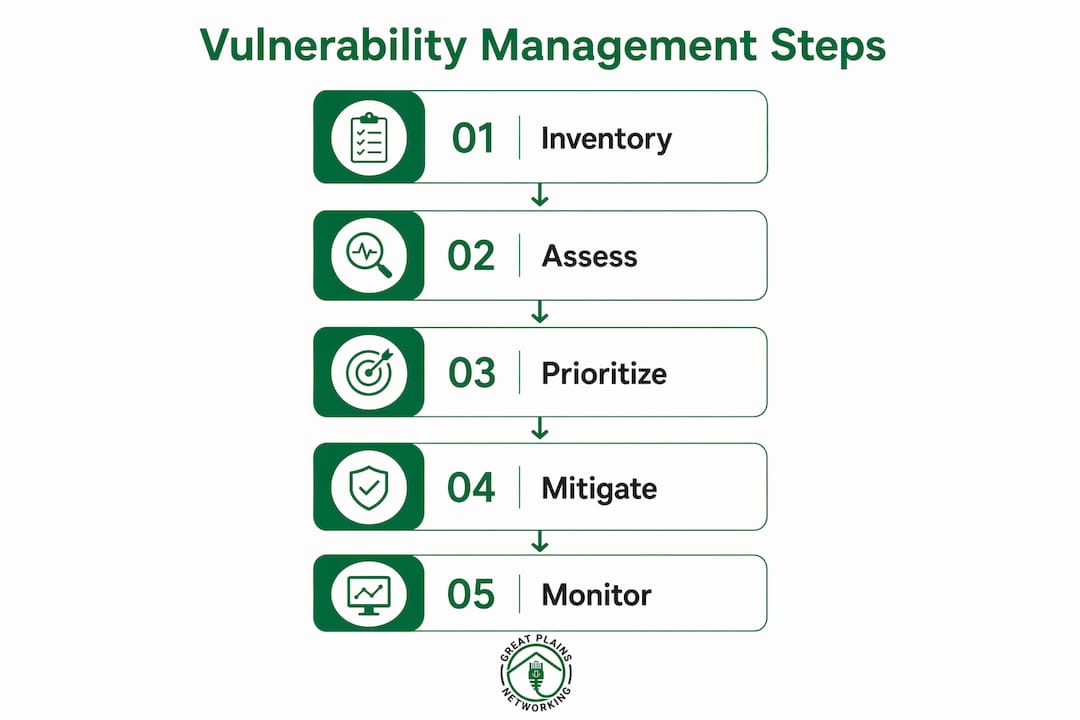
Pro Tip: Start every vulnerability management cycle with a verified asset inventory. You cannot protect what you have not identified. Shadow IT and rogue devices connected to OT networks are among the most common sources of undetected exposure in manufacturing.
NIST guidance on asset inventory confirms that maintaining a comprehensive and accurate inventory is foundational because protecting unidentified assets is simply not possible. That inventory should include every PLC, human-machine interface (HMI), historian, and network device on the plant floor, along with ownership, firmware version, and network connectivity.
Vulnerability prioritization steps for manufacturing:
- Score vulnerabilities based on their potential impact on safety, production availability, and data integrity, not just CVSS scores alone
- Identify which assets are internet-facing or connected to corporate IT networks, as these carry the highest exposure
- Use continuous vulnerability scanning tools compatible with OT protocols to avoid disrupting sensitive devices
- Track rogue or unauthorized devices through network monitoring and asset tracking tools that flag new connections automatically
- Prioritize patching or isolating vulnerabilities in systems that control physical processes, where a compromise could cause equipment damage or worker injury
Manufacturing cybersecurity prioritizes integrity and availability over confidentiality, with safety as the overarching concern. That is a deliberate departure from traditional IT security, where confidentiality typically ranks first. Keeping production running safely is the mission, and vulnerability management decisions should reflect that.
Building cyber resilience directly into manufacturing operations
Resilience means your operations can absorb a cyberattack and recover without catastrophic loss. That does not happen by accident. It requires deliberate planning, practiced procedures, and technical controls layered across the entire environment.
| Resilience Measure | Threat It Addresses | Implementation Notes |
|---|---|---|
| Network segmentation (DMZ, unidirectional gateways) | Lateral movement from IT to OT | Enforce at the network boundary; audit quarterly |
| Air-gapped and offline backups | Ransomware, data destruction | Test restoration integrity on a scheduled basis |
| Incident response plan with OT-specific procedures | All attack types | Document hard-restart procedures for each critical system |
| Employee cybersecurity training | Phishing, insider threats | Tailor content to manufacturing roles, not generic IT scenarios |
| Behavior anomaly detection | Unauthorized software, malware | Deploy on HMIs, historians, and engineering workstations |
An effective incident response program for manufacturing must go beyond a written plan. It should include regular drills that simulate communication failures and attack scenarios, validating that backup systems actually work and that operators know what to do when a PLC goes dark. Plans should document hard-restart procedures for every critical system, not just general recovery guidance.
Operational resilience practices to implement now:
- Conduct tabletop exercises and live drills at least twice per year, involving both IT and OT personnel
- Store backups offline or air-gapped, with strict access controls and periodic integrity validation
- Segment OT networks into zones based on criticality, applying defense-in-depth between each layer
- Train manufacturing staff on phishing recognition, safe USB practices, and how to report anomalies
- Review and update the incident response plan after every drill and every real incident
For manufacturers in Oklahoma City, Norman, and Moore, Greatplainsnetworking provides IT disaster recovery planning that accounts for the specific demands of OT environments.
How the NIST CSF 2.0 Manufacturing Profile guides your cybersecurity program
The NIST Cybersecurity Framework 2.0 Manufacturing Profile is the most authoritative sector-specific cybersecurity roadmap available to manufacturers in 2026. It provides a voluntary, risk-based approach structured around six core functions, each mapped to manufacturing-specific outcomes and impact levels.
The six functions and what they mean in practice:
- Govern: Establish cybersecurity policies, roles, and risk tolerance levels specific to your manufacturing environment
- Identify: Inventory all assets, data flows, and risks, including supply chain dependencies and insider threats
- Protect: Implement access controls, employee training, data protection, and platform security consistent with your risk strategy
- Detect: Deploy continuous monitoring, behavior anomaly detection, and audit logging to catch incidents early
- Respond: Execute documented incident response procedures, coordinate with IT and OT teams, and communicate with stakeholders
- Recover: Restore systems using tested backup and recovery procedures, and incorporate lessons learned into future planning
The profile is structured across three impact levels: Low, Moderate, and High, allowing manufacturers to calibrate their controls to the criticality of each system. A conveyor control system and a safety instrumented system do not carry the same risk, and the framework acknowledges that. Greatplainsnetworking helps manufacturing clients in the Oklahoma City metro apply this cybersecurity framework to their specific environments, translating NIST guidance into practical, prioritized action plans.
Supply chain cybersecurity: the risk that enters through your vendors
Your cybersecurity program is only as strong as the weakest link in your supply chain. Third-party vendors, equipment manufacturers, and software providers all represent potential entry points into your OT environment. Attackers increasingly target smaller suppliers to reach larger manufacturers, making supply chain security a front-line concern rather than an afterthought.
CISA's Secure by Demand guidance places the responsibility for security outcomes on both buyers and sellers. When procuring new OT products, manufacturing organizations should ask vendors specific questions: Does the product encrypt data at rest and in transit? Can the vendor explain how they protect copies of your operational data? Does the product require operator approval before establishing external connections?
OT data is particularly sensitive because it describes the engineering logic of your systems. As CISA notes, an attacker who understands your operational data can craft targeted attacks that go well beyond simple denial of service, potentially bypassing safety checks entirely. Buyers should favor products that push data out of the OT network rather than pulling it in from outside, keeping control on the operator's side.
Practical supply chain security steps:
- Require vendors to provide documented security practices and vulnerability disclosure policies before contract award
- Include cybersecurity requirements in all OT procurement contracts, specifying encryption, authentication, and patch support expectations
- Assess third-party remote access carefully; require MFA and time-limited sessions for all vendor connections
- Review the CISA Critical Manufacturing Sector Security Guide for supply chain security practices specific to your sector
- Audit vendor access logs regularly and revoke credentials when a vendor relationship ends
Is your manufacturing operation ready for Greatplainsnetworking?

Safeguarding manufacturing data from cyberattacks takes more than a firewall and a password policy. It takes a partner who understands both the technical complexity of OT environments and the operational realities of keeping a plant running. Greatplainsnetworking delivers proactive managed cybersecurity for manufacturing businesses in Norman, Moore, and Oklahoma City, including 24/7 monitoring, incident response support, and backup and recovery planning built around your specific systems. No long-term contracts, no jargon, and no waiting days for a response when something goes wrong.
Key Takeaways
Protecting manufacturing data from cyberattacks requires layered controls across IT/OT separation, identity security, patch management, risk-based vulnerability prioritization, and embedded operational resilience.
| Point | Details |
|---|---|
| IT/OT separation is foundational | Use DMZ architectures and unidirectional gateways to prevent direct traffic between corporate and plant-floor networks. |
| Asset inventory enables all other controls | You cannot protect unidentified assets; a verified inventory of every OT device is the starting point for threat detection. |
| NIST CSF 2.0 Manufacturing Profile | This voluntary framework structures manufacturing cybersecurity around six functions: Govern, Identify, Protect, Detect, Respond, and Recover. |
| Patch OT devices on a tested schedule | Test every patch under field conditions before deployment to avoid disrupting production while closing known vulnerabilities. |
| Supply chain is an active attack surface | Require vendors to document security practices and encrypt OT data at rest and in transit before granting network access. |
Recommended
Want help putting this into practice?
We'll audit your security, speed, and hardware in under an hour — no commitment, no sales pitch. Just a clear roadmap of what to fix and why.