
How to Prevent Supply Chain Cyber Vulnerabilities in 2026

What does it actually take to secure your supply chain?
Preventing supply chain cyber vulnerabilities requires a layered, proactive approach: identify your critical suppliers, assess each one's risk exposure, enforce documented security policies grounded in NIST standards, and build a culture where cybersecurity is a leadership priority, not an afterthought. The Cybersecurity and Infrastructure Security Agency (CISA) recommends a focused three-step foundation: supplier identification, risk impact assessment, and contingency planning. From there, the work becomes continuous.
Here is what that looks like in practice:
- Map your critical suppliers. Identify every vendor with access to your hardware, software, or cloud services. Prioritize them by the impact their disruption would have on your operations.
- Assess risk from each supplier. Evaluate financial stability, cybersecurity posture, and reputational risk. Schedule recurring reassessments, not just one-time reviews.
- Establish written security policies. Base them on NIST Cybersecurity Framework 2.0 and CISA guidance. Policies without documentation are not enforceable.
- Require contractual security obligations. Add clauses that specify incident notification timelines and minimum security standards for every vendor.
- Commit leadership to cybersecurity culture. Executives who treat supply chain security as an IT-only issue leave the organization exposed. Leadership must model and fund the effort.
- Implement continuous monitoring. Real-time tools that flag supplier vulnerabilities, patch gaps, or unusual access patterns catch threats before they escalate.
- Encrypt data across the supply chain. Data in transit between your systems and vendors should always be encrypted, with access limited to what each party genuinely needs.
- Train your people. Supply chain personnel need regular, role-specific training on phishing, unauthorized software, and incident reporting procedures.
- Build an incident response plan. A supply chain breach needs its own playbook, separate from a general IT incident plan, with pre-identified alternative suppliers and clear activation criteria.
How to identify and assess supply chain cyber risks step by step
Knowing where your vulnerabilities live starts with knowing who has access to your systems. You cannot protect what you have not mapped.
- Build and maintain a supplier inventory. List every third party that touches your data, systems, or physical premises. Include cloud providers, software vendors, contractors, and managed service providers.
- Categorize by criticality and access level. A vendor with direct access to your customer database carries far more risk than one who ships office supplies. Prioritize suppliers based on the business functions they support.
- Run formal, recurring risk assessments. Evaluate cyber risk alongside financial and reputational exposure. A supplier's financial instability can be just as dangerous as a software vulnerability.
- Establish patch and vulnerability notification processes. Know how you will receive timely updates when a supplier's product has a known flaw. Waiting for news coverage is too late.
- Focus your deepest scrutiny on critical-function suppliers. Not every vendor needs the same level of review. Concentrate your resources where a compromise would hurt most.
- Develop a vendor attestation process. Require suppliers to document their security practices at onboarding and at regular intervals thereafter. Self-attestation backed by audit rights carries more weight than a verbal assurance.
- Map your digital supply chain beyond direct vendors. Free software, open-source tools, and mobile apps your employees use are part of your attack surface. A complete picture includes all of them.
Pro Tip: Involve procurement, IT, and leadership together in risk assessments. Each function sees different risks. Procurement knows contract leverage points; IT knows technical exposure; leadership knows which business functions are truly mission-critical.
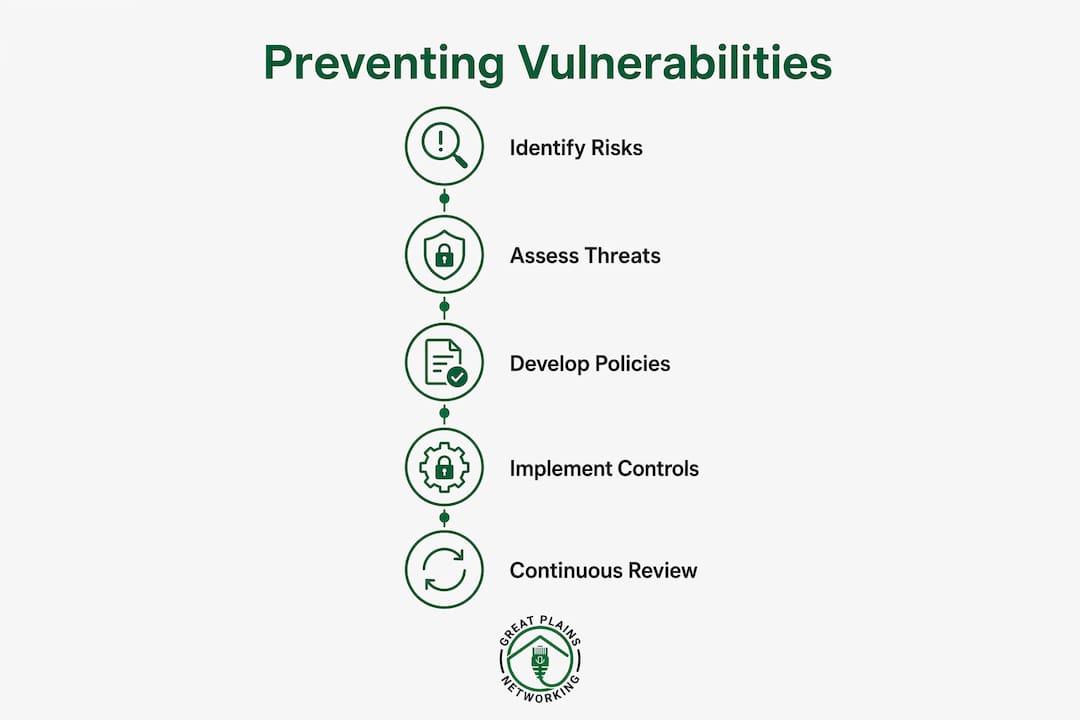
Building a supply chain risk management program that actually holds up
A Supply Chain Risk Management (SCRM) program is not a one-time project. It is a living process that adapts as your vendor relationships and threat environment change.
- Ground your policies in NIST and CISA frameworks. NIST Special Publication 800-161 provides specific guidance on identifying, assessing, and mitigating cybersecurity risks throughout the supply chain. CISA's SCRM resources for SMBs offer practical templates you can use immediately.
- Get leadership visibly involved. The Canadian Centre for Cyber Security and CISA both emphasize that leadership-driven security culture is a prerequisite for effective SCRM, not a bonus feature.
- Run tabletop exercises with supply chain stakeholders. Simulated disruption scenarios reveal gaps in your response plans before a real incident does. Schedule these at least annually.
- Deploy third-party risk management tools. Continuous monitoring software that tracks supplier security posture, software patch status, and access anomalies gives you real-time visibility rather than a snapshot.
- Document contingency plans with named alternatives. A contingency plan that lists specific alternative suppliers and clear criteria for activating them prevents operational paralysis when a primary vendor fails.
- Train supply chain personnel on a regular schedule. Threats evolve. Training outdated by several years does not cover today's social engineering tactics or ransomware delivery methods.
- Treat SCRM as iterative, not finished. Continuous monitoring and adjustment outperform rigid, static defenses. Reassess your program whenever your vendor landscape changes significantly.
Pro Tip: Align your SCRM review cycle with your broader enterprise risk management calendar. When supply chain security reviews happen at the same time as annual business planning, they get the budget attention and leadership time they need.

What SMBs get wrong about supply chain cybersecurity
The most dangerous misconception a small business owner can hold is that size provides protection. It does not.
Supply chains are targeted precisely because smaller businesses tend to have weaker defenses. Attackers use vulnerable SMBs as backdoors into larger partners or critical infrastructure. Your business may be the weakest link in a chain that connects to a hospital, a utility, or a government contractor.
A second misconception is that outsourcing IT or cybersecurity transfers the risk. It does not. Business owners retain ultimate responsibility for supply chain security even when vendors manage the technical work. Outsourcing is a tool, not a shield.
Other risks SMBs routinely underestimate:
- Free and open-source software carries real exposure. Any software your team downloads and uses, paid or free, is part of your digital supply chain and must be tracked.
- Outdated hardware and software are soft targets. Unpatched systems are among the most common entry points attackers exploit.
- Unauthorized third-party apps expand your attack surface without your IT team's knowledge or consent.
- Perfect security is not the goal. A flexible, iterative approach to risk mitigation outperforms any attempt to build an impenetrable perimeter. Resilience matters more than perfection.
- Cybersecurity is cross-functional. Procurement signs the vendor contracts. IT manages the systems. Leadership sets the budget. All three must be engaged for supply chain security to work. You can read more about the current threat landscape to understand what your business is up against in 2026.
How Greatplainsnetworking supports SMB supply chain cybersecurity
Greatplainsnetworking works with small businesses in Norman, Moore, and Oklahoma City to build cybersecurity programs that address the full scope of supply chain risk, not just the obvious entry points.
Their approach is built around 24/7 monitoring that catches threats before they become incidents. For SMBs without a dedicated IT team, that kind of continuous visibility is the difference between a contained problem and a business-disrupting breach. Every client engagement starts with a customized IT plan that maps the business's specific vendor relationships and identifies where the highest-risk exposures sit.
What sets Greatplainsnetworking apart for supply chain security:
- Proactive threat detection through continuous monitoring aligned with CISA and NIST frameworks
- Plain-language communication that keeps business owners informed without requiring a technical background
- Customized cybersecurity plans that address supply chain risk management for each client's specific vendor mix
- Same-day response times with no long-term contracts, so you are never locked into a service that stops meeting your needs
- Comprehensive cybersecurity solutions covering vendor risk, endpoint protection, and incident response planning
- Practical guidance backed by their 2026 tech upgrade checklist and ongoing educational resources for SMB decision-makers
Greatplainsnetworking: proactive IT support for SMB supply chain security
Small businesses in Oklahoma need a cybersecurity partner who understands their vendor relationships, their budget constraints, and the real consequences of a supply chain breach. Greatplainsnetworking delivers exactly that through managed IT support built specifically for SMBs in Norman, Moore, and Oklahoma City.
Unlike a generic IT provider, Greatplainsnetworking combines 24/7 monitoring with localized expertise and no long-term contracts. You get continuous visibility into your supply chain's cyber exposure, a team that responds the same day, and a cybersecurity plan written in plain language you can actually act on. Whether you run a dental practice, a law firm, or a professional services business, the supply chain risks are real and the solutions are practical. Contact Greatplainsnetworking today to get a customized assessment of your supply chain security posture.
Key Takeaways
Preventing supply chain cyber vulnerabilities requires continuous risk assessment, documented policies grounded in NIST and CISA standards, leadership commitment, and a contingency plan with named alternative suppliers ready to activate.
| Point | Details |
|---|---|
| Map every supplier | Inventory all vendors with hardware, software, or cloud access and categorize them by criticality. |
| Enforce contractual security | Require incident notification clauses and minimum security standards in every vendor agreement. |
| Iterate, don't perfect | A flexible, iterative SCRM approach outperforms rigid, static defenses against evolving threats. |
| SMB size is no protection | Supply chains are targeted precisely because smaller businesses tend to have weaker defenses. |
| Greatplainsnetworking | Provides 24/7 monitored, customized cybersecurity support for SMBs in Norman, Moore, and OKC with no long-term contracts. |
Recommended
Want help putting this into practice?
We'll audit your security, speed, and hardware in under an hour — no commitment, no sales pitch. Just a clear roadmap of what to fix and why.