
Benefits of a Local IT Provider for Small Business

A local IT provider is defined as a managed service provider (MSP) operating within your geographic area, offering on-site support, personalized service, and community-based accountability that remote or national firms cannot replicate. The benefits of a local IT provider go well beyond convenience. Small businesses in Norman, Moore, and Oklahoma City that partner with nearby IT teams consistently see faster issue resolution, stronger cybersecurity, and technology plans built around their actual workflows. This article breaks down the specific, measurable advantages of choosing local IT support and explains why that decision matters more than most business owners realize.
1. Benefits of local IT providers: faster response times cut downtime
Speed is the most direct advantage of working with a local IT provider. Local providers dispatch technicians within the hour for critical outages, while national providers often take 24–48 hours due to geographic distance and multi-tier ticketing systems. That gap is not a minor inconvenience. For a dental practice or law firm, even two hours of downtime can mean missed appointments, lost billable time, and frustrated clients.

The difference comes down to proximity. A local technician can walk into your office, assess the physical environment, and resolve hardware or network failures that no remote session can fix. National providers route your request through a help desk, escalate it through tiers, and may ultimately dispatch a contractor who has never visited your office.
Key situations where local response time makes a direct impact:
- A server failure during business hours requires physical access to restore operations.
- A network outage affecting point-of-sale systems needs on-site diagnosis, not a remote session.
- A ransomware incident requires immediate containment, which benefits from a technician who knows your network layout.
- A new employee setup or hardware swap cannot be completed remotely.
Pro Tip: When evaluating any IT provider, request a written Service Level Agreement (SLA) that specifies guaranteed response times for critical, high, and standard priority issues. A provider unwilling to commit to an SLA in writing is signaling that speed is not a priority.
2. Contextual familiarity speeds up diagnosis and repair
A provider familiar with your business environment can cut diagnosis time from a 30-minute briefing to near-instant recognition. That efficiency compounds over time. After six months with a local IT partner, your technician already knows your server room layout, your software stack, your team's habits, and your most common failure points.
Remote or national providers start from zero every time. You explain your setup, your history, and your current problem to a new agent on each call. That repetition wastes your time and delays resolution.
The advantages of contextual familiarity include:
- Faster root cause identification because the technician knows your baseline configuration.
- Smoother technology adoption because the provider understands which tools fit your team's workflows.
- Better planning conversations because the provider knows your growth trajectory and current constraints.
- Fewer errors during upgrades or migrations because the environment is already documented and understood.
Local IT partners also act as strategic advisors for long-term growth, not just reactive repair technicians. They can recommend technology investments that align with your three to five year business goals because they understand your operations from the inside.
3. Accountability tied to community reputation
Local IT providers operate in the same community as their clients. Their reputation is visible and direct. Their success depends on customer satisfaction in their local market, which creates a strong incentive to deliver quality service consistently. A national firm losing one small business client barely registers. A local provider losing a client in a tight-knit business community feels it immediately.
This accountability produces measurable differences in service quality:
- Lower technician turnover means the same person handles your account month after month, building institutional knowledge.
- Clear, plain-language communication replaces jargon-heavy reports that obscure what is actually happening with your systems.
- Transparent billing with no hidden fees reflects a provider that values long-term relationships over short-term revenue.
- Face-to-face visits allow the provider to spot inefficiencies and frustrations that a remote provider would never notice.
Choosing a local IT partner also supports the broader local business ecosystem. When you invest in a local provider, that investment stays in your community and strengthens the network of businesses around you.
4. Tailored solutions, transparent pricing, and stronger cybersecurity
Local IT providers offer three advantages that national firms structurally cannot match: regional infrastructure expertise, flexible pricing, and context-aware cybersecurity.
Regional infrastructure expertise
Local providers recommend ISPs, understand local power and compliance challenges, and optimize your infrastructure based on what actually works in your area. A national firm recommends the same solutions regardless of geography. A local provider in Oklahoma City knows which internet service providers deliver reliable uptime in Norman, which compliance requirements apply to local healthcare or legal practices, and which vendors have strong regional support.
Transparent and flexible pricing
National firms often pass travel and overhead costs to clients. Local providers operate with lower overhead and price their services accordingly. Many local MSPs also hold certifications such as Microsoft Cloud Solutions Provider status, which gives their clients access to enterprise-grade discounts that would otherwise require large-scale purchasing power. You get enterprise tools at small business prices.
Pro Tip: Ask any IT provider for a full breakdown of what is included in their monthly fee and what triggers additional charges. Local providers with transparent pricing will answer this question clearly and in writing.
Cybersecurity built on continuous monitoring
Local providers spot threats faster than distant Security Operations Centers managing hundreds of unrelated networks. Because a local MSP knows your environment, any anomaly stands out immediately. A remote SOC sees a deviation from a statistical baseline. A local provider sees a deviation from your specific, known configuration. That distinction matters when a threat is moving through your network in real time.
The table below compares key service dimensions across local and national IT support models.
| Feature | Local IT provider | National IT provider |
|---|---|---|
| On-site response time | Within the hour for critical issues | 24–48 hours or contractor dispatch |
| Environment familiarity | Deep, built over ongoing relationship | Starts from zero each contact |
| Pricing transparency | Flexible, low overhead, no hidden fees | Often includes travel and overhead markups |
| Cybersecurity monitoring | Context-aware, anomaly detection in known environment | Broad baseline monitoring across many clients |
| Regional compliance advice | Tailored to local regulations and infrastructure | Generalized, not location-specific |
Key takeaways
Partnering with a local IT provider gives small businesses faster on-site response, deeper contextual knowledge, stronger accountability, and cybersecurity monitoring that national firms cannot match at the same price point.
| Point | Details |
|---|---|
| Response time advantage | Local providers dispatch technicians within the hour; national firms average 24–48 hours. |
| Contextual familiarity | Ongoing relationships cut diagnosis time and reduce repeated explanations on every call. |
| Community accountability | Local reputation drives consistent quality, transparent pricing, and lower technician turnover. |
| Cybersecurity effectiveness | Continuous monitoring of a known environment detects threats faster than remote SOC models. |
| Cost and certification value | Local MSP certifications like Microsoft CSP status deliver enterprise tools at small business pricing. |
Why local IT partnerships are the most underrated decision a small business can make
I have watched small business owners spend months comparing national MSP contracts, chasing lower per-seat pricing, and then spend far more money recovering from a single outage that a local provider would have resolved in under an hour. The math rarely favors the national option once you account for downtime costs.
The deeper issue is that most business owners think of IT support as a utility. You pay for it, it runs in the background, and you call when something breaks. That model works until it does not. When a ransomware attack locks your files at 9 a.m. on a Tuesday, the difference between a local technician who can be on-site by 10 a.m. and a remote help desk that escalates your ticket by Thursday is not a service level difference. It is a business survival difference.
What I find most valuable about local IT support for small businesses is the advisory relationship that develops over time. A good local provider does not just fix what breaks. They walk through your office, notice that your team is working around a software limitation, and bring a solution to your next quarterly review. That kind of proactive engagement does not happen on a national help desk ticket.
The businesses I have seen thrive with local IT partners share one trait. They treat their IT provider as a member of the team, not a vendor. That relationship pays dividends in faster decisions, better technology choices, and fewer surprises.
— Nicholas
Greatplainsnetworking: local IT support built for Oklahoma small businesses
Small businesses in Norman, Moore, and Oklahoma City have a direct option for the kind of local IT partnership described throughout this article.
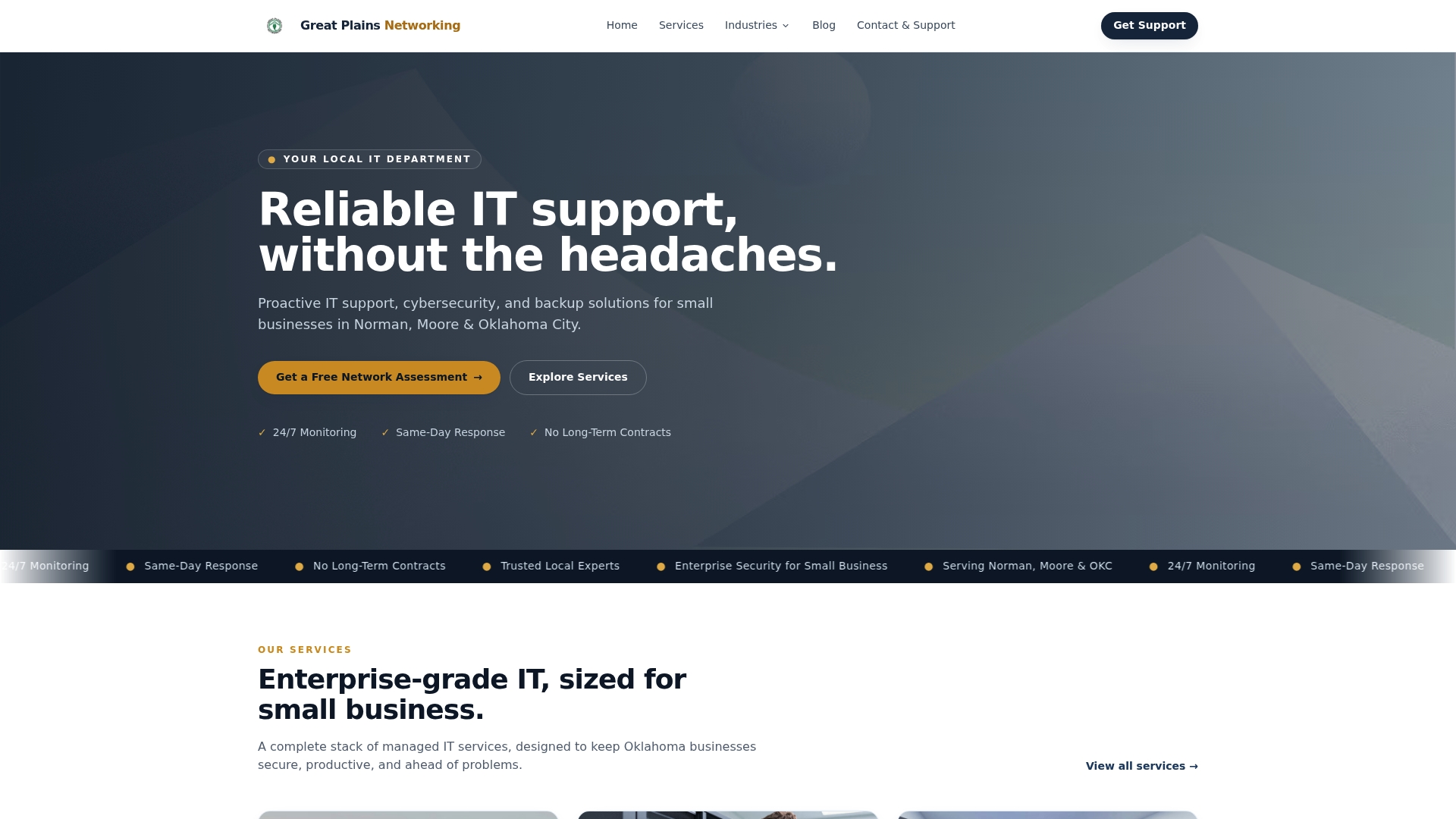
Greatplainsnetworking provides managed IT support with same-day response times, 24/7 monitoring, and no long-term contracts. Their team works with dental practices, law firms, and other local businesses to deliver plain-language IT management, proactive cybersecurity, and rapid data recovery. If you are evaluating your current IT setup or looking for a provider that knows your community, Greatplainsnetworking offers a straightforward conversation about what your business actually needs.
FAQ
What are the main benefits of a local IT provider?
Local IT providers deliver faster on-site response, deeper knowledge of your specific environment, and stronger accountability tied to their community reputation. These advantages reduce downtime and produce more consistent service quality than national alternatives.
How does a local IT provider compare to a national MSP for response time?
Local providers dispatch technicians within the hour for critical issues, while national providers typically take 24–48 hours. That gap directly affects how long your business is offline during an outage.
Is local IT support more cost-effective than national providers?
Local IT support is often more cost-effective because local providers carry lower overhead and do not pass travel costs to clients. Many also hold vendor certifications that give clients access to enterprise-grade tools at reduced prices.
Why does cybersecurity benefit from a local IT provider?
Local MSPs monitor a known environment, which means any unusual activity stands out immediately. Remote security operations centers manage many unrelated networks and rely on statistical baselines rather than specific knowledge of your systems.
How do I choose the right local IT provider for my small business?
Look for a provider that offers written SLAs, transparent pricing, and references from businesses similar to yours. A guide on choosing the right IT provider can help you evaluate candidates against criteria that match your specific needs.
Recommended
Want help putting this into practice?
We'll audit your security, speed, and hardware in under an hour — no commitment, no sales pitch. Just a clear roadmap of what to fix and why.