
Intrusion Detection for Small Clinics: 2026 Guide

An intrusion detection system (IDS) is a network security tool that continuously monitors traffic and devices within a small clinic's IT environment to detect and alert on unauthorized or malicious behavior. For small clinics handling protected health information, an IDS is not optional equipment. HIPAA requires covered entities to implement technical safeguards that guard against unauthorized access to electronic patient records, and an IDS directly supports that requirement. Without one, a clinic may not discover a breach until patient data has already been stolen or encrypted by ransomware.
What is intrusion detection for small clinics?
An IDS monitors your clinic's network traffic in real time, looking for patterns that signal a threat. The industry standard term is intrusion detection system, and it covers two core detection methods: signature-based detection and anomaly-based detection.
Signature-based detection works like antivirus software. It compares network traffic against a library of known attack patterns. If a packet matches a known threat signature, the system fires an alert. This method catches well-documented threats quickly but misses new attack types with no existing signature.

Anomaly-based detection takes a different approach. It learns what normal traffic looks like on your specific network, then flags anything that deviates from that baseline. A staff member downloading 2 gigabytes of patient records at 2 a.m. would trigger an alert, even if no known malware signature is present. AI-powered anomaly detection across multi-location clinics can reduce security incident response times by up to 94% through automated triage of suspicious activity. That figure reflects how much faster a monitored clinic can contain a threat compared to one relying on manual review.
One critical distinction: an IDS detects and alerts but does not block traffic directly. Think of it as a security camera, not a locked door. Blocking is handled by firewalls or intrusion prevention systems (IPS). The IDS feeds alerts to your security team or, in more advanced setups, to a SIEM (Security Information and Event Management) platform for centralized analysis.
- Signature-based detection: Fast and reliable against known threats; requires regular signature updates.
- Anomaly-based detection: Catches novel threats; needs a learning period to establish baselines.
- Passive monitoring: The IDS taps network traffic without disrupting clinic operations, so patient care systems stay online even if the IDS malfunctions.
- Alert generation: Alerts route to IT staff, an MSSP, or a SIEM for triage and response.
Pro Tip: Ask any IDS vendor whether their system supports passive tap mode. A passive IDS will not crash your electronic health record (EHR) system if it encounters an error, which matters enormously in a clinical setting.
What are the specific benefits of IDS for small clinics?
The most immediate benefit is early detection of threats like phishing, ransomware, and insider misuse before they escalate into full breaches. A clinic that catches a compromised credential within minutes faces a very different recovery situation than one that discovers the intrusion weeks later during a routine audit.
Beyond threat detection, an IDS produces documented logs of network activity. Those logs serve as evidence during HIPAA audits and forensic investigations. Regulators want proof that you monitor your environment. An IDS provides that proof automatically.
"Many clinics only discover unauthorized network devices after deploying IDS, highlighting hidden vulnerabilities." Intrusion detection provides visibility into shadow devices like legacy monitors or medical printers that represent unseen HIPAA compliance risks. These undocumented devices, sometimes called "IT drift," create gaps that attackers exploit.
Additional benefits for small clinic administrators include:
- Faster incident response: Clinics with tested, written incident response plans recover from breaches twice as fast as those without documentation. An IDS alert is the trigger that activates that plan.
- Compliance evidence: IDS logs satisfy HIPAA's audit control requirements under 45 CFR § 164.312(b).
- Insider threat detection: Anomaly-based systems flag unusual access patterns from current employees, not just external attackers.
- Forensic support: Detailed traffic logs let investigators reconstruct exactly what happened, which limits liability and speeds notification decisions.
What challenges do small clinics face when implementing IDS?
Limited IT staffing is the most common barrier. Most small clinics do not employ a full-time security engineer. An IDS that generates hundreds of alerts per day with no one qualified to triage them creates more confusion than protection.
False positives compound this problem. A new medical device connecting to the network, a software update pushing large file transfers, or a staff member working late can all trigger alerts in an unconfigured system. Modern AI-based IDS systems require a 1–2 week learning phase to build reliable behavioral baselines and reduce false positives. Skipping that learning period is the single most common setup mistake in small clinic deployments.
Here is a practical approach to addressing these challenges:
- Start with a passive IDS. A passive system monitors without interfering. If it generates a false positive or malfunctions, your EHR and scheduling systems keep running.
- Allow the full learning phase. Give the system 1–2 weeks to baseline normal behavior before acting on every alert. Adjust thresholds after reviewing the first week of output.
- Outsource 24/7 monitoring to an MSSP. Small clinics that outsource network monitoring to managed security service providers get continuous threat triage without hiring a dedicated security analyst. This is the most cost-effective path for clinics with fewer than 20 staff.
- Layer IDS with other controls. Prioritize Multi-Factor Authentication, Endpoint Detection and Response, and daily backups alongside your IDS. These controls address phishing and ransomware, the two most common attack vectors in small healthcare settings.
- Define alert escalation paths. Decide in advance who receives an alert, who investigates, and who has authority to isolate a device. Without this, alerts sit unanswered.
Pro Tip: Before purchasing any IDS solution, map your clinic's network. List every device that connects, including medical equipment, tablets, and printers. An IDS cannot protect devices it cannot see, and undocumented devices are the most common source of surprise alerts.
What are best practices for integrating IDS into a clinic's cybersecurity program?
An IDS works best as one layer in a documented security program, not as a standalone tool. The following practices maximize its effectiveness in a small clinic setting.
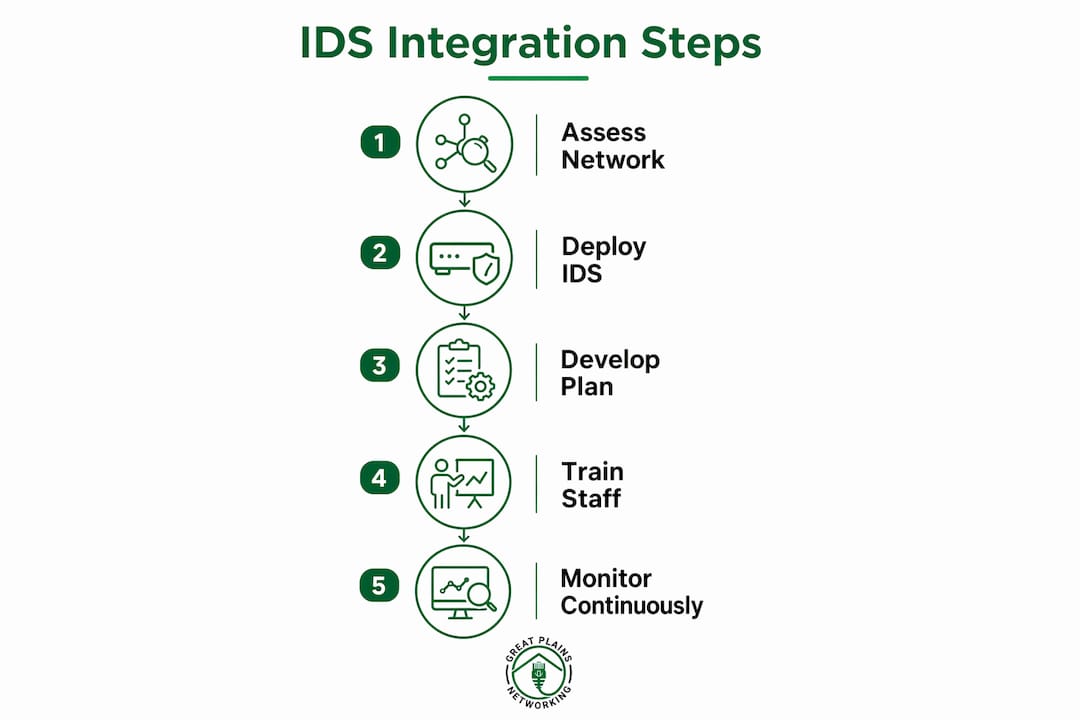
Develop and test an incident response plan. A one-page document defining roles, communication steps, and authority notifications is enough to start. Clinics with tested incident response plans recover from breaches twice as fast as those without one. Run a tabletop exercise twice a year where staff walk through what they would do if an IDS alert fired at 7 p.m. on a Friday.
Train staff to recognize and report suspicious activity. Most breaches start with a phishing email, not a sophisticated network attack. Staff who know how to spot a suspicious link and report it immediately reduce the number of incidents your IDS needs to catch. Pair training with network security awareness resources relevant to your clinic's specific workflows.
The table below summarizes the core integration practices and their primary purpose:
| Practice | Primary purpose |
|---|---|
| Written incident response plan | Defines roles and speeds recovery when an IDS alert fires |
| Staff phishing awareness training | Reduces the volume of incidents the IDS must catch |
| MFA on all patient-data access points | Blocks credential-based attacks before they reach the network |
| Daily backup verification | Ensures recovery options exist if ransomware bypasses detection |
| Quarterly IDS configuration review | Keeps detection rules aligned with evolving clinic workflows |
- Enable MFA on every patient-data access point. MFA stops credential-based attacks even when a password is compromised. Pair it with your IDS so that a failed MFA attempt can trigger an alert.
- Verify backups daily and run restoration drills quarterly. An IDS may detect ransomware after encryption has started. A verified backup is your recovery option. Explore backup and recovery services designed for small healthcare providers to keep this process manageable.
- Review IDS configurations quarterly. Clinic workflows change. New devices join the network. Staff roles shift. A configuration that was accurate in january may generate excessive false positives by april if it has not been updated.
Key Takeaways
Intrusion detection systems give small clinics the network visibility they need to detect threats early, meet HIPAA audit requirements, and recover faster from security incidents.
| Point | Details |
|---|---|
| IDS detects, not blocks | An IDS alerts on threats but does not stop traffic; pair it with a firewall or IPS. |
| Allow the learning phase | Give AI-based systems 1–2 weeks to baseline behavior before acting on every alert. |
| Outsource monitoring | MSSPs provide 24/7 triage for clinics without dedicated security staff. |
| Layer your defenses | Combine IDS with MFA, EDR, and verified daily backups for full coverage. |
| Document everything | Written incident response plans and IDS logs satisfy HIPAA audit requirements. |
What I have learned from watching small clinics adopt IDS
The clinics that get the most value from intrusion detection are not the ones with the biggest budgets. They are the ones that treat IDS as a process, not a product. They assign a specific person to review alerts, they test their incident response plan at least twice a year, and they update their device inventory every time something new connects to the network.
The biggest mistake I see is clinics deploying an IDS and then assuming they are protected. An alert that nobody reads is the same as no alert at all. The tool is only as useful as the process behind it. If your clinic does not have the internal capacity to monitor alerts consistently, outsourcing to an MSSP is not a compromise. It is the right answer for your situation.
The other thing worth saying plainly: do not wait until your IDS is perfect before acting on it. Start with a passive system, let it run through its learning phase, and review the first two weeks of alerts with your IT partner. You will learn more about your actual network in those two weeks than you have in the past year. That knowledge alone justifies the investment, even before the system catches its first real threat. Small, incremental improvements in cybersecurity compound over time. An IDS is one of the most practical starting points a small clinic can choose.
— Nicholas
How Greatplainsnetworking supports small clinics with managed cybersecurity
Small clinics in Norman, Moore, and Oklahoma City face the same cybersecurity threats as large hospital systems, but with a fraction of the IT resources. Greatplainsnetworking provides managed IT support that includes 24/7 network monitoring, intrusion detection oversight, and same-day response, all without requiring a long-term contract.
Greatplainsnetworking works directly with dental practices, medical offices, and other small healthcare providers to build layered security programs that fit real budgets. Their clinic cybersecurity services cover IDS monitoring, MFA setup, backup verification, and HIPAA compliance support. If your clinic has not had a cybersecurity audit, that is the right place to start.
FAQ
What is an intrusion detection system in simple terms?
An IDS is a tool that watches your clinic's network traffic and alerts you when it spots suspicious activity. It does not block threats directly but gives your team the information needed to respond quickly.
Does a small clinic need an IDS to comply with HIPAA?
HIPAA requires covered entities to implement audit controls and monitor access to electronic patient records. An IDS directly supports both requirements by logging network activity and flagging unauthorized access attempts.
How long does it take to set up an IDS in a clinic?
Basic deployment can take a few hours, but AI-based systems need 1–2 weeks to learn normal network behavior and reduce false positives before alerts become reliable.
What is the difference between an IDS and a firewall?
A firewall blocks unauthorized traffic at the network perimeter. An IDS monitors traffic passively and generates alerts without blocking anything. Both tools serve different functions and work best together.
Can a small clinic manage IDS monitoring without a dedicated IT team?
Yes, by outsourcing to a managed security service provider. MSSPs provide continuous monitoring and alert triage around the clock, which is the most practical option for clinics without full-time security staff.
Recommended
Want help putting this into practice?
We'll audit your security, speed, and hardware in under an hour — no commitment, no sales pitch. Just a clear roadmap of what to fix and why.