
Why ERP Systems Need Secure Networks in 2026

Enterprise resource planning (ERP) security is defined as the set of controls that protect the centralized business data an ERP system holds, and why ERP systems need secure networks becomes clear the moment you realize that a single breach can expose financials, customer records, HR data, and production schedules all at once. 73% of cyberattacks in 2026 target SMEs because their ERP systems carry high-value data with weaker defenses than enterprise counterparts. That asymmetry makes network security not a luxury but a baseline requirement. If you manage IT for a small or mid-sized business running an ERP platform, the network surrounding that system is either your strongest defense or your biggest liability.
Why ERP systems need secure networks: the core risk
ERP platforms sit at the center of your business operations. They process payroll, manage vendor payments, track inventory, and store customer contracts. That concentration of data makes them the single most attractive target on your network.
84% of major security incidents in SMEs during 2025 involved compromise of the main management system. That figure means an attacker who reaches your ERP does not just steal one file. They gain access to the operational core of your business. The downstream consequences include regulatory fines, halted production, and loss of customer trust.
The network is the path every attacker must travel to reach your ERP. Securing that path is the most direct way to reduce exposure. Without deliberate network controls, your ERP is reachable from any compromised device on the same flat network, including a staff member's laptop infected by a phishing email.

What network vulnerabilities put ERP systems at risk?
Several specific weaknesses consistently appear in SME ERP environments. Understanding them by name helps you prioritize fixes.
- Overprivileged user accounts. The FBI reported $2.9 billion in business email compromise losses in 2023, with manufacturers disproportionately targeted through ERP payment manipulation enabled by excessive account permissions. When too many users hold admin-level access, one compromised credential unlocks the entire system.
- Unsecured remote access. VPN misconfigurations and direct internet-facing ERP portals give attackers a direct route in. Many SMEs open remote access during a crisis and never close it properly.
- Flat networks with no segmentation. A flat network means every device can reach every other device. Ransomware that lands on a reception desk computer can crawl directly to your ERP server within minutes.
- Insecure API integrations. Vendor API connections often operate with broad permissions and long-lived tokens. In 2025, Jaguar Land Rover stopped production due to a cyberattack traced to an unsecured ERP API vendor, illustrating how third-party integrations create supply chain exposure.
- Delayed patching. Aging ERP configurations with unpatched software give attackers known exploit paths. Many SMEs delay patches out of fear of disrupting operations, which is a trade-off that consistently backfires.
- No ERP-specific monitoring. Most SMEs treat ERP security as standard IT hygiene but fail to watch for ERP-specific behaviors like unusual configuration changes or large data exports. Perimeter defenses alone will not catch a sophisticated intrusion once an attacker is already inside.
The common thread across all these vulnerabilities is network access. Each one exploits a gap in how the network controls who and what can reach the ERP system. Closing these gaps requires deliberate architecture, not just antivirus software. For a broader view of current SME attack vectors, the threat landscape in 2026 has expanded well beyond basic malware.
How do secure network practices protect ERP systems?
The importance of secure networks for ERP becomes concrete when you map specific controls to specific risks. The following practices address the vulnerabilities above in a structured, implementable order.
-
Segment your network with dedicated VLANs. Placing ERP servers on isolated VLANs stops lateral movement. If ransomware compromises a workstation, it cannot reach the ERP segment. CISA and the FTC both recommend network segmentation as a low-cost, high-impact control for SMBs.
-
Apply zero-trust principles. Traditional castle-and-moat security is obsolete for modern ERP environments. Zero-trust architecture verifies every user, device, and API call regardless of where the request originates. For legacy ERP systems that lack native identity federation, an Identity-Aware Proxy (IAP) layer enforces this verification without rewriting ERP code.
-
Deploy MFA and Privileged Access Management (PAM). Multi-factor authentication blocks credential-based attacks. PAM controls limit what privileged accounts can do and logs every action they take. Both are now mandatory under NIS2 and similar frameworks.
-
Encrypt data at rest and in transit. Transparent Data Encryption (TDE) on on-premise ERP databases causes only a 3%–5% performance impact. That is a negligible cost for protecting financial records against unauthorized database access. TLS encryption covers data moving between your ERP and connected systems.
-
Secure API integrations with OAuth 2.0 and token lifecycle management. Limit API permissions to the minimum required scope. Rotate tokens regularly and revoke them immediately when a vendor relationship ends.
-
Audit user rights on a fixed schedule. Remove inactive accounts and review role assignments quarterly. Overprivileged accounts are one of the most common entry points attackers exploit.
Pro Tip: When enabling TDE on an existing ERP database, test the 3%–5% performance impact during off-peak hours before rolling it out in production. Most SMEs find the impact is invisible to end users, which removes the most common objection to enabling encryption.
The benefits of secure ERP systems compound over time. Each control you add raises the cost and complexity of an attack, which pushes opportunistic attackers toward easier targets.
What compliance requirements relate to ERP network security for SMEs?
Regulatory pressure is now a direct driver of ERP network security investment. Treating compliance as a separate concern from security is a mistake. The two are aligned.
- NIS2 (EU Network and Information Security Directive 2). NIS2 mandates MFA, encryption, and auditable logging for systems that process business-critical data. Non-compliance carries fines of up to 2% of annual turnover. For a business generating $5 million in revenue, that is a $100,000 exposure from a single audit finding.
- GDPR. Any ERP system storing EU customer data falls under GDPR. Network segmentation and access logging are technical controls that directly support GDPR's data protection requirements.
- Supply chain security mandates. Regulations increasingly hold businesses accountable for the security of their vendor integrations. Unsecured ERP API connections to third-party apps create compliance exposure beyond your own perimeter.
- Audit trail requirements. Regulators expect documented evidence that access controls exist and function. PAM tools and network logging provide this evidence automatically when configured correctly.
Compliance frameworks like NIS2 now make ERP security a non-negotiable aspect of business operations. SMEs that treat it as optional IT hygiene face both regulatory penalties and elevated breach risk simultaneously.
How can SMEs implement secure ERP network strategies effectively?
Practical implementation is where most SMEs struggle. The gap between knowing what to do and doing it without breaking existing business processes is real.
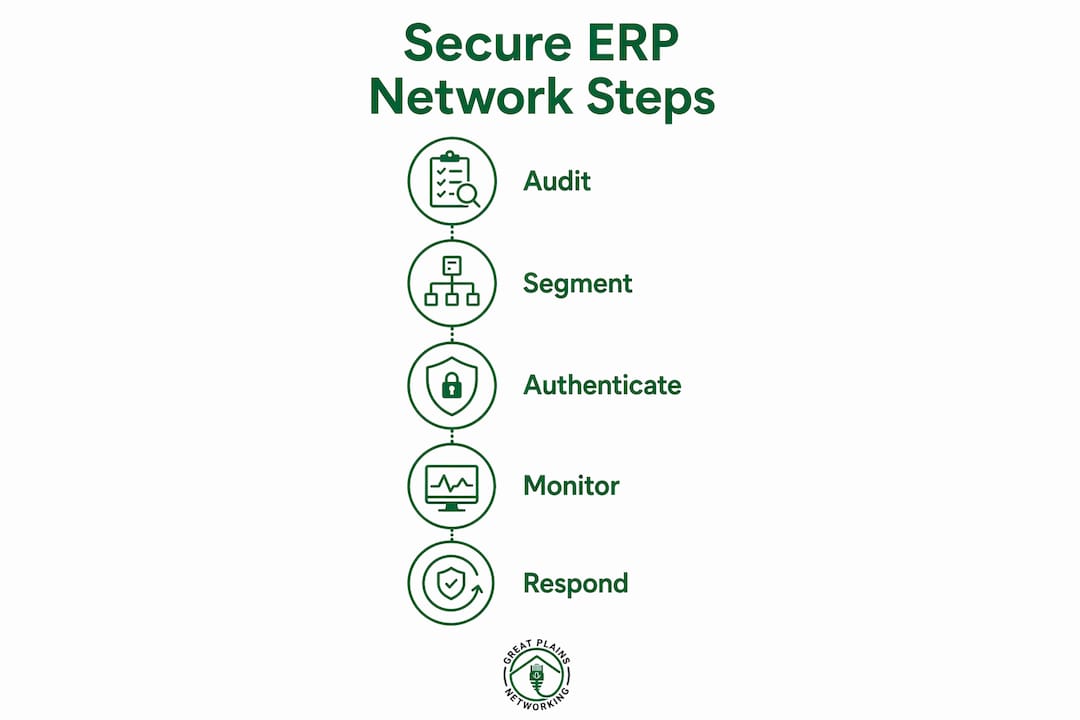
Start with a data flow audit. Poorly planned microsegmentation can break business processes by accidentally blocking legitimate ERP integrations. Map every integration, API endpoint, scheduled data transfer, and port your ERP uses before you change a single firewall rule. This audit prevents the most common implementation failure.
Implement zero-trust incrementally. Legacy ERP systems often lack modern MFA and identity federation support. You do not need to replace your ERP to apply zero-trust. Add an IAP layer in front of the ERP, enforce MFA at the network boundary, and use microsegmentation to block lateral movement. These steps work without touching the ERP application itself.
Manage service credentials actively. Long-lived service accounts with static passwords are a persistent risk in ERP environments. Rotate credentials on a schedule, document every service account's purpose, and disable any account that has not authenticated in 90 days.
Build an emergency access procedure. Zero-trust and PAM controls must include a documented break-glass process for administrative access during an incident. Without one, a lockout during a crisis compounds the damage.
Monitor ERP-specific behavior. Configure alerts for after-hours configuration changes, bulk data exports, and new admin account creation. Standard network monitoring misses these signals. ERP-focused behavioral monitoring catches breaches that bypass perimeter defenses entirely.
Pro Tip: Employee phishing awareness training reduces credential compromise risk more than almost any technical control. A staff member who recognizes a phishing email and reports it stops an attack before it reaches your network. Schedule quarterly training sessions and test with simulated phishing campaigns.
The broader impact of IT gaps on small businesses extends well beyond the immediate incident. Downtime, recovery costs, and reputational damage accumulate quickly when ERP security fails.
Key Takeaways
Secure networks are the primary defense layer protecting ERP systems from breaches, ransomware, and compliance failures that can shut down a small business entirely.
| Point | Details |
|---|---|
| ERP systems are high-value targets | 73% of cyberattacks in 2026 target SMEs, with 84% of major incidents involving the core management system. |
| Network segmentation stops lateral movement | Isolating ERP servers on dedicated VLANs prevents ransomware from spreading from a compromised workstation. |
| Encryption carries minimal performance cost | Transparent Data Encryption causes only a 3%–5% performance impact, making it a practical default for all ERP databases. |
| Compliance mandates specific controls | NIS2 and GDPR require MFA, encryption, and auditable logging, with fines up to 2% of annual turnover for non-compliance. |
| Audit data flows before segmenting | Mapping every API, integration, and scheduled transfer prevents broken business processes during implementation. |
What I have learned from watching SMEs secure their ERP networks
Most IT managers I speak with know they need better ERP security. The part that trips them up is sequencing. They want to deploy zero-trust on day one, before they have mapped a single data flow. That approach breaks integrations, frustrates users, and often gets rolled back entirely. The security posture ends up worse than before because leadership loses confidence in the project.
The SMEs that get this right start with visibility. They spend two to four weeks documenting exactly what talks to the ERP, on which ports, at what times. That audit is unglamorous work, but it is the only foundation that holds. Every segmentation decision, every firewall rule, every API token scope flows from that map.
The second thing I have observed is that technical controls without staff training fail faster than you expect. A perfectly segmented network with MFA on every account still falls to a well-crafted phishing email if your staff does not recognize the warning signs. The businesses that combine network architecture with quarterly training and simulated phishing tests maintain a materially stronger security posture over time.
Regulatory pressure is accelerating this conversation. NIS2 is not a distant European concern for Oklahoma SMEs. If you process data from EU customers or work with supply chains that do, the compliance exposure is real. Proactive security investment now costs a fraction of a breach response or a regulatory fine later.
— Nicholas
How Greatplainsnetworking helps protect your ERP network
Greatplainsnetworking works with small businesses in Norman, Moore, and Oklahoma City to build and maintain the network security controls that protect ERP systems from the threats described above.
The team at Greatplainsnetworking designs network segmentation, deploys MFA, and configures ERP-specific monitoring tailored to your existing systems, without long-term contracts or technical jargon. Their managed IT support includes 24/7 monitoring that catches anomalous ERP behavior before it becomes a breach. If your business runs an ERP platform and you are not confident in the network controls surrounding it, contact Greatplainsnetworking for a straightforward assessment of your current setup. Their cybersecurity services address the specific gaps that put SME ERP systems at risk.
FAQ
What makes ERP systems a target for cyberattacks?
ERP systems centralize financial records, customer data, HR files, and production data in one place. That concentration of high-value information makes them the most attractive target on any business network.
How does network segmentation protect an ERP system?
Placing ERP servers on a dedicated VLAN means a compromised workstation cannot reach the ERP directly. Ransomware or malware is contained to the infected segment rather than spreading to critical business infrastructure.
What is the performance impact of encrypting an ERP database?
Transparent Data Encryption (TDE) causes a 3%–5% performance impact on on-premise ERP databases. Most users do not notice this difference, making encryption a practical default rather than a trade-off.
Do SMEs need to comply with NIS2 for ERP security?
Any SME that processes data from EU customers or operates within regulated supply chains faces NIS2 exposure. Non-compliance carries fines of up to 2% of annual turnover, making compliance a financial risk as well as a security one.
Where should an SME start when securing its ERP network?
Start with a full audit of every data flow, API connection, and integration your ERP uses. That map is the foundation for every segmentation and access control decision that follows, and skipping it is the most common cause of failed implementations.
Recommended
Want help putting this into practice?
We'll audit your security, speed, and hardware in under an hour — no commitment, no sales pitch. Just a clear roadmap of what to fix and why.