
The Role of IT in Small Business Growth in 2026

Information technology is the primary driver of operational efficiency, revenue growth, and competitive positioning for small businesses today. The role of IT in small business growth extends well beyond fixing computers or managing email. It covers automation, AI-powered tools, cloud infrastructure, and strategic planning that together determine whether a small business scales or stagnates. 82% of small business employers have adopted at least one AI tool, with the typical small business now running five distinct AI tools across its operations. That figure signals a fundamental shift in how small businesses compete, and it makes a deliberate IT strategy non-negotiable.
How IT solutions drive operational efficiency in small businesses
The most direct IT impact on small businesses is the elimination of manual, repetitive work that consumes time without generating revenue. Automated workflows replace spreadsheets, email chains, and paper-based processes with systems that run without human intervention. A dental practice in Norman, for example, can automate appointment reminders, insurance verification, and billing follow-ups through integrated practice management software, freeing staff to focus on patient care.
Cloud computing is the backbone of this efficiency shift. 59% of businesses call cloud services very important to their operations, citing reduced hardware costs, support for remote work, and simplified collaboration as the top benefits. For small businesses, cloud platforms like Microsoft 365, Google Workspace, and QuickBooks Online replace expensive on-premise servers with predictable monthly costs and automatic updates. The benefits of IT infrastructure extend further when these platforms integrate with each other, eliminating duplicate data entry and reducing human error across accounting, CRM, and project management.
Key efficiency gains from small business IT solutions include:
- Automated invoicing and payment collection through tools like FreshBooks or QuickBooks
- Centralized customer records via CRM platforms like HubSpot or Zoho CRM
- Cloud-based file sharing through Microsoft SharePoint or Google Drive, replacing local servers
- Automated scheduling and reminders through platforms like Calendly or Acuity Scheduling
- Integrated payroll and HR through Gusto or ADP Run
Pro Tip: When evaluating cloud tools, prioritize vendors that offer flat-rate pricing over usage-based billing. Variable consumption models create budget unpredictability that can blindside small businesses, a risk the industry now calls "Token Shock."
How AI and digital tools affect revenue and customer engagement
Technology in business growth is no longer theoretical. 66% of small businesses report revenue increases linked to AI adoption, and 22% report gains exceeding 10%. That means AI is not a back-office curiosity. It is a front-line revenue tool for businesses that deploy it correctly.

AI-enabled marketing platforms like Mailchimp, Klaviyo, and HubSpot now include predictive send-time optimization, audience segmentation, and automated follow-up sequences that previously required a dedicated marketing team. E-commerce integrations through Shopify and WooCommerce connect inventory, pricing, and customer behavior data to generate personalized product recommendations automatically. Automated pricing tools adjust rates based on demand, competitor activity, and inventory levels without requiring manual intervention, giving small retailers a competitive edge that was once exclusive to large enterprises.
Customer communication has also changed materially. AI-powered chat tools like Intercom and Drift handle first-contact support queries around the clock, routing complex issues to human staff while resolving common questions instantly. This reduces response times and improves customer satisfaction without adding headcount. For small businesses in service industries, AI adoption in niche sectors demonstrates how even specialized operations can use AI to personalize service delivery and retain customers more effectively.
Top AI use cases for small businesses in 2026:
- Content generation and social media scheduling via tools like Jasper or Buffer
- Customer service automation through AI chat platforms
- Financial forecasting and cash flow modeling using tools embedded in QuickBooks or Xero
- Lead scoring and sales pipeline management in CRM platforms
- Inventory demand forecasting for retail and product-based businesses
What does strategic IT planning actually look like?
Strategic IT planning is the practice of aligning technology investments with documented business objectives over a one to three year horizon, rather than purchasing tools reactively when problems arise. Most small businesses skip this step and pay for it in wasted spend, incompatible systems, and productivity losses that compound over time.
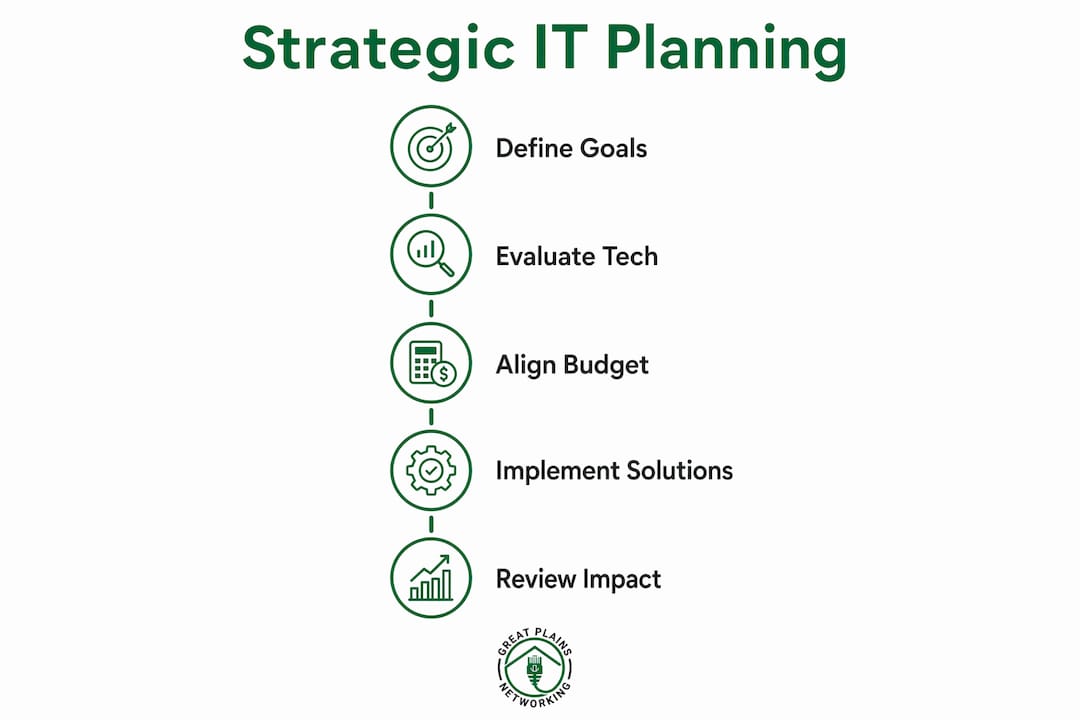
The process starts with defining specific business goals before evaluating any technology. A law firm targeting 20% revenue growth in 12 months needs different IT investments than a retail shop focused on reducing inventory shrinkage. Once goals are documented, a phased implementation plan maps technology purchases to budget cycles, preventing the all-at-once spending that strains cash flow. Strategic IT roadmapping yields productivity improvements that often reach $60,000 per year per organization by replacing legacy systems with integrated, automated solutions. That figure represents real recovered capacity, not projected savings.
The table below contrasts reactive and strategic IT approaches across key dimensions:
| Dimension | Reactive IT approach | Strategic IT approach |
|---|---|---|
| Purchasing trigger | Equipment failure or urgent need | Planned budget cycle tied to business goals |
| Cost predictability | Unpredictable, often emergency spend | Defined annual IT budget with phased rollout |
| System compatibility | Fragmented tools that don't integrate | Unified platforms selected for interoperability |
| Security posture | Addressed after incidents occur | Proactive monitoring and documented policies |
| Productivity impact | Minimal, often disruptive | Documented gains, often $60,000+ per year |
Understanding IT budgeting for small businesses is the first step toward moving from the reactive column to the strategic one. Hidden costs like software licensing overruns, emergency support fees, and productivity losses from downtime consistently exceed what a planned budget would have cost.
What challenges do small businesses face when adopting IT?
Small business technology adoption creates three categories of risk that owners frequently underestimate: data governance failures, cybersecurity exposure, and unpredictable technology costs.
The data governance problem is specific and underappreciated. Unclean and fragmented data residing in SaaS silos undermines effective AI use, producing hallucinations, compliance risks, and incorrect outputs. A business that has used three different CRM platforms over five years likely has duplicate customer records, inconsistent contact data, and incomplete purchase histories spread across all three. Feeding that data into an AI tool without sanitizing it first produces unreliable results. Data cleaning and governance must precede AI deployment, not follow it.
Cybersecurity is a business continuity issue, not an IT department concern. Neglected IT creates security vulnerabilities that translate directly into operational disruptions, financial losses, and reputational damage. Small businesses are disproportionately targeted by ransomware because attackers know they are less likely to have layered defenses. Network security investments in 2026 include multi-factor authentication (MFA), endpoint detection and response (EDR), and encrypted backups as baseline requirements, not optional upgrades.
Cost management is the third challenge. Variable, usage-based pricing for AI and cloud tools creates budget unpredictability that flat-rate pricing models eliminate. Token Shock occurs when a business deploys an AI tool on consumption pricing, usage spikes unexpectedly, and the monthly bill doubles or triples without warning.
Pro Tip: Before signing any AI or cloud service contract, ask the vendor specifically whether pricing is flat-rate or consumption-based. If it is consumption-based, request a usage cap or alert threshold to prevent runaway costs.
Best practices for using IT to scale and compete with larger firms
Small businesses that use IT strategically close the competitive gap with larger firms by deploying the same category of tools at a fraction of the cost. Managed IT services reduce downtime, prevent security incidents, improve productivity, and provide access to expertise that would cost significantly more to hire internally. The model works because it converts unpredictable IT costs into a fixed monthly fee while delivering proactive monitoring rather than break-fix responses.
Scalable IT investments for small businesses include:
- Unified communication platforms like Microsoft Teams or Slack that consolidate messaging, video, and file sharing
- Cloud-native accounting and ERP tools that scale without hardware upgrades
- Managed detection and response (MDR) services for continuous security monitoring
- AI-embedded CRM platforms like Salesforce Starter or HubSpot CRM that automate follow-up and reporting
- Backup and disaster recovery solutions with tested restore procedures and documented recovery time objectives (RTO)
Reducing tech sprawl is as important as adding new tools. A business running 15 disconnected applications spends more time managing integrations than benefiting from them. Consolidating onto unified platforms like Microsoft 365 Business Premium, which includes productivity tools, security features, and device management in a single subscription, reduces both cost and complexity. IT consulting for growth helps small businesses audit their current stack, identify redundancies, and build a leaner, more effective technology environment.
Key takeaways
IT functions as a strategic growth engine for small businesses when it is planned deliberately, governed carefully, and supported proactively rather than managed reactively.
| Point | Details |
|---|---|
| IT drives measurable revenue growth | 66% of small businesses report revenue increases from AI, with 22% exceeding 10% gains. |
| Strategic planning outperforms reactive spending | IT roadmapping produces documented productivity gains of up to $60,000 per year per organization. |
| Data governance precedes AI deployment | Unclean SaaS data produces unreliable AI outputs; sanitize data before deploying AI tools. |
| Flat-rate pricing protects budgets | Choose vendors with fixed pricing to avoid Token Shock from usage-based billing spikes. |
| Managed IT levels the competitive field | Managed services provide enterprise-grade expertise and monitoring at small business costs. |
What I've learned from watching small businesses get IT right and wrong
I've worked with enough small businesses across Oklahoma to recognize a consistent pattern. The owners who treat IT as a cost center to minimize are the same ones calling us after a ransomware incident or a server failure that takes them offline for three days. The owners who treat IT as a growth investment are the ones expanding their teams and opening second locations.
The shift happening right now is genuinely encouraging. 77% of small business owners now see AI and digital technology as growth enablers rather than threats. That is a meaningful change from even two years ago, when the dominant sentiment was anxiety about complexity and cost. But optimism without governance is still a liability. I see businesses adopt five AI tools in six months without cleaning their underlying data, then wonder why the outputs are unreliable.
My practical advice is this: own your IT strategy at the leadership level. Do not delegate it entirely to a vendor or a part-time IT person. Understand what tools you are running, what data they touch, and what your recovery plan looks like if something fails. Start with one or two well-integrated tools rather than ten loosely connected ones. Think in three-year horizons, not quarterly purchases. The businesses that compete effectively with firms ten times their size are not doing so because they have more money. They are doing so because they made deliberate technology decisions and stuck with them.
— Nicholas
How Greatplainsnetworking helps small businesses grow through IT
Greatplainsnetworking provides proactive managed IT services designed specifically for small businesses in Norman, Moore, and Oklahoma City. Their 24/7 monitoring identifies and resolves IT issues before they disrupt operations, converting unpredictable IT costs into a fixed, manageable monthly investment. Services cover cybersecurity, data backup and recovery, strategic IT planning, and day-to-day support, all delivered in plain language without technical jargon. Whether you run a dental practice, a law firm, or a retail operation, Greatplainsnetworking builds a customized IT plan aligned with your growth goals. Same-day response times and no long-term contracts mean you get reliable support without the risk.
FAQ
What is the role of IT in small business growth?
IT serves as the operational and strategic foundation for small business growth by automating workflows, enabling AI-powered tools, securing data, and connecting systems that drive revenue and efficiency. Without integrated IT, small businesses face bottlenecks, manual errors, and security vulnerabilities that make scaling more expensive.
How many AI tools does the average small business use?
The typical small business uses five distinct AI tools across its operations, with 82% of small business employers having adopted at least one AI tool as of 2026.
What is Token Shock and how can small businesses avoid it?
Token Shock refers to unexpected cost spikes from usage-based AI and cloud pricing models. Small businesses avoid it by selecting vendors with flat-rate pricing or by negotiating usage caps and billing alerts before signing contracts.
Why is data governance important before adopting AI?
Fragmented and unclean data stored across multiple SaaS platforms produces unreliable AI outputs, including hallucinations and compliance risks. Cleaning and consolidating data before AI deployment is a required step, not an optional one.
What does managed IT actually provide for a small business?
Managed IT delivers proactive monitoring, cybersecurity protection, data backup, and technical support under a fixed monthly fee, giving small businesses access to enterprise-level expertise without the cost of a full internal IT team.
Recommended
Want help putting this into practice?
We'll audit your security, speed, and hardware in under an hour — no commitment, no sales pitch. Just a clear roadmap of what to fix and why.