
Managed IT Benefits for Nonprofits: Cost, Security & Scale

Managed IT services give nonprofits predictable budgets, enterprise-grade security, and restored staff capacity for mission work. For any organization spending more time troubleshooting printers than serving clients, a managed IT plan is worth pursuing. The core benefits are well documented: nonprofit leaders report that offloading IT removes the "accidental IT" burden from program and development staff, returning hours to donor engagement and program delivery.
Here is what managed IT delivers for nonprofits at a glance:
- Predictable, flat-rate pricing aligned to grant cycles and annual budgets
- 24/7 monitoring and helpdesk through a staffed NOC and SOC
- Enterprise security tools including SIEM, endpoint protection, and MFA
- Nonprofit licensing management via Microsoft 365 Nonprofit, Google Workspace, and TechSoup
- Scalability for seasonal campaigns, new programs, or multi-site expansion
- Compliance documentation for HIPAA, IRS requirements, and donor-data audits
- Tested backup and disaster recovery with documented RTO and RPO targets
- Reduced "accidental IT" burden so staff focus on mission, not tech triage
If your organization is ready to move from reactive break-fix to proactive IT management, request a nonprofit IT assessment from Greatplainsnetworking to get a clear picture of your current environment and risks.
Table of Contents
- How managed IT services benefit nonprofits across every department
- What a managed IT plan for nonprofits actually includes day to day
- What does managed IT cost for a nonprofit, and how do you budget for it?
- How to choose the right managed IT provider for your nonprofit
- Why enterprise security tools and predictable billing matter most for nonprofits
- Key Takeaways
- Why the "accidental IT" problem is the real cost nonprofits miss
- Greatplainsnetworking provides nonprofit IT support in Norman, Moore & OKC
- Useful sources and further reading
How managed IT services benefit nonprofits across every department
The advantages of IT management go well beyond keeping computers running. Each benefit below maps directly to a mission-critical function.
1. Predictable budgets and lower total IT spend
Nonprofits that switch to managed IT typically reduce overall IT spend by 25–40%, with savings reinvested into programs. Flat-rate monthly fees replace unpredictable break-fix invoices that can derail grant-funded work mid-cycle. Finance leads can present a single, documented line item to boards and funders rather than a string of emergency repair bills.
2. Enhanced cybersecurity with enterprise-grade tools

Nonprofits are targeted by cybercriminals because they hold valuable donor and beneficiary data while historically underinvesting in security. Managed IT providers deploy layered defenses: MFA, endpoint protection, email filtering, and SIEM-backed SOC monitoring that most organizations could never afford to run in-house.
3. Round-the-clock monitoring and helpdesk support
A staffed NOC watches your network continuously. When a development associate gets locked out at 7 PM before a major fundraising push, a live helpdesk resolves it. That kind of coverage is simply not possible with a single internal IT hire or a break-fix vendor who answers calls during business hours.
4. Access to current technology and nonprofit licensing
Managed IT providers audit and activate nonprofit licensing programs such as Microsoft 365 Nonprofit, Google Workspace for Nonprofits, and TechSoup discounts, offsetting a significant portion of management fees in some cases. Your team gets current, patched software without the administrative overhead of tracking renewals and eligibility.
Pro Tip: Ask any prospective provider to run a nonprofit licensing audit before signing a contract. Many organizations are sitting on unclaimed Microsoft 365 Nonprofit or TechSoup discounts that can substantially reduce net managed service costs.
5. Scalability for seasonal and program-driven growth
A food bank scaling up for the holiday season or a workforce development nonprofit launching a new site needs IT capacity quickly. Managed IT scales user counts, device provisioning, and security policies without the lead time of a new hire or a capital equipment purchase.

6. Reduced "accidental IT" burden on program staff
Program directors, grant writers, and volunteer coordinators are not IT professionals. When they spend hours troubleshooting Wi-Fi or resetting passwords, those are hours not spent on client services or fundraising. Managed IT removes that burden entirely by giving staff a single number to call.
7. Compliance and audit readiness
Organizations handling protected health information under HIPAA, processing donor payments under PCI DSS, or filing IRS Form 990 need documented controls. Managed IT providers maintain governance documentation, access logs, and security policies that satisfy auditors and give funders confidence in your data stewardship.
8. Tested backup and disaster recovery
A backup that has never been tested is a hypothesis, not a recovery plan. Managed IT includes scheduled backup verification, documented recovery time objectives (RTO), and recovery point objectives (RPO) so your team knows exactly how quickly operations can resume after a ransomware event or hardware failure. For low-cost cybersecurity controls that complement a full managed plan, the foundational steps matter as much as the tooling.
What a managed IT plan for nonprofits actually includes day to day
Understanding the service map helps you compare proposals and recognize gaps.
Core services in a typical managed IT engagement:
- Helpdesk support (phone, email, remote, and onsite)
- Device management, patching, and software updates
- 24/7 network and endpoint monitoring via NOC
- Backup and disaster recovery with tested restores
- Email security filtering and anti-phishing controls
- Vendor management (internet, phone, SaaS subscriptions)
- vCIO quarterly planning and technology roadmapping
- Nonprofit licensing optimization and renewal management
How managed IT handles common scenarios differently than break-fix:
- Phishing event: Under break-fix, staff call a vendor after clicking a malicious link. Response takes hours. Under managed IT, the SOC detects anomalous login behavior within minutes, isolates the affected endpoint, and notifies your team before data leaves the network.
- New-hire provisioning: Break-fix means emailing a vendor and waiting. Managed IT uses documented onboarding workflows: device imaging, account creation, Microsoft 365 license assignment, and security policy enrollment completed before the employee's first day.
- Failed backup recovery: Break-fix discovers the backup was corrupted only when recovery is needed. Managed IT runs scheduled test restores and alerts your team to failures before a crisis forces the issue.
Fully managed vs. co-managed: Fully managed suits nonprofits with no internal IT staff. Co-managed works when you have one internal IT person who needs specialized support for security, compliance, or after-hours coverage. Most small nonprofits in the Oklahoma City metro area fit the fully managed model.
What does managed IT cost for a nonprofit, and how do you budget for it?
Cost clarity is one of the strongest arguments for managed IT. An in-house IT hire costs roughly $88,000–$125,000 per year once salary, benefits, training, and security tools are included. Managed IT for a comparable 25-person organization typically runs $30,000–$52,500 per year, covering monitoring, helpdesk, security, and licensing management.
Common pricing models:
- Flat-rate per user/month: The most common model for nonprofits. One predictable fee covers all services for each staff member. Easy to budget and explain to finance committees.
- Tiered per-service: Organizations pay for specific service tiers (basic monitoring, full security stack, vCIO). Useful for co-managed arrangements.
- A la carte / project fees: One-time engagements for migrations, assessments, or compliance audits. Not suitable as a primary model for ongoing support.
- Hybrid: A base flat-rate fee plus project billing for major initiatives. Common when a nonprofit is scaling rapidly.
Onboarding timeline: Most organizations see operational improvements within the first 30–90 days: fewer support tickets, clearer accountability, and documented systems. Meaningful cost savings against a break-fix baseline typically appear within 3–6 months as reactive incidents decline.
Pro Tip: Present managed IT fees as a fixed operating expense in your annual budget narrative. Grant funders increasingly accept technology infrastructure costs as legitimate program support expenses. A single monthly line item is far easier to justify than a series of emergency repair invoices.
For a step-by-step approach to building a realistic IT budget, the IT support plan for nonprofits on a limited budget walks through phased implementation and cost prioritization.
How to choose the right managed IT provider for your nonprofit
The vendor selection process is where most nonprofits make avoidable mistakes. Use this checklist during any RFP or first call.
Vendor checklist:
- Documented nonprofit experience (references from similar organizations)
- Ability to audit and manage nonprofit licensing programs
- 24/7 SOC and NOC monitoring with staffed response
- Written SLAs with defined response and resolution times
- Scheduled backup testing with documented results
- Compliance documentation for HIPAA, PCI, or IRS requirements as relevant
- Local or regional presence for onsite response
- No long-term contract lock-in
Questions to ask on the first call:
- What is your average response time for a critical outage, and is that guaranteed in writing?
- Can you show us a sample monthly security report and backup verification log?
- Do you have current nonprofit clients who can speak to your licensing optimization work?
- How do you handle a ransomware event at 2 AM on a Saturday?
- What compliance frameworks do you support, and how is that documentation maintained?
Red flags to watch for:
- No written SLA or vague "best effort" language
- Pricing that changes based on ticket volume (hidden break-fix model)
- Staff without documented certifications or security training
- No evidence of backup testing or DR planning
- Inability to provide references from nonprofit clients
Trust signals to request: Monthly security reports, board-ready audit documentation, SOC monitoring dashboards, and scheduled vCIO meetings. Nonprofit IT support best practices detail what a well-structured provider relationship looks like from the leader's perspective.
Why enterprise security tools and predictable billing matter most for nonprofits
The CyberPeace Institute reports that nonprofits are "cyber poor, target rich" — they hold sensitive donor, beneficiary, and financial data while operating with security budgets a fraction of what for-profit organizations spend. That gap is exactly what managed security services close.
SIEM (Security Information and Event Management) and staffed SOC monitoring are the tools that detect threats in real time. Running either in-house requires dedicated security analysts, licensed software, and continuous tuning. For most nonprofits, that is cost-prohibitive. A managed IT provider with an existing SOC infrastructure spreads those costs across many clients, making enterprise-grade detection accessible at a fraction of the standalone price.
"Access to enterprise-grade detection (SIEM) and staffed SOCs is the primary security advantage MSPs bring to nonprofits. These tools are essential to protect donor and beneficiary data and are cost-prohibitive to run in-house for most organizations." — BizTech Magazine
Minimum security controls nonprofits should implement first:
- Multi-factor authentication (MFA) on all accounts, especially email and financial systems
- Endpoint detection and response (EDR) on every device
- Email filtering with anti-phishing and anti-spoofing rules
- Automated, tested offsite backups with documented RTO/RPO
- SIEM or managed detection and response (MDR) through a staffed SOC
For a detailed control-by-control breakdown, the nonprofit cybersecurity checklist covers 15 specific controls scaled for small organizations.
Key Takeaways
Managed IT services give nonprofits cost-predictable, enterprise-grade technology support that returns staff time to mission work and protects donor data from increasingly targeted cyber threats.
| Point | Details |
|---|---|
| Cost savings are substantial | Nonprofits typically reduce IT spend by 25–40% after moving to managed services. |
| Flat-rate pricing fits grant cycles | A single monthly fee is easier to budget and justify to funders than variable break-fix invoices. |
| Enterprise security is now accessible | SIEM and SOC monitoring protect donor data at a cost nonprofits can afford through a managed provider. |
| Licensing discounts offset fees | Microsoft 365 Nonprofit and TechSoup discounts can offset a significant portion of managed service fees when properly activated. |
| Greatplainsnetworking serves nonprofits locally | Greatplainsnetworking provides 24/7 monitoring, flat-rate pricing, and nonprofit IT support in Norman, Moore, and Oklahoma City. |
Why the "accidental IT" problem is the real cost nonprofits miss
Most nonprofit leaders focus on the dollar comparison when evaluating managed IT: outsourced fees versus the cost of an internal hire. That math is straightforward, and the outsourced model wins on cost for most organizations under 50 staff. But the more consequential cost is harder to see on a spreadsheet.
When a program director spends two hours troubleshooting a VPN connection, or a development associate loses a morning to a frozen laptop before a grant deadline, those hours are gone from mission-critical work. Multiply that across a team of 15 people over a year, and the lost productivity dwarfs any licensing fee. The cultural shift that managed IT produces — staff who trust that technology works and know exactly who to call when it doesn't — is the benefit that rarely appears in a vendor proposal but shows up immediately in team morale and output.
The organizations that get the most from managed IT are not the ones with the most complex infrastructure; this is a core idea explored in streamlining SaaS operations without adding overhead to maintain efficiency and reduce internal strain. They are the ones whose leaders made a deliberate decision to stop treating technology as a problem to be endured and start treating it as infrastructure to be managed. That decision is the real turning point.
Greatplainsnetworking provides nonprofit IT support in Norman, Moore & OKC
Nonprofits in the Oklahoma City metro area have a specific, local option for managed IT support that understands small-organization budgets and mission priorities.
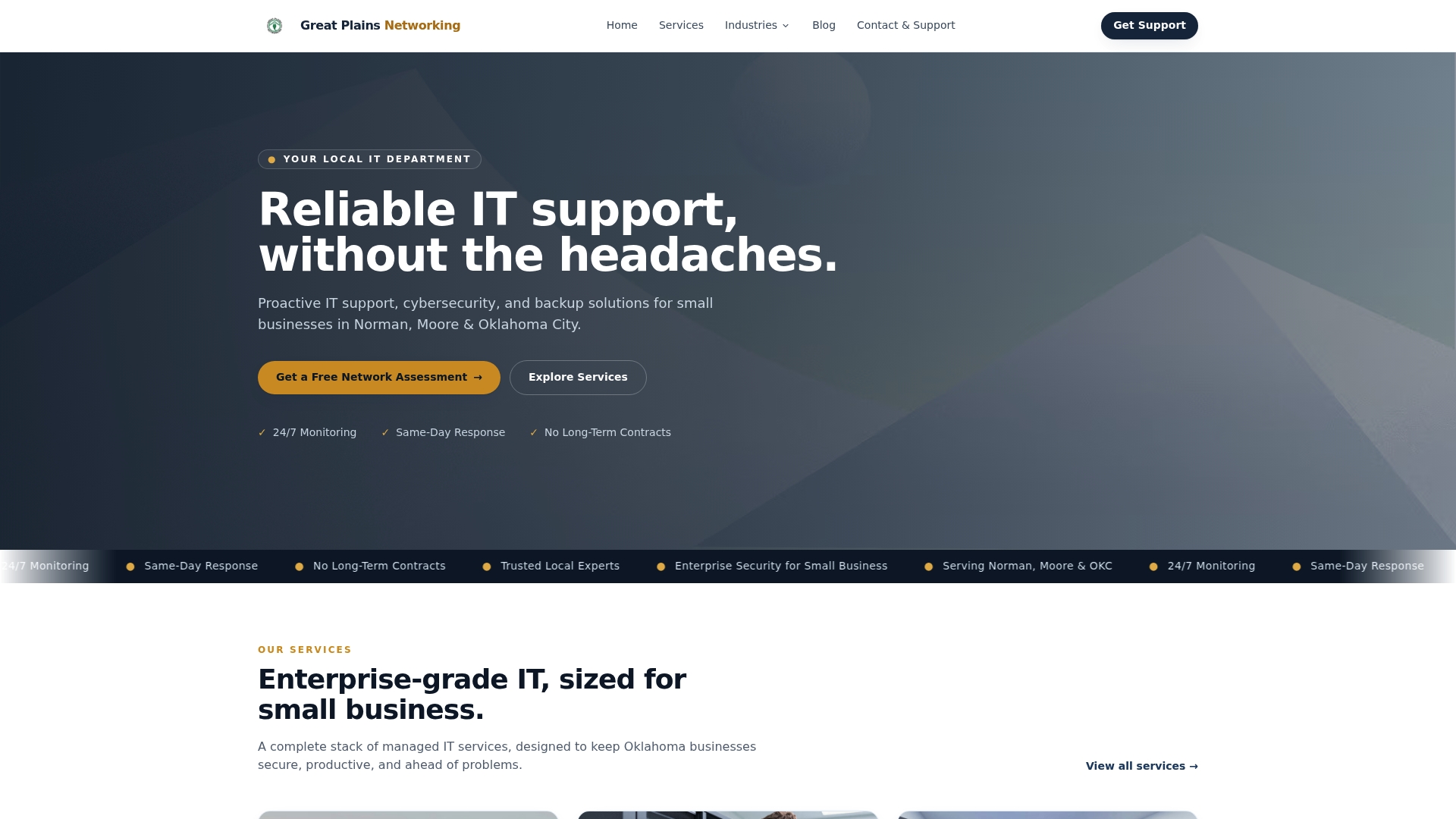
Greatplainsnetworking delivers flat-rate managed IT support with no long-term contracts, 24/7 monitoring, and same-day response for nonprofits in Norman, Moore, and Oklahoma City. The service covers everything a nonprofit needs in a single, predictable monthly fee: helpdesk support, cybersecurity with SOC monitoring, Microsoft 365 management, backup and disaster recovery testing, and compliance documentation for HIPAA and IRS requirements. There is no technical jargon, no surprise invoices, and no waiting days for a callback.
A nonprofit IT assessment from Greatplainsnetworking includes:
- A snapshot of your current environment and documented gaps
- A prioritized risk list with remediation recommendations
- A budget estimate aligned to your operating or grant cycle
To request your assessment and see how managed IT support can reduce costs and protect your organization, contact Greatplainsnetworking today.
Useful sources and further reading
The claims and recommendations in this article draw from the following sources. Each is worth reviewing if you want the research behind the guidance.
- Cyber Poor, Target Rich: The Crucial Role of Cybersecurity in Nonprofit Organizations — CyberPeace Institute analysis of why nonprofits are disproportionately targeted and what governance measures reduce risk.
Recommended
Want help putting this into practice?
We'll audit your security, speed, and hardware in under an hour — no commitment, no sales pitch. Just a clear roadmap of what to fix and why.